 Favors.dev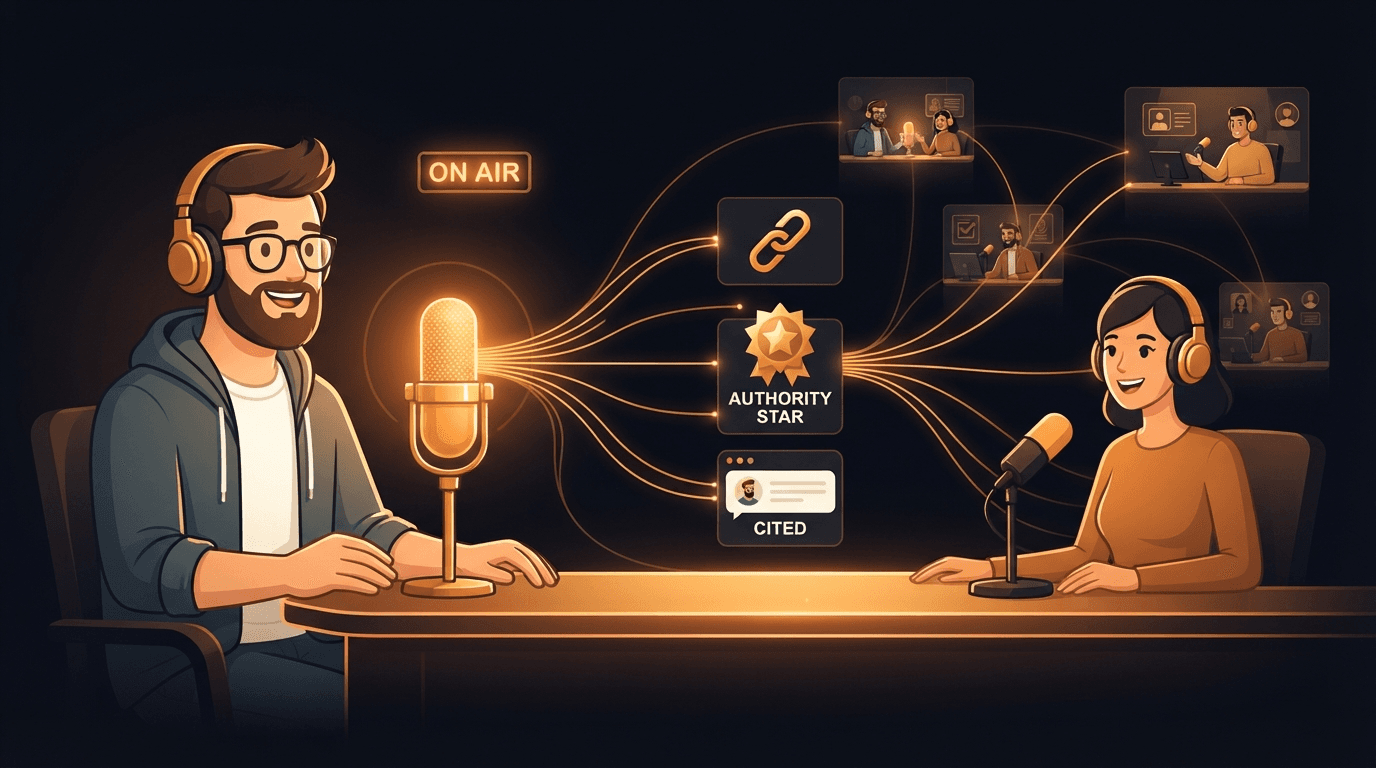
To get on podcasts as a founder, you don't need an audience or a publicist — you need a sharp angle, a short target list of shows whose listeners are your buyers, and a personalized pitchthat leads with what the host's audience gets, not with your product. Booking is a disciplined outbound process, not a hopeful blast to big shows.
It's also one of the highest-leverage things a solo founder can do with 45 minutes. Podcasts now reach more than half the country — Edison Research's Infinite Dial 2025 found 55% of Americans age 12+ listen to podcasts monthly — and unlike a tweet, an episode keeps working for months. This guide is the no-fluff version: why guesting beats most channels, how to find shows that'll actually book you, the exact pitch, and how to turn one recording into a dozen assets.
Why one good podcast beats a month of tweets
A tweet lives for a few hours and dies. A podcast episode is an asset. When you appear on the right show, one 45-minute conversation quietly produces four things at once — and every one of them compounds.
A borrowed audience, pre-trusted
The host has spent months earning their listeners' trust. When they introduce you, a slice of that trust transfers to you in a way an ad never could.
An editorial backlink that lasts
The show-notes link is a real, editorial backlink from a relevant site — the kind that compounds, not the kind that expires by morning.
A named-author authority trail
You, quoted and attributed across multiple shows, become a recognizable voice on your topic — the exact signal answer engines cite.
Evergreen reach
Episodes don't expire. A large share of podcast listening comes from back-catalog episodes weeks or months old, so your appearance keeps finding new listeners.
That last point is easy to underrate. Spotify has said roughly 30% of consumption across its top 100 shows comes from episodes older than eight weeks (reported by Podnews), and a single Spotify stream drives about 1.5× more consumption time than a comparable YouTube view. Podcast attention is deep and it's durable. Compare that to the reach math of launching cold — the same reason building SaaS marketing on no budget is about picking channels that compound instead of channels that spike and vanish.
Finding shows that book founders at your stage
The single biggest mistake founders make is aiming too high, too early. You pitch the three huge shows you already listen to, hear nothing back, and conclude podcast guesting doesn't work. It works — you just skipped the ladder.
Rank your list into three tiers and spend most of your energy in the middle. Audience alignment beats audience size every time: five appearances on shows where every listener could be your user will do more than one appearance on a giant, generic show.
| Tier | Typical audience | Why it matters | Book it when |
|---|---|---|---|
| Warm-up | A few hundred listeners | Niche or brand-new shows hungry for guests. Low stakes, high yes-rate. This is where you get reps, tighten your stories, and collect your first clips. | Weeks 1–2, while you learn to talk in soundbites. |
| Target | Low thousands, tightly niched | The real prize. Small enough to book, precise enough that every listener could plausibly be your user. Five of these beat one giant, irrelevant show. | Ongoing — this is where you spend most of your pitches. |
| Dream | Large, well-known | Aspirational shows that book proven guests. Pitch them once you have episodes, clips, and a reel to point at — not on day one. | After you have 3–5 target-tier episodes as proof. |
To build the list itself, three sources cover almost everything:
- Competitor and peer trails.Search a founder like you plus "podcast" and note every show that booked them. Those hosts already book people at your stage — that's your warm list.
- Podcast databases and directories.Tools like Listen Notes, Rephonic, and Apple/Spotify category charts let you filter by topic and find niche shows you'd never surface otherwise.
- Founder communities.The most reliable source is other founders. Plenty run their own shows and would rather book a peer who'll return the favor than cold-pitch a stranger — more on that below.
The pitch that gets you booked
Here's the whole game in one email. A great pitch does three things: it proves you actually listened, it hands the host a topic their audience will love, and it makes saying yes effortless. Keep it to about 100–150 words — long pitches get skipped. Below is the exact skeleton, annotated line by line.
The annotated pitch
Subject line — specific, not salesy
“Guest idea: what 40 failed onboarding flows taught me”
No “podcast guest request.” Lead with the episode topic a host could publish tomorrow.
Line 1 — prove you actually listen
“Loved your episode with Dana on pricing for tiny teams — the bit about charging before you feel ready stuck with me.”
One true, specific detail. This single sentence is what separates a booked pitch from the trash folder.
Line 2 — the angle (their audience's problem, not your product)
“I rebuilt my SaaS onboarding six times to get activation from 20% to 55%. I could walk your listeners through the three changes that actually moved the number — and the ones that did nothing.”
An angle solves a problem for the host's audience. A pitch about your product solves a problem for you. Hosts can tell the difference instantly.
Line 3 — proof, in one line
“I'm the solo founder of [Product]; I've shipped it to 1,200 users and written about activation for [publication].”
Just enough credibility to be worth 45 minutes. No résumé.
Line 4 — make saying yes effortless
“Happy to send three talking points and work around your recording schedule. Would a 30-minute conversation be useful for the show?”
You do the work; they just say yes. End with a real question, not “let me know.”
The mechanics matter less than the mindset behind them. Your company's value proposition is not your podcast angle. Your product solves a problem for customers; your angle solves a problem for the host — namely, "what do I publish this week that my audience will love?" Founders who internalize that one distinction stop getting ignored.
Then follow up once, about a week later, with a single line: "Bumping this in case it's useful — happy to send those talking points." One nudge is professional; three is a reason to block you. And never send the identical email to twenty shows — a personalized pitch referencing a specific episode books at a wildly higher rate than mass outreach, and hosts can smell a template from the subject line.
Turning one episode into compounding assets
The interview is the middle of the process, not the end. Most founders record, tweet "had a great time on the show!", and let the asset rot. The work that actually pays is what you do in the week after it airs. Treat every episode as raw material and run this checklist:
Episode → assets checklist
- One backlink from the show notes to your site (ask for it, with your preferred anchor text)
- 2–4 short vertical clips of your best 30–60 second answers
- A written recap post on your own blog: “I went on [show] — here's the argument I made”
- 3–5 quote graphics pulled from the transcript
- A link in your next newsletter and on your founder profile
- The full transcript, published somewhere indexable (your site or the show's)
- One or two new relationships — the host, and often a future guest
The backlink line is the one founders forget to ask for, and it's free money. Politely request that the show notes link to your site, and suggest the anchor text yourself. That single link is often worth more over a year than the episode's day-one listens — the same logic behind how to get backlinks for a startup: one editorial link from a relevant site beats fifty shares that expire overnight.
The transcript is the other underrated asset. A published transcript turns a 45-minute audio file into an indexable page full of your words, attributed to you by name. That's what makes podcast guesting quietly one of the best answer-engine plays available to a founder — which brings us to the reason this channel is more valuable in 2026 than it was even a year ago.
The fastest shortcut: founders who host shows
Here's the part the booking-agency guides leave out, because it can't be sold as a service: the fastest way to get booked is to trade with other founders who already run shows. A peer host would rather book someone who'll reciprocate — a share, a review, an intro, a return appearance — than cold-pitch a stranger. That's not a hack; it's just how relationships between builders work.
It also happens to feed the machine that's reshaping search. AI answer engines cite very different sources — Wikipedia and Reddit alone account for more than a quarter of ChatGPT's U.S. citations, per the 5W AI Platform Citation Source Index 2026 — and every one of them rewards attributed, named-author content over anonymous pages. A founder quoted across several podcast transcripts, each linking back, is building exactly the kind of citable footprint those engines look for. Reviews, mentions, and named-author trails are the currencies that get you named inside an answer, and they're the same favors founders can trade directly.
That's the loop Favors.dev was built to run. It's a marketing co-op where founders earn points by helping each other and spend them to get help back, with every action verified before points move — so the help is real, not hollow. A podcast-interview favor is worth 2,000 points precisely because it's one of the most valuable things a founder can do for another: a booking on a show you can't reach cold. You can earn it by hosting, guesting, or making the intro — and spend it to get onto a show that fits your niche. It's the reciprocal version of the newsletter-trade idea in newsletter swaps for founders, applied to audio.
Frequently asked questions
How do founders get on podcasts with no audience?
You don't need an audience to be a good guest — you need a good angle. Hosts book people who will be interesting for their listeners, not people who will bring a crowd. Start with warm-up and niche target shows that are actively looking for guests, lead your pitch with a specific topic their audience cares about, and make the host's job effortless. Booking is an outbound process: a tight target list plus personalized pitches, not a hopeful blast to big shows.
What should a podcast pitch email say?
Keep it to about 100–150 words. Open with one true, specific detail proving you actually listened to the show. State your angle as a problem you can solve for the host's audience (not a pitch for your product). Add one line of proof that you're worth 45 minutes, then close with an easy yes: offer to send talking points and ask a direct question. Skip your résumé, skip the hard sell, and never send the same email to twenty shows.
How many podcasts should I pitch?
Think in tens, not hundreds. A focused list of 15–30 well-matched shows, each pitched personally, will out-book a spray of 200 generic emails. Personalized pitches that reference a specific episode convert far better than mass outreach. Batch your research, write each pitch by hand, and follow up once after about a week before moving on.
Do podcast appearances help SEO and AI search?
Yes, on both fronts. A show-notes link is a real editorial backlink that keeps working long after the episode airs, and the episode itself is evergreen — a meaningful share of podcast listening comes from episodes that are weeks or months old. Just as important, a named-author trail (you, quoted and attributed across multiple shows and transcripts) is exactly the kind of signal answer engines lean on when they decide who to cite. One interview does quadruple duty: audience, backlink, authority, and AI-citation fuel.
Do you have to pay to be a podcast guest?
No. Legitimate shows do not charge guests, and any host asking for a fee to appear is running a pay-to-play scheme you should avoid — those placements carry no real authority. You can pay a booking agency to do the outreach for you, but the pitching itself is free. The real cost is time: research, personalized pitches, and prep. For a solo founder, trading that time with other founders who host shows is usually the highest-leverage version of all.