 Favors.dev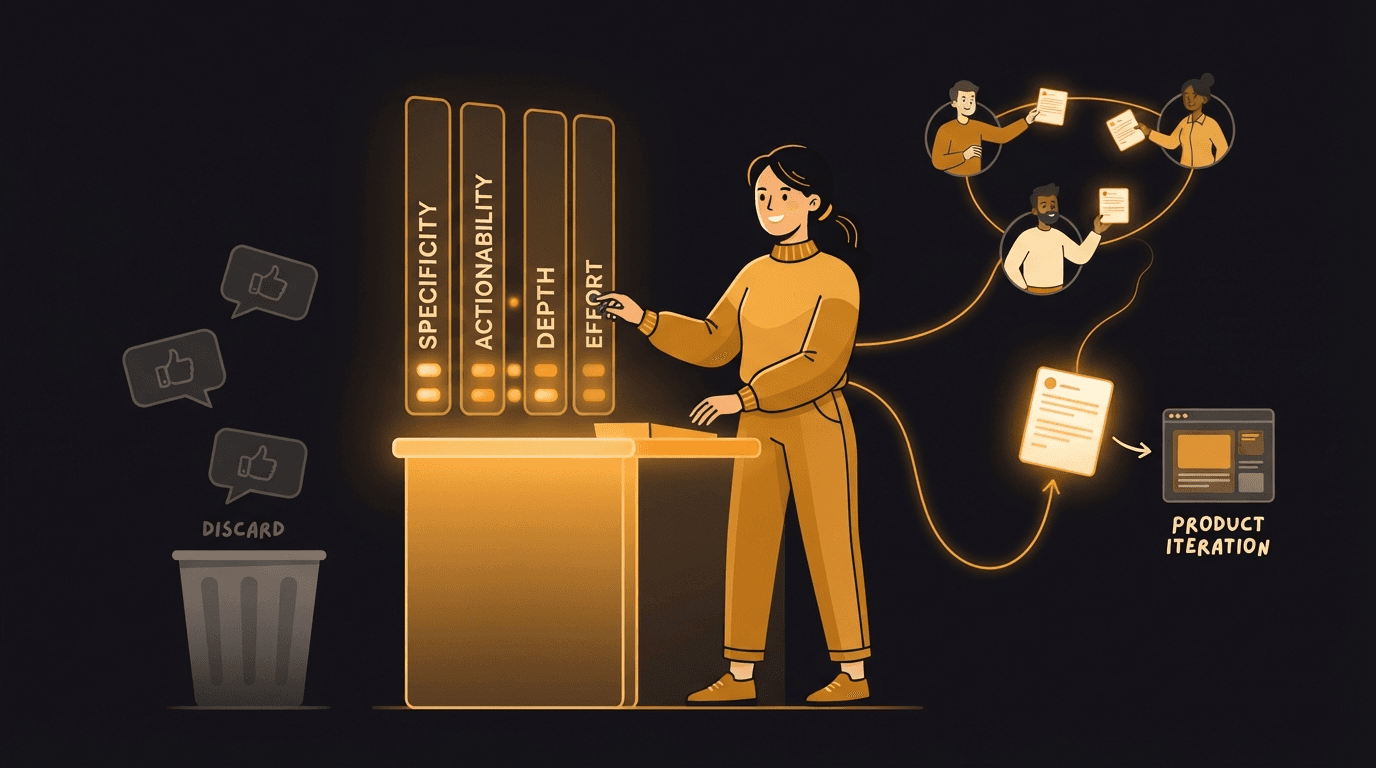
To get useful product feedback before launch, put the working product in front of about five people who actually resemble your user, ask them what they did rather than what they think, and then grade what comes backinstead of just feeling good about it. Most pre-launch feedback fails not because founders don't ask, but because they ask the wrong people the wrong questions and then have no way to tell a compliment from a finding.
Every other guide on this query hands you a list of methods — surveys, focus groups, card sorting, diary studies — written for a product team that already has users and a research budget. That advice quietly assumes the hardest part is collecting feedback. It isn't. For a solo founder two weeks from launch, the hard parts are finding anyone honest enough to give it and knowing which of it to act on. This guide is about those two, and it ends with the rubric I use to score every piece of feedback out of 100.
Why founder feedback beats user surveys pre-launch
Before launch, feedback from a few founders who ship products beats a survey of a hundred prospects — because pre-launch you have a product problem, not a market-research problem. A survey tells you what people say about a description of your product. A founder who has shipped six things will open your app, get stuck in the same place your real users will get stuck, and tell you exactly where — because they've watched their own users get stuck there.
There's a second reason, and it's about incentive structure. Feedback quality tracks how much the giver has at stake in being right. A stranger filling in a survey has none. A friend has an incentive to be kind. A founder who wants you to look at theirproduct next has a direct incentive to give you something good enough to be worth reciprocating. That's not cynicism — it's the only reliable way I've found to buy candor without a budget.
Why what people say and what they do don't match
People are unreliable narrators of their own behavior, and that is the single biggest reason pre-launch feedback misleads founders. Nielsen Norman Group put a number on it decades ago and it has aged perfectly: in their research on why you shouldn't simply listen to users, measured task performance and stated preference correlated at only 0.44 — meaning you can predict about a quarter of how well a design actually works from how much people say they like it. Three distortions do the damage: people answer to match social expectation, they misremember what they did, and they rationalize their behavior after the fact.
The practical consequence for a pre-launch founder is blunt: "Would you use this?" is not a research question. It's a politeness prompt. So is "what do you think?" The way out is to stop asking about the future and start asking about the past — what they've already tried, what it cost them, where they gave up. That's the central move in Rob Fitzpatrick's The Mom Test: ask questions that even someone who loves you couldn't comfortably lie in response to.
The other consequence is about sample size, and it's good news. You don't need a hundred people. Jakob Nielsen's classic finding on testing with five users is that five participants surface roughly 85% of a design's usability problems, and that several small rounds beat one big study — fix what you found, then test again. For a solo founder, that reframes the whole task: you need five good sessions and the discipline to run them three times, not a research panel.
Who to ask for feedback (and who to never ask)
Ask people who have context and no reason to flatter you. In practice, that's three groups — and one group you should politely route around entirely.
People with the problem
Find them where they already complain about it — a subreddit, a Slack, a Discord. They can't tell you how to build it, but they can tell you whether your framing of the problem is even right.
Founders who ship
They'll open the app, break it, and describe the break in your language. They've made the same mistakes and can name yours quickly. The fastest source of specific critique a pre-launch founder has.
Your first five beta users
Anyone who signed up for a waitlist or early access has already self-selected for interest. Watch them use it live — screen-share, mute yourself, take notes on where they pause.
Who to never ask
Friends, family, your partner, and anyone whose relationship with you is more valuable to them than your product is. They will be encouraging, and the encouragement will feel like validation for about six weeks — which is exactly long enough to build the wrong thing. If you must ask them, ask only factual questions about their own behavior, never about your idea.
The founders-who-ship group is the one nobody writes about, because most feedback guides are written for companies, not for one person with no users. It's also the group that scales, because the exchange is symmetric: you review their product, they review yours. That reciprocity is the same engine behind launching a SaaS with no audience — you borrow other founders' attention by giving yours first.
That's the specific job of the structured-feedback action on Favors.dev. Favors.dev is a founder marketing co-op with a points economy: you earn points by giving another founder detailed feedback on their product, and you spend points to get detailed feedback on yours. The submission is graded before points move, on the four dimensions in the rubric below, and it pays out 300, 400, or 500 points depending on how it scores. A one-line "looks great" earns nothing — which is exactly why what comes back to you isn't a one-line "looks great."
The questions that surface real objections
The best pre-launch questions ask about behavior that has already happened. Here's the short list I actually use, and what each one is really digging for:
- "What did you try to do first?"— Reveals whether your landing page and first screen agree with each other. If their first move isn't the move you designed for, your positioning is off, not their instincts.
- "Where did you stop, and what were you expecting to happen?" — The single highest-yield question in the set. The gap between expectation and behavior is where every conversion problem lives.
- "How are you solving this today, and what does that cost you?" — Tests whether the problem is real. A problem nobody currently spends time or money on is a problem nobody will pay you to solve.
- "What would have to be true for you to pay for this?" — Surfaces the actual blocker (trust, a missing integration, a price ceiling) instead of a courteous "maybe later."
- "Who is this obviously not for?" — People will criticize your targeting far more freely than they will criticize you. This is the safe-harbor question that gets you honest negatives.
Two mechanics matter as much as the questions. First, watch them use it — a live screen-share where you stay quiet for sixty seconds after they get stuck will teach you more than any written response. Second, never defend. The instant you explain why they misunderstood the button, the session is over; they've learned that disagreeing with you costs them something.
How to grade feedback: the 4-dimension rubric
Grade every piece of feedback on four dimensions — specificity, actionability, depth, and effort — worth 25 points each, for a score out of 100. This is the rubric our AI grader runs on every feedback submission on Favors.dev, and it works just as well on a pasted Slack message. The point isn't the number. It's that scoring forces you to notice when a paragraph that felt encouraging contains zero information.
| Dimension (0–25) | The question it asks | Scores low | Scores high |
|---|---|---|---|
| Specificity | Does it point at something real? | “The landing page could be clearer.” | “Your hero says ‘ship faster’ but the first screenshot is a settings panel — I still didn’t know what it does at the fold.” |
| Actionability | Could you implement it Monday? | “Improve the onboarding.” | “Move the API-key step after the first project is created — I bounced because step one asked for a credential I didn’t have yet.” |
| Depth | Is there insight, or just a reaction? | “I like the design.” | “You’re priced like a tool but positioned like a service — the $9 tier undercuts the ‘done for you’ promise in your headline.” |
| Effort | Did they actually use the thing? | Two lines, no evidence they got past the homepage. | Walks a real path through the product, names screens and copy, flags where they stopped and why. |
Add the four together and you get a band. What you do next depends entirely on which band it lands in:
| Score | Verdict | What to do with it |
|---|---|---|
| 0–54 | Vibes | Politeness or a surface reaction. Thank them, log nothing, don’t change the roadmap. |
| 55–69 | Useful | One real observation you can act on. Worth a ticket; not worth a rewrite. |
| 70–84 | Strong | Names a specific friction point and a plausible fix. Go back and ask two follow-up questions. |
| 85–100 | Roadmap-changing | Rare. Reframes something you believed about the product. Book a call with this person. |
Structured feedback beats vibes for a reason that has nothing to do with rigor for its own sake: it protects you from the two failure modes that actually kill pre-launch products. The first is acting on a confident opinion from someone who never used the thing. The second is discarding a quiet, awkward observation from someone who did — because it arrived without enthusiasm. Score both, and the ranking usually inverts.
One warning about the rubric: it grades the quality of feedback, not whether the person is right. A 90-scoring critique can still be wrong about your market. The score tells you what deserves a serious hour of your attention. You still have to decide.
Turning feedback into a pre-launch crowd
Everyone who gives you real feedback before launch is a launch-day supporter you already have. This is the step most founders skip: they treat feedback as an input to the product and forget it's also the beginning of a relationship. Someone who spent twenty minutes inside your unfinished app is far more invested than someone who saw a tweet — and they're the easiest person in the world to tell "I shipped the thing you told me to fix."
So close the loop, out loud. Tell each person what you changed because of them, by name, before you launch. Three things follow from that one habit: they show up on launch day, they're primed to write you an honest testimonial because they watched the product improve, and you get a genuinely good thing to post about — which is the entire substance of building in public. "Here's what five founders told me was broken, and here's what I fixed" outperforms any progress screenshot.
There's a 2026 tail on this too. Reviews, testimonials, and community discussion are exactly the source types answer engines reach for when they synthesize an answer — Similarweb's research on generative-AI citation patterns shows Wikipedia and Reddit at the top of ChatGPT's most-cited domains, ahead of most brand sites. Feedback conversations that happen in public — in a community thread, on a product's directory page, in a review — keep working long after the launch spike is gone. The private DM version helps your product; the public version helps your product and your discoverability.
The sequence, then, is short enough to hold in your head: get five people who resemble your user, ask them about what they did, score what comes back, fix the highest-scoring complaint, tell them you fixed it, and invite them to launch day. That's the whole pre-launch feedback loop. Everything else is instrumentation.
Frequently asked questions
How do I get product feedback before launch when I have no users?
Recruit five people who genuinely resemble your target user and watch them try the product, rather than surveying a large group who won't. Before launch your options are people in the communities where your audience already gathers, a small beta list, and — the fastest one for a solo founder — other founders who ship products themselves and will trade honest critique with you. Five hands-on sessions with real usage will teach you more than a hundred survey responses from people who never opened the app. What you're buying is observed behavior, not opinions.
How many people should I get feedback from before launching?
For usability problems, roughly five is the sweet spot. Nielsen Norman Group's classic finding is that testing with five users surfaces about 85% of usability issues, and that running several small rounds beats one big study, because you fix what you found and then re-test. That's for usability specifically — for questions about positioning, pricing, or whether anyone wants this at all, you want a wider spread of people over time, since those answers vary by segment rather than converging the way interface problems do.
Why is most pre-launch feedback useless?
Because most of it is politeness, and because people are unreliable narrators of their own behavior. Friends and family answer the question they think you want answered, and even well-meaning strangers can't accurately predict what they'd do with a product they've only looked at. Nielsen Norman Group measured only a 0.44 correlation between how well people performed with a design and how much they said they liked it. The fix is to change what you ask for: stop asking whether they like the idea and start asking what they did, what stopped them, and what they've already tried to solve this problem with.
What questions should I ask to get honest product feedback?
Ask about the past, not the future. Questions like “what did you try to do first?”, “where did you stop, and what were you expecting to happen?”, “what have you used to solve this before, and what did it cost you?” and “what would have to be true for you to pay for this?” all pull for facts and behavior. Avoid “would you use this?” and “do you like it?” — both invite a courteous yes. This is the core idea in Rob Fitzpatrick's The Mom Test: ask questions even your mother couldn't lie in response to.
How do I tell good product feedback from bad product feedback?
Score it instead of feeling it. Grade each piece of feedback on four dimensions — specificity (does it reference actual screens, copy, flows, or prices?), actionability (is there a concrete next step?), depth (does it reveal something about UX, positioning, or conversion rather than a surface reaction?), and effort (is there evidence they really used the product?). Feedback that scores low on all four is a compliment, not data. Feedback that scores high on all four is worth reorganizing your week around, even when it stings.