 Favors.dev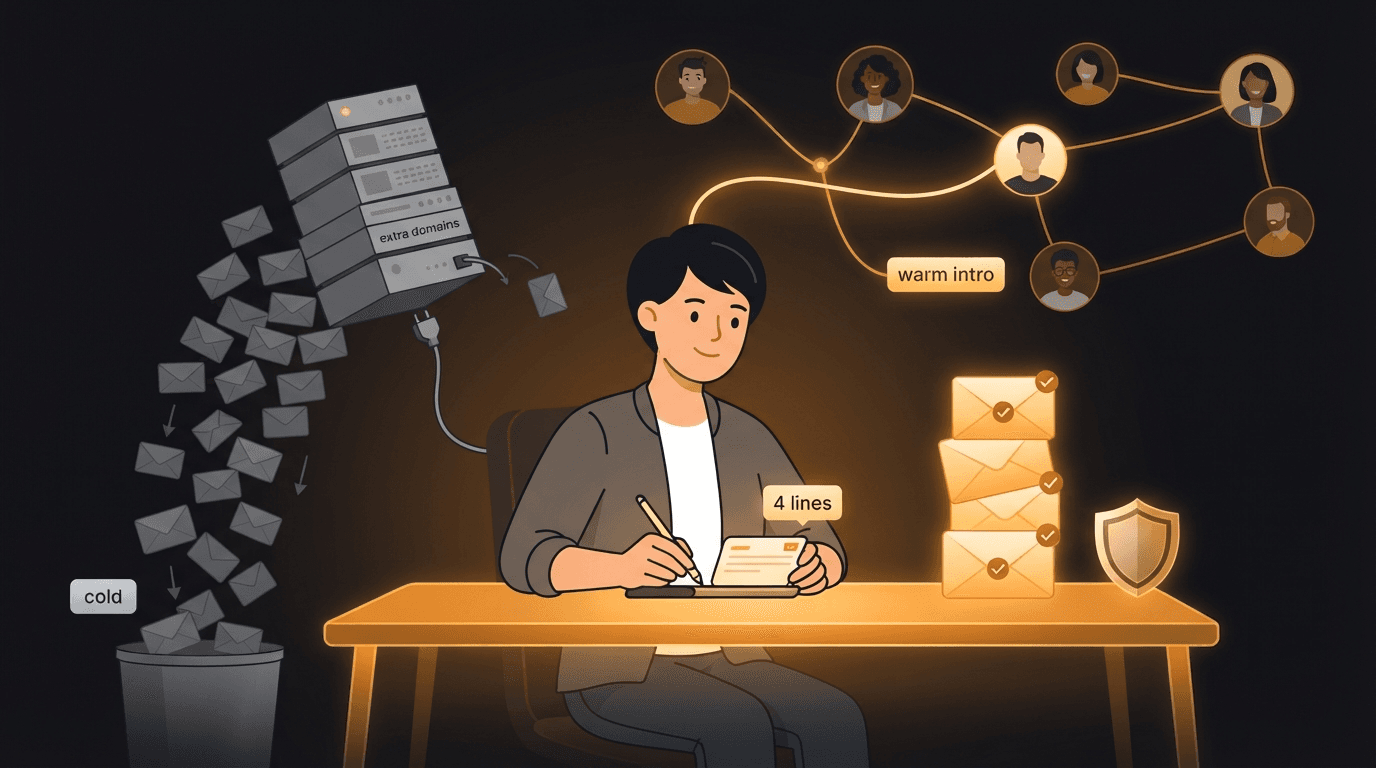
A founder cold email should be four lines long, sent from your real inbox to a person you can describe in a sentence, and it should open with something you could only know by having read what they wrote. That is the entire method. The reason cold email still works for founders in 2026 is not that it is clever — it is that almost everyone doing it has automated away the one thing that made it work, so a message that is obviously typed by a human now stands out in a way it did not five years ago.
I want to be upfront about why this post exists in the shape it does. I read the pages currently ranking for this query before I wrote it, and nearly all of them are published by companies that sell sending infrastructure. The advice is competent and it is also shaped like a purchase order: buy two spare domains, run six to nine mailboxes, warm them for four to eight weeks, send 150 to 300 a day. That is a description of an outbound sales team, sold to a person who needs about forty conversations. So this post covers the forty-email version, includes no reply-rate benchmarks I could not verify, and spends a whole section on the legal requirements that almost none of those pages mention.
When cold email is the right channel — and when it isn't
Cold email is the right channel when you can name the person, name their problem, and name what changed in their world recently. It is the wrong channel — it is spam with extra steps — when any one of those three is missing, and no amount of copywriting fixes a missing one.
It is also, honestly, the lowest rung on the ladder. If you have read the first-10-paying-customers playbook, you have seen the ranked list of where early revenue actually comes from: people you already have a reason to contact, then people you interviewed during discovery, then warm introductions one step out, then people publicly describing the problem this week, and only then cold outreach. Founders invert that order almost universally, because rejection from a stranger costs nothing and asking someone who knows you is uncomfortable. The inversion costs weeks.
So the honest scope for this post: cold email is worth doing once the warm end is genuinely exhausted, when your market is one you cannot reach through a launch or a community, or when you need to talk to a specific role — heads of ops at 20-to-50-person agencies, say — that does not congregate anywhere you can post. If your buyers do congregate somewhere, go there first; the first-100-users playbook maps those channels, and a directory listing keeps working long after a send goes out.
Why the list beats the copy, every time
List quality is not one of several factors in cold email; it is the factor, and everything else is a rounding error against it. A mediocre email to forty people who have the problem this month will beat a brilliant email to four hundred people who might have it in principle, and no amount of subject-line testing closes that gap.
Build the list by hand, in one sitting, using a definition narrow enough to feel uncomfortable. Not “SaaS founders” but “founders of bookkeeping tools who posted about invoice reconciliation in the last 60 days.” The discomfort is the signal that you have specified enough. Three things earn a place on the list:
- A named human, not a role inbox. Nothing sent to hello@ or info@ has ever started a founder-led sale. If you cannot find a person, that company does not go on the list.
- A dated piece of evidence. A post, a review, a job ad, a changelog, a conference talk — something with a date on it that tells you the problem is live right now rather than plausible in general. Paste the link into your sheet; you will need it for line one.
- A reason to believe they can decide. Emailing a user when only a director can sign is not a wasted email, but it is a different email with a different ask, and pretending otherwise is where most founder outreach quietly dies.
The research is the work. Budget five to ten minutes per contact, accept that this makes forty emails a full day, and notice that the constraint is doing something useful: it forces you to disqualify people, which is the skill the whole exercise is actually teaching. If you have run discovery interviews already, your transcripts are the best possible source of search terms — the phrases your buyers use for their own problem are the phrases that find more of them.
The four-line founder email
Four lines, under 100 words, no images, no signature graphic, no tracking pixel. Each line does exactly one job, and the order is load-bearing.
- The specific observation. One sentence proving you read something they wrote or did, with the detail included. If this line could be sent to a second person unchanged, it has failed and the rest of the email is dead on arrival.
- Who you are, in one clause.Your name, what you build, and ideally why you built it. Founders have exactly one unfair advantage in an inbox — “I hit this problem myself” is a sentence a sales rep cannot write — and this is where you spend it.
- The honest qualifier.A line conceding what you don't know or don't do well. This is the counterintuitive one, and it is the line most people delete. Keep it: it converts the message from a pitch into a question, and it is the fastest way to sound like a person.
- One small ask, with an exit.A time-boxed request and explicit permission to decline. “A one-word reply is a fine answer” produces fast noes, and a fast no on Tuesday is worth more than a maybe that decays over six weeks.
Then a plain-text signature carrying your name, your company, a real postal address, and a working opt-out — for legal reasons covered below, not stylistic ones. Skip the tracking pixel entirely. Open tracking has been unreliable since mail clients started pre-fetching images, it is a common spam-filter signal, and at forty emails the data would not change a single decision you make.
Five annotated templates you can copy
Five scenarios a founder actually faces, each broken into its four lines with a note on why that line is doing what it does. Copy the structure, not the words — the words are load-bearing only when they are yours, and a template pasted verbatim reads exactly like a template pasted verbatim.
They described the problem in public, this week
Subject — your Thursday post about reconciling invoices by hand
Saw your post in r/bookkeeping on Thursday about reconciling 400 invoices by hand at month end — the bit about rebuilding the spreadsheet every time a client changes their PO format.
Why it works — The whole email is bought with this sentence. It names the place, the day, and a detail you could only have from reading it. Nothing here is a merge field, which is exactly the point.
I'm Mark — I build a small tool that does that one reconciliation step, mostly because I spent two years doing it the way you described.
Why it works — One sentence, first person, and a reason you exist that isn't a value proposition. Founders get to say “I had this problem” and nobody else on the internet does.
No idea yet whether it fits your PO-format problem specifically — that's the part I'd want to check before claiming anything.
Why it works — The line that separates you from every other sender. Admitting you might not be a fit is disarming, and it makes the next sentence a question rather than a pitch.
Worth ten minutes on a call this week? Happy to just send you the link instead if that's easier, or to leave you alone entirely — a one-word reply is a completely fine answer.
Why it works — A small, time-boxed ask with two exits. Giving explicit permission to say no is what gets you a fast no instead of six weeks of silence, and a fast no is worth real money at this stage.
They are unhappy with the incumbent, out loud
Subject — the export limit you hit in [Incumbent]
You left a review last month saying [Incumbent] caps CSV exports at 5,000 rows and you'd been splitting files by hand ever since.
Why it works — A public complaint about a competitor is the highest-intent signal a founder can find for free. Quote the specific limitation, never the star rating — nobody wants to be reminded they wrote an angry review.
I'm the founder of [Product]; the export is uncapped, which is a small thing to build and a strange thing to charge for.
Why it works — Answer the exact complaint in the same clause. Do not list your other eleven features — the only claim that matters is the one that maps to the sentence they wrote themselves.
I'm not going to pretend we match them on everything — their reporting is genuinely better than mine right now.
Why it works — Conceding a real competitive weakness costs you nothing and buys the rest of the email credibility. It also pre-empts the comparison they were about to run in their head.
If the export is the thing that actually hurts, I'll set you up on a free account myself and export your last quarter so you can see it work — no call needed.
Why it works — Replaces the meeting request with an outcome. When the pain is narrow and provable, doing the work is a stronger ask than asking for time to talk about doing the work.
You want to learn, not sell (early discovery)
Subject — quick question about how your team handles X
You run support for a 12-person agency, which puts you in almost exactly the situation I keep hearing about and don't understand well enough yet.
Why it works — Names why this specific person, not a flattery opener. “I don't understand it well enough yet” is true at this stage and is the most inviting thing you can say to someone who does.
I'm not selling you anything — I'm two months into building something in this space and I'd rather find out I'm wrong now than after I've built it.
Why it works — Say it plainly and then honor it absolutely. If you pitch on this call you have spent a reputation you cannot get back, and word travels in small industries.
Fifteen minutes, four questions, all about how you do it today — nothing to look at, no demo.
Why it works — Specify the length, the number of questions, and the absence of a screen share. Every removed unknown makes yes cheaper, and “no demo” is the reassurance that converts.
If it's useful I'll send you the write-up of what I learn across all of these — a few people have said that's the more interesting half.
Why it works — Offer something back. A synthesis of what peers said is genuinely valuable, costs you one afternoon, and turns a favor into a trade.
A peer founder, for a collaboration
Subject — your users are already doing this manually between us
Three of my users have told me they paste data out of [Your Product] into mine every Monday morning.
Why it works — Lead with evidence of shared audience, not with admiration for their product. A founder can ignore a compliment; they cannot ignore their own users doing manual work.
I'm Mark, I run [Product] — about your size, similar stage, no funding either.
Why it works — Establish peer status in one line. Collaboration pitches fail when the recipient can't tell whether they're being asked for a favor or offered one, and stage-matching answers that.
The obvious version is an integration, but honestly the cheaper experiment is a swap: I write about how your users solve this, you write about how mine do, we both link it.
Why it works — Offer the low-effort option first. Proposing the thing that costs them an afternoon rather than a sprint is how these actually get said yes to.
Want me to draft my half first so you can see what you'd be agreeing to? Zero obligation if it reads badly.
Why it works — Volunteering to go first removes the risk entirely. The founder who drafts first almost always sets the terms, which is a nice side effect of being generous.
The follow-up that isn't “just bumping this”
Subject — (reply on the same thread — do not start a new one)
Following up once on this, then I'll leave it.
Why it works — State the limit out loud in the first line. It converts a nag into a courtesy and — crucially — it means you have to actually stop, which keeps your domain and your reputation clean.
Since I wrote, I shipped the bulk-import thing, which was the part I thought you'd care about most.
Why it works — A follow-up must carry new information. “Bumping this” asks the recipient to do the work of remembering; a shipped change gives them a reason to re-read.
If it's a no or a not-now, genuinely no need to reply — I'll assume not-now and won't email again.
Why it works — The single most effective sentence in cold email. It removes the guilt cost of ignoring you, which is the real reason busy people don't answer, and it often produces the reply anyway.
— Mark · [Product] · [street address] · reply “stop” and I'll remove you from my list
Why it works — The compliance footer. A real postal address and a working opt-out are legal requirements in the US for a commercial message, not stylistic choices — see the next section.
Two rules that apply to all five. Subject lines should be lowercase, specific, and boring — they should read like a note from a colleague rather than a campaign, and the CAN-SPAM requirement that a subject line accurately reflect the message is a legal one, not a preference. And never send an attachment on a first email; a PDF from a stranger is both a filter problem and a social one.
The legal floor almost every guide skips
Cold B2B email is legal in the United States and it is regulated, which is a distinction most founder-facing guides skate past entirely. The FTC's CAN-SPAM compliance guide is unusually readable, takes about fifteen minutes, and states directly that the law makes no exception for business-to-business email. Its main requirements: your From, Reply-To and routing details must be accurate; the subject line must not be deceptive; the message must disclose that it is an advertisement; it must carry a valid physical postal address; it must explain clearly how to opt out; and opt-outs must be honored within 10 business days, with the opt-out mechanism working for at least 30 days after you send. The FTC puts the maximum penalty at up to $53,088 per violating email.
In practice, the two that trip up solo founders are the postal address and the opt-out. A registered PO box or a commercial mailbox satisfies the address requirement, so “I work from my kitchen” is not a reason to omit it — and “reply STOP and I'll remove you” is a perfectly adequate opt-out mechanism at this volume, provided you actually keep the list.
The UK and much of the EU work on a different principle, and this is where founders emailing internationally get caught. Under the UK's PECR regime, the Information Commissioner's Office guidance on electronic mail marketing says you may email a corporate body — a limited company, an LLP, a government body — without prior consent, but that you must not send marketing email to individuals without their specific consent. The sting is in the definition: the ICO states that sole traders and some partnerships are treated as individuals. Read that against a typical indie outreach list and the problem is obvious, because a large share of the founders, freelancers and consultants on it are sole traders. The ICO also notes that emailing a named personal address at a company (firstname.lastname@) brings data-protection considerations of its own.
I am a founder, not a lawyer, and none of this is legal advice. But both primary sources above are free, short, and written for non-specialists, and reading them before your first send is the cheapest risk reduction available to you. The practical version for a solo founder: keep a permanent do-not-contact list and screen every new batch against it, put a real address and a real opt-out in the footer of every commercial message, and when you are emailing into the UK or EU, prefer named people at incorporated companies over sole traders.
Deliverability without buying an agency stack
At forty emails a day from your own domain, deliverability is an afternoon of setup and then a discipline, not a product category. Google's email sender guidelines are the authoritative statement of what Gmail expects, and the structure of that document is the part worth internalizing: some requirements apply to every sender, and a stricter set applies only to bulk senders, which Google defines as those sending roughly 5,000 messages or more per day to personal Gmail accounts.
You are not a bulk sender. That means the DMARC and one-click unsubscribe header requirements in that document are not aimed at you — while the requirements for all senders very much are: set up SPF or DKIM authentication for your sending domain, keep valid forward and reverse DNS records, use a TLS connection, and keep your reported spam rate below 0.3%. Set up both SPF and DKIM anyway; your mail provider has a documented path for it, it is free, and it takes less time than reading a comparison of warm-up tools.
The 0.3% ceiling deserves a note, because at founder scale it is not a dial you can watch. Postmaster Tools needs meaningful volume before it reports anything, so at forty a day you will likely see an empty dashboard — which means the spam rate functions as a constraint on behavior rather than a metric. One complaint in a few hundred sends is the budget. That is a rounding error for a bulk sender and a real ceiling for you, and the only reliable way to stay under it is to send messages nobody wants to report.
| What you're told to buy | The pitch | What 40 emails actually needs |
|---|---|---|
| 2–3 extra sending domains | “Protect your main domain from burning.” | You are sending from the domain you want them to trust. A reply from mark@lookalike-domain.co is a reason to distrust the message. At 40 emails there is nothing to protect against. |
| 6–9 mailboxes with rotation | “Spread the volume so no inbox trips a limit.” | Rotation exists to send more than one human can write. If a person did not write it, the founder advantage — that a founder wrote it — is gone, which was the only edge you had. |
| A warm-up tool running for 4–8 weeks | “Build sender reputation before you launch the campaign.” | Warm-up services simulate engagement to fool filters. Your real inbox, which you have used for years to email real people who reply, already has the thing the tool is imitating. |
| A sending platform with sequences | “Automate follow-ups so nothing falls through.” | Forty conversations fit in a spreadsheet with a date column. Sequencers also strip the one signal that makes founder email land: that it was typed, once, for one person. |
| An email finder + verifier subscription | “Never bounce again.” | The only genuinely useful line item on this list, and you need it for one afternoon, not one year. Verify the forty addresses, cancel it, move on. |
On the benchmarks you will see everywhere
While researching this post I collected the reply rates, open rates and funnel ratios quoted on the pages currently ranking for this query — 3–8% replies, 30–50% opens, 500 prospects to 10 customers, a 32.7% lift from personalization. Not one was attributed to data I could inspect, and several appeared on pages published by companies selling sending tools. So there are no performance numbers anywhere in this post. Send forty emails, record sends, replies, calls and closes in a spreadsheet, and in two weeks you will have the only benchmark that describes your market. Compare yourself to last week, not to a vendor's landing page.
Following up without becoming the thing you hate
Follow up once, on the same thread, with something new — then stop. That is a narrower rule than the four-to-seven-touch sequences the outbound playbooks recommend, and it is the right one when you are sending from the domain your customers will later trust and the signature says founder.
The reason to cap it at one is not squeamishness, it is arithmetic. A sequencer sending seven touches to a thousand strangers is playing a volume game where the reputational cost of annoying 900 of them is diffuse. You are sending to forty named people in a market small enough that they talk to each other, and where the person who ignores you in March may be the person you need an introduction from in September. The follow-up that says “following up once, then I'll leave it” and then actually leaves it is the version that preserves that.
Three rules for the one follow-up you get:
- Same thread, always. A new thread with a new subject asks them to rebuild the context. Replying to your own message keeps the original email one scroll away.
- Carry new information.Something you shipped, a second customer with their exact problem, a relevant thing that changed in their market. “Just bumping this to the top of your inbox” asks them to do the work and answers nothing.
- Give them permission to not reply.Say you will assume not-now and won't write again. It removes the small guilt cost that is the actual reason busy people leave things unanswered, and it frequently produces the reply anyway.
One more thing worth doing with the non-replies: they are not nothing. A person who read a specific email about their specific problem and did not answer has told you something, and if the same silence repeats across a dozen contacts with the same profile, the problem is your premise rather than your copy. Change the segment before you change the subject line.
The version of this that works better
Everything above is the honest craft of a channel that is, at best, the fifth-best thing you could be doing. Which is worth saying plainly at the end of a post full of templates: a single warm introduction outperforms the entire forty-email exercise, and it is not close. An introduced email gets opened because someone the recipient trusts vouched for it, and it starts the conversation past the part where you have to prove you are not spam.
The standard objection is that introductions require a network you either have or don't. That framing is the actual mistake. Introductions are favors, favors accrue to people who have done favors, and almost every solo founder with an empty balance has one for the same reason: the giving happens months before the needing, and nobody keeps score. So the well never fills, and cold email stays permanently available as the thing you can do instead.
That specific gap is the problem Favors.dev exists to close. It is a founder marketing co-op with a points economy: you earn points by doing verified favors for other founders — an honest review, structured feedback, a testimonial, a warm introduction — and you spend those points to pull the same help back when it is your turn. Because the score is kept, the balance is real, and you cannot spend what you have not earned. That single constraint is why it does not collapse in month three the way informal founder groups reliably do. The founder directory is a searchable list of people who have already opted into being useful, the apps directory is where your own product becomes findable by the same people, and a warm-intro request in the favor queue gets you the opening line no amount of research can manufacture. The same logic applies one step out into reciprocal creator collabs: the person who introduces you to a niche audience is nearly always someone you did something for first.
So do both, in the right order. Spend an hour a week making yourself useful to founders whose introductions you will want in six months, and spend the days between writing forty specific, compliant, four-line emails to people whose problem you can name. The cold ones will get you conversations. The warm ones will get you customers.
Frequently asked questions
Is cold email legal for startups?
In the United States, yes, with conditions — and the conditions are stricter than most founders assume. The FTC's CAN-SPAM compliance guide states plainly that the law makes no exception for business-to-business email, so the requirements apply to a one-person startup emailing forty CTOs exactly as they apply to a retailer emailing a million consumers: accurate From and Reply-To details, a non-deceptive subject line, disclosure that the message is an advertisement, a valid physical postal address, a working opt-out, and honoring opt-out requests within 10 business days. The FTC puts the maximum penalty at up to $53,088 per violating email. The picture is different in the UK and much of the EU, where the rules turn on who the recipient is rather than on what your footer says: the UK's Information Commissioner's Office is explicit that you may email a corporate body without prior consent, but that sole traders and some partnerships are treated as individuals — meaning a great many of the indie founders and freelancers on a typical outreach list are people you need consent to email. None of this is legal advice; it is a strong argument for reading the two primary sources yourself before your first send, because they take about twenty minutes and the alternative is expensive.
How many cold emails should a founder send per day?
Far fewer than the tooling industry recommends, because the correct number is set by how many you can genuinely research rather than by what a mailbox can technically push. If a specific opening line takes you five to ten minutes to earn — reading what they posted, finding the actual complaint, checking they are who you think they are — then twenty to forty emails is a full, hard day of work, and forty well-aimed emails will comfortably outperform four hundred merged ones. The guides recommending 150 to 300 sends a day across rotating mailboxes are describing an outbound sales operation, and they are usually published by companies selling the mailboxes. The volume advice is not wrong for that job; it is answering a different question than the one a solo founder is asking.
Do I need a separate domain and an email warm-up tool?
At founder volume, almost certainly not, and the standard setup actively costs you something. Extra domains and mailbox rotation exist to send more mail than a person can write, and warm-up tools exist to manufacture the engagement history that an ordinary working inbox already has — yours has years of real conversations with real people who replied, which is the exact signal the tool is simulating. Sending from a lookalike domain also undercuts the one advantage you hold: that a real founder at a real company wrote this, and the address proves it. What is worth doing is free and takes an afternoon: set up SPF and DKIM on your sending domain per Google's email sender guidelines, verify your addresses once so you are not bouncing, and keep the copy specific enough that nobody wants to report it.
What is a good reply rate for founder cold email?
I am not going to give you a number, and I would treat every guide that does with suspicion. Nearly every benchmark circulating for this query — the 3 to 8 percent replies, the 30 to 50 percent opens, the tidy 500-prospects-to-10-customers funnel — is published without a source by a company selling sending software, and I could not verify a single one against primary data. They also describe a different activity: hundreds of templated sends to a purchased list, which is not what you are doing. Your real benchmark arrives after your first forty emails, it is specific to your market and your price point, and it is the only one that will ever tell you anything. Track sends, replies, calls booked, and closes in a spreadsheet, and compare week two to week one rather than to a stranger's blog post.
Should a founder cold email or ask for a warm introduction first?
Warm introduction, every time, and it is not close — a message that arrives with a mutual contact's endorsement gets read, gets replied to, and starts from trust rather than from suspicion. The reason founders default to cold email anyway is not that they have weighed it up; it is that cold email is available immediately and introductions appear to require a network you either have or don't. That framing is the actual mistake. An introduction is a favor, favors accrue to people who have done them, and the accumulation starts the week you decide to be useful to other founders rather than the week you need something. Work the warm end until it is genuinely empty, keep building it in the background, and treat cold email as what it is: the honest, effortful, lowest-yield rung you reach for once the rungs above it are exhausted.