 Favors.dev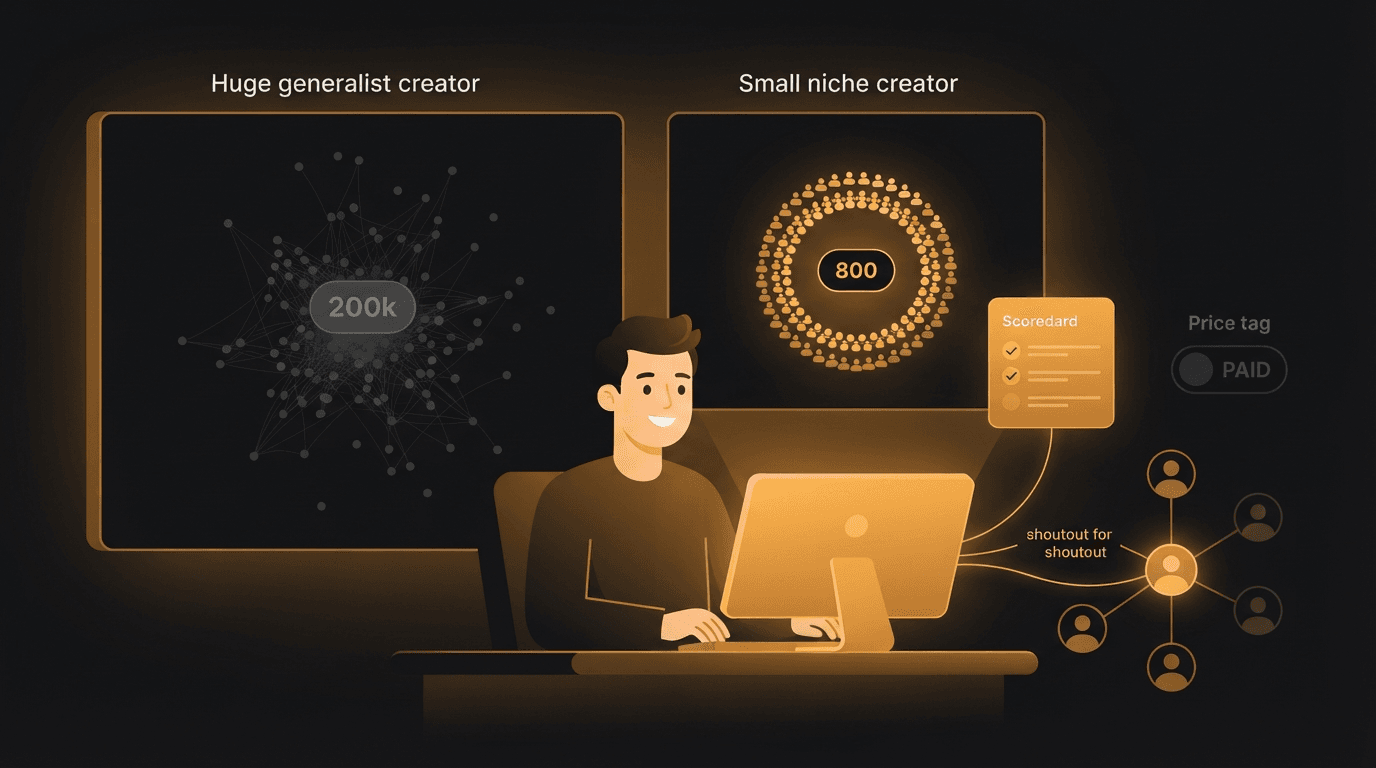
Micro-influencer marketing for startups is the practice of partnering with small, niche creators — usually 10,000 to 100,000 followers, and often far fewer — to reach a tightly aligned audience through someone that audience already trusts. For a founder, the winning version has almost nothing to do with reach or ad budget. The right 800-follower creator in your exact niche beats a 200,000-follower generalist, and the best early collabs are traded, not bought.
Almost every guide you'll find on this assumes a marketing budget — "start with a $5,000 monthly spend and three to five paid partnerships." That's fine advice for a funded team. It's useless for a solo founder pre-revenue. This is the version that starts at $0, treats creators as peers instead of billboards, and builds collabs that keep paying off long after a single post.
Why an 800-follower creator can beat a 200k one
Because relevance and trust convert; reach alone doesn't. A large generalist account sells you impressions — most of them from people who will never care about your product. A small niche creator sells you something rarer: a warm recommendation to the exact people with the problem you solve.
Trust is the whole game here, and the data on it is unusually consistent. Across a decade of research, Nielsen has found that recommendations from people we know remain the single most trusted form of marketing — roughly 83% of people trust them, far above any paid format. A niche creator sits as close to "someone you know" as a stranger can get: their audience follows them precisely because they feel like a knowledgeable friend. A polished ad from a mega-account gets the opposite treatment — it's discounted on sight as advertising.
Engagement follows the same curve. Small, dedicated audiences reply, ask questions, and click; sprawling ones scroll past. So when you hand your launch to a creator whose followers are your buyers, you get fewer eyeballs and dramatically more of the only thing that matters — people who actually try the product. This is the same logic behind marketing a SaaS on no budget: effort and relevance compound where reach and spend evaporate.
How to find creators actually aligned with your product
Start from your users and the rooms they're already in, not from a follower-count leaderboard. The goal isn't to find the biggest creator in your category — it's to find the one whose audience overlaps most exactly with the people you want. A few reliable sources:
- Your own users' follows. Who do the customers you already have reply to, quote, and reshare? Those creators come pre-validated for audience fit.
- Search the exact terms your buyers use.Not "marketing" but "RevOps for seed-stage SaaS." The narrower the query, the more relevant the creators who show up.
- Newsletter and podcast recommendations. The creators other trusted voices in your niche point to are a shortcut to relevance — and often more reachable than they look.
- Communities where founders and creators mix. Many small creators are also builders. Trading value with a peer who happens to have an aligned audience is far easier than a cold pitch to a stranger.
One rule to save you weeks: read the replies, not the bio. A creator can claim any audience in their bio. The comment section tells you who actually shows up — and whether those people sound like your users or like a bot farm.
The creator-fit scorecard (score before you reach out)
Before you spend a single message, score each candidate out of 100. This keeps you honest — it's astonishingly easy to talk yourself into a creator because their follower count is impressive, and this scorecard puts follower count exactly where it belongs: nowhere.
Audience overlap
Do their followers look like your users — same job, stage, or problem? Read their replies, not their bio.
Real engagement
Are comments specific and human, or generic emoji spam? Ten real conversations beat 10,000 silent followers.
Genuine fit
Would they plausibly use your product themselves? An endorsement only lands if it's believable.
Cadence & trust
Do they post consistently and disclose partnerships honestly? Sloppy disclosure taints your brand too.
Reciprocity signal
Do they amplify peers, answer DMs, trade shoutouts? Give-first creators say yes to give-first founders.
Add it up. 70+ is a strong yes — reach out this week. 40–69 is a maybe worth a warm, low-stakes first touch. Under 40, walk away no matter how big the account is. Notice that four of the five criteria have nothing to do with size; a nano-creator with 800 deeply engaged, perfectly aligned followers routinely scores higher than a six-figure generalist.
Four collab models that cost $0
You do not need a budget to work with creators. You need something to trade. Here are the four models that work best for founders with more hustle than cash, roughly in order of how easy they are to land:
- Shoutout swaps. You post about their work to your audience; they post about yours to theirs. Fairest when your audiences are a similar size and equally relevant — the same fairness logic behind newsletter swaps.
- Co-creation. Build something together — a template, a teardown, a joint live session, a small piece of research — that both audiences genuinely want. The collateral outlives the post and gives each of you a reason to keep sharing it.
- Value-for-value gifting.Give lifetime access, a founder-tier plan, or a genuinely useful custom build in exchange for honest coverage — with no script and no guarantee. It works because the creator actually gets something they'd use.
- Warm-intro trades.Sometimes the most valuable thing you can offer isn't exposure — it's an introduction. Connect a creator to a guest, a sponsor, or a peer they'd love to know, and a warm intro back to a creator in your niche is a natural trade.
All four share one trait paid posts lack: they build a relationship instead of buying a transaction. A creator you helped is a creator who shares your next launch too.
Reciprocal vs paid: which to run first
The short answer: run reciprocal collabs first, and only pay once you've seen a creator convert organically.Paying up front means betting money on a relationship you haven't tested. Trading value first lets you learn who actually moves your audience before any cash is at stake. Here's the honest side-by-side:
| Dimension | Paid post | Reciprocal collab |
|---|---|---|
| Upfront cost | $200–$2,000+ per post | $0 — you trade value, not cash |
| Believability | Reads as an ad; audiences discount it | Reads as a genuine recommendation |
| Repeatability | Ends when the budget ends | Becomes an ongoing relationship |
| Content rights | Negotiate (and pay) for reuse | Usually granted freely between peers |
| Downside risk | Money gone whether it converts or not | Only your time is at stake |
| Best when | You've already validated the creator organically | You're pre-revenue and testing fit |
Paid isn't evil — it's just the wrong first move for a pre-revenue founder. Once a creator has proven, for free, that their audience trusts them enough to try your product, paying to run that back at a larger scale is a reasonable investment. Buying that relationship on day one, sight unseen, usually isn't.
How to brief a creator without scripting them
The fastest way to waste a good collab is to hand the creator a script. Their audience follows them for their voice; a corporate paragraph read aloud fools no one and converts no one. Brief the outcome, not the words:
- Give them the "why now."The specific problem you solve and who it's for. Let them translate it into their own language.
- Hand over three proof points, not a paragraph. A stat, a before/after, a link they can check. Facts they can trust, phrased however they like.
- Set boundaries, not a script.What's off-limits (unfounded claims, competitor jabs), and everything else is theirs.
- Require honest disclosure.If there's any consideration — payment, free product, or a trade — it has to be clearly disclosed. The FTC's endorsement guides make the brand responsible for that too, and audiences respect creators who are upfront far more than ones who hide the tag.
There's a compounding reason to keep the collab genuine, beyond this week's clicks. The content a real collab produces — an honest review, a named creator writing about your product, a discussion thread — is exactly what AI answer engines cite. Recent analysis of hundreds of thousands of citations found that Wikipedia and Reddit together drive over 25% of ChatGPT's US citations, and community and named-author content is what the engines reach for — while Perplexity specifically rewards attributed, named sources. A scripted ad gets ignored by both humans and machines. A genuine creator endorsement earns a click today and a citation tomorrow. It's the same reason podcast guesting pays off twice over.
Frequently asked questions
What is a micro-influencer, and why do they work for startups?
A micro-influencer is a creator with roughly 10,000 to 100,000 engaged followers in a defined niche — and for founder products, nano-creators under 10,000 often work just as well. They work for startups because a tightly aligned audience trusts the creator's recommendation the way they'd trust a friend's. Reach is cheap and hollow; relevance and trust are what actually move a launch. A niche creator whose 800 followers are exactly your buyers will out-convert a 200,000-follower generalist whose audience barely overlaps with yours.
How much do micro-influencers cost, and can I do this with no budget?
Paid micro-influencer posts typically run $200 to $2,000 depending on platform and niche, and gifting (free product for an unguaranteed post) is common. But you don't need any budget to start. The highest-ROI early collabs are reciprocal: you trade a shoutout for a shoutout, co-create something both audiences want, or swap warm introductions. Peer creators at your stage are far more open to value-for-value than to being treated as a paid billboard.
How do I find the right micro-influencers for my niche?
Start from your existing users and the communities they're in, not from a follower-count leaderboard. Search the exact terms your buyers use, look at who they already reply to and reshare, and check newsletter recommendations and podcast guest lists in your space. Then score each candidate on audience overlap and real engagement before you reach out — a 100-point creator-fit scorecard (in this guide) keeps you from chasing vanity reach.
Do I need to worry about disclosure rules?
Yes. When a creator posts about your product in exchange for payment, free product, or any other consideration, the relationship has to be clearly disclosed — a plain '#ad' or 'gifted by', not a hidden tag. The FTC's endorsement guides make the brand responsible too, so a partner who discloses sloppily is a risk to you. Good disclosure doesn't hurt believability; audiences respect creators who are upfront.
Why do creator collabs matter for AI search, not just social?
Because the content a collab produces — a genuine review, a named creator writing about your product, a discussion thread — is exactly the kind of source AI engines cite. ChatGPT leans heavily on community and reference content: Wikipedia and Reddit alone account for more than a quarter of its US citations, and Perplexity rewards attributed, named-author sources. A creator's honest post about your product is a distribution asset today and a citation asset for tomorrow's answer engines.
Micro-influencer collabs are just reciprocity with a bigger microphone: you help a creator, they help you, and the audience gets a recommendation it can actually trust. The hard part is finding aligned partners who'll reliably reciprocate — which is exactly what a founder co-op is built to solve.