 Favors.dev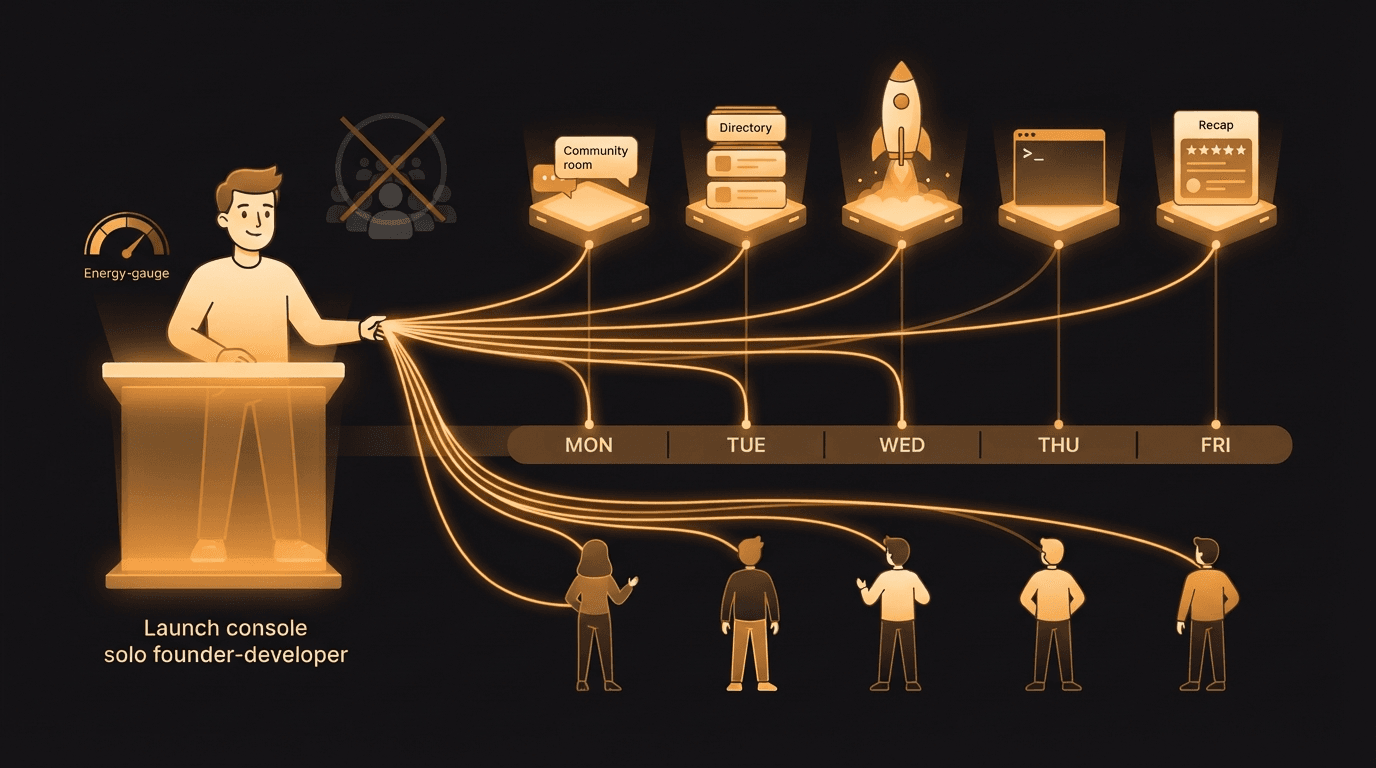
A launch week is a launch spread across five days instead of compressed into one. For a company, that means shipping a new feature every day. For a solo founder with one product and no feature backlog, it means something better: taking the same product to a different distribution surface each day — your own communities Monday, directories Tuesday, Product Hunt Wednesday, Hacker News and a write-up Thursday, a recap Friday.
I spent months building something and then gave it four hours of attention on a Tuesday. That is the actual failure mode of the single launch day, and it has nothing to do with the product. You build an asset over a quarter and then hand it one narrow window, on one platform, in front of one audience, and if the window is bad you have no second move. The launch week fixes that, but every guide written about it assumes you have a team and a feature pipeline. This is the version for the rest of us.
Why does a launch week beat a launch day?
Because a launch day can only fail in one direction, and a launch week can fail in four and still work. Concentrating everything into twenty-four hours means a single scheduling collision, an outage, a bigger launch landing the same morning, or a flu can take the whole thing down. Spreading the same effort across five days turns those from catastrophes into a bad Tuesday.
There's a second reason that's less obvious and matters more. The audiences on these platforms barely overlap. The Indie Hackers regulars, the directory browsers, the Product Hunt crowd, and the Hacker News readers are largely different people with different reasons for being there. Announcing to all of them simultaneously doesn't multiply your reach — it just means four of the five conversations happen while you're not looking. And the conversation is the launch. A comment you answer well converts; a comment you never see does nothing.
Supabase, the company that made this format famous, arrived at it from the same observation. In their own write-up of how they launch, they describe running one big announcement, doing the retrospective, and asking why they should only have one launch — settling on one major feature or announcement every day for a week, on a quarterly cycle. The line worth stealing is the reasoning behind it: you can launch the same thing many times over and still reach people who forgot, ignored, or plain missed it the first time.
Why you can't run Supabase's launch week
The honest problem with every launch-week guide on the internet: they're written for companies whose scarce resource is engineering time. The advice is about coordinating a feature backlog, staffing parallel projects, and keeping five demos from breaking at once. If you're one person with one product, none of that applies, and following it anyway produces a week of four thin days and one real one.
The inversion is simple. A company launch week is supplied by features. A solo founder's launch week is supplied by surfaces. You don't need five things to say; you need five rooms to say the one thing in, and to say it in the way each room expects.
| Company launch week | Solo founder launch week | |
|---|---|---|
| What ships each day | A new feature or a major announcement | Nothing new — the same product, shown to a different audience |
| What supplies the week | A multi-month build cycle and a feature backlog | One product and five distribution surfaces |
| Who does the work | A team running five to seven projects in parallel | You, on top of support tickets and whatever broke that morning |
| Where it lands | Mostly one owned channel, amplified daily | A different platform each day, each with its own rules and culture |
| What failure looks like | A thin day nobody reads | Burning your one real launch on a surface you weren't ready for |
| The scarce resource | Engineering time | Your attention span |
Read the last row twice. A company can throw more people at a launch week; you can only throw more hours, and you have a fixed number of those before the quality of your replies falls off a cliff. Every decision in the plan below exists to protect Wednesday.
The five-day sequence: one surface per day
Here is the week, with the honest time cost of each day. The bars are the point: this is not five equal days, it's one enormous day braced on either side by preparation and follow-through. Total cost is roughly 19 focused hours, which is a real week of work for one person and worth planning around rather than discovering on Wednesday morning.
Tell the people who already know you, before strangers hear it
The communities you've been part of for months are the only audience that owes you nothing and shows up anyway. Going to them first means Wednesday's crowd isn't cold — and it means the embarrassing bug gets found by someone friendly.
- Post the teaser where you're already a regular — a Slack, a Discord, Indie Hackers, your newsletter
- Message the ten people who gave you feedback during the build, individually
- Put the Product Hunt Upcoming page live and link it once
- Ask nothing except: does the first screen make sense?
- Fix whatever the first ten people trip over, today
Bank the permanent listings while nobody's watching
Directory submissions are the only part of the week that keeps working in month six, and they're the only part with no timing pressure at all. Doing them Tuesday means the listings are live and indexed before your biggest traffic day, so Wednesday's visitors find a product with a footprint.
- Submit to the eight to twelve directories that are actually worth your hour
- Reuse one description, one logo, one screenshot set across every form
- Record which ones require an email confirmation and clear them same-day
- Skip anything that wants payment for a basic listing on a first launch
- Log every submission URL in one file so you can check them Friday
The one genuinely time-boxed day
Product Hunt ranks on a daily cycle, which makes it the only surface in the week where the clock actually matters. Everything else can slip a day without cost. This one can't, which is why it sits mid-week where you're rested and the crowd you warmed on Monday is available.
- Publish first thing and post your maker comment immediately after
- Reply to every comment within the hour, all day, including the terse ones
- Tell the people who said they'd show up that it's live — never ask for an upvote
- Keep a browser tab on your error logs; the traffic will find something
- Do not schedule anything else on this day. Nothing. Not one call
Publish the thing that outlives the week
Thursday is where the durable asset gets made: a Show HN, plus the technical write-up or teardown that explains how you built it. Hacker News can't be scheduled or campaigned, so treat the post as optional and the write-up as mandatory — the article ranks either way.
- Publish the build write-up on your own domain first, then submit
- Post the Show HN yourself, with a boring title and an honest first comment
- Block three hours to sit with the thread; do not post if you can't
- Name the rough edges before the comments do
- If it sinks, shrug — the write-up is the point and it's already yours
Convert the week into proof you can reuse forever
This is the day almost every solo founder skips, and it's the one that pays for the other four. A recap gives the people who missed Wednesday a second entry point, and it's the natural moment to collect the reviews and testimonials that will still be selling for you next year.
- Post the honest numbers — including the disappointing ones
- Ask every new user who replied to anything for a review, by name
- Check all twelve directory listings actually went live
- Write down what you'd change, while you still remember
- Close the laptop. The week is over and Saturday is not day six
Two of those days deserve their own guides, and they have them. The Wednesday mechanics — the maker comment, the assets, the hour-by-hour shape of the day — are in the Product Hunt launch guide, and Thursday's rules are unforgiving enough that I wrote a separate Show HN guide for them. Tuesday's target list — which directories are worth the hour and which order to submit in — is the startup launch directories guide. And if you want the pre-flight version of all of this, the launch-day checklist covers what has to be true before Monday.
One structural note about Wednesday and Thursday, because getting it wrong is expensive. These two platforms reward opposite behavior. Telling your network that your Product Hunt launch is live is normal there. On Hacker News it is against the rules — the official Show HN rules say plainly not to ask friends to upvote or comment, and they also rule out sign-up pages and reading material as off-topic. Running both on one day means carrying launch-day energy into a room that treats it as a defect. Separate days, separate voices.
How do you prepare assets once and slice them five ways?
The week only fits into one person's calendar because you make almost nothing new after Monday. Five surfaces want the same five artifacts in slightly different shapes, and the difference between a sustainable week and a brutal one is deciding that in advance instead of rewriting your description from scratch at 11pm on Tuesday.
| Asset | Made once | Reused on |
|---|---|---|
| The 90-second demo video | Mon, for the community teaser | Product Hunt gallery (Wed) · Show HN first comment (Thu) · recap post (Fri) |
| The one-paragraph description | Tue, for the first directory form | Every other directory · PH tagline (Wed) · Show HN title (Thu) |
| The five-screenshot set | Tue, for directory listings | PH gallery (Wed) · write-up illustrations (Thu) · recap (Fri) |
| The “why I built this” story | Mon, for the people who know you | PH maker comment (Wed) · HN first comment (Thu) |
| The known-issues list | Mon, from the first ten testers | HN first comment (Thu) · “what we fixed” in the recap (Fri) |
The one artifact worth making fresh is Thursday's write-up, and it's worth it because it's the only thing from the week that's permanently yours. Everything else lives on someone else's platform under someone else's rules. A build write-up on your own domain keeps ranking, keeps getting linked, and keeps being quotable long after the launch traffic is gone.
That last part carries more weight than it used to. AI assistants sent 1.13 billion referrals to the top 1,000 websites in June 2025, up 357% year over year according to Similarweb data reported by TechCrunch — with ChatGPT accounting for more than 80% of them. Keep it in proportion: Google Search sent 191 billion referrals to the same sites over the same period, so this is a fast-growing sliver, not a replacement. But the direction is clear, and the material these engines pull from is durable written pages and public discussion threads. Your Thursday write-up and the comment threads under your launch are exactly that kind of material. The spike is the smallest thing your launch week produces.
What can one person actually sustain?
Roughly 19focused hours across five days, with more than a third of them on Wednesday. That's the honest budget, and the reason the week is five days and not ten. The failure mode isn't running out of things to announce, it's running out of the ability to answer a stranger's question thoughtfully at 4pm on day four.
The strongest thing you can do for the week is decide, before it starts, what you will refuse to do during it.
Protect these
- One surface per day, chosen before Monday
- A single asset set, made once and re-cut
- Wednesday completely clear of everything else
- The Friday recap, even if the numbers are small
- The people you helped in the months before, invited personally
Refuse these
- A paid press release timed to the week
- A sixth and seventh day, because the week has momentum
- Two launch platforms on the same day
- A feature you started building on Tuesday because a commenter asked
- Any surface where you've never posted before
The Saturday rule
When Friday goes well there is enormous pressure to add a sixth day, then a seventh, then a “launch fortnight.” Every solo founder I've watched do this has produced a worse week, because the extra days are unprepared by definition — you planned five. Momentum is not a resource you can spend; attention is, and yours is finished. Stop on Friday, take the weekend, and put the next launchable moment on the calendar in a few weeks instead.
How do you know whether the week worked?
Not by the upvote count. The number that tells you something is the behavior of the people who arrived: how many signed up, how many came back on day seven, and how many said something specific enough to act on. A launch that produced four detailed bug reports and twelve returning users beat a launch that produced six hundred upvotes and silence, every time.
Track four things and ignore the rest. Qualified signups, not raw traffic. Day-seven retention of the launch cohort, tagged so you can find them later. Permanent assets earned — live directory listings, links to the write-up, threads that will still be indexed next year. And relationships: replies that turned into a conversation, which is the input to your next launch.
The last one is the one founders under-count. The people who showed up on Wednesday because you helped them in March are the entire reason Wednesday worked. Which means the real preparation for a launch week doesn't start two weeks out — it starts whenever you begin being useful to other founders, and it's the part you can't buy at the last minute.
Booking the crowd, day by day
The one thing you genuinely cannot make on Monday is other people's attention. On Favors.dev that's the whole mechanic: founders trade verified marketing help — real testing, honest feedback, reviews from people who actually used the thing — metered by a points economy so nobody spends what they haven't earned. Put your week on the launch calendar and the help lands where it belongs: testers on Monday so Wednesday's visitors don't find the bug, and reviews on Friday while people still remember using it. Nobody trades upvotes. That's the part that would get you banned anyway.
Frequently asked questions
What is a launch week?
A launch week is a multi-day launch campaign that spreads announcements across a week instead of concentrating them in a single day. The format was popularized by developer-tool companies like Supabase, which ships one major feature or announcement every day for a week, several times a year. For a solo founder with one product and no feature backlog, the format inverts: instead of one new feature per day on one channel, you take one product to a different distribution surface each day — your own communities, directories, Product Hunt, Hacker News, and a recap.
How long should a launch week be?
Five weekdays, Monday to Friday, and then stop. The five-day shape isn't magic — it's the number of distribution surfaces a solo founder can prepare properly and the number of consecutive high-attention days one person can sustain before quality drops. Companies running launch weeks vary between three and six days depending on how many features they have ready. You're not limited by features, you're limited by attention, so let the calendar end on Friday even if the week is going well.
Do I need new features to run a launch week?
No — and this is the most common reason founders talk themselves out of it. A company launch week is supplied by a feature backlog; a solo founder's launch week is supplied by distribution surfaces. The same unchanged product is genuinely new information to the Indie Hackers regulars on Monday, the directory browsers on Tuesday, the Product Hunt audience on Wednesday, and the Hacker News crowd on Thursday. Those audiences barely overlap. Shipping five features to reach them would be doing five times the work for the same result.
Can you launch on Product Hunt and Hacker News in the same week?
Yes, and putting them on separate days is the entire point. They reward opposite behavior: Product Hunt is a scheduled, single-day ranking event where telling your network it's live is normal, while Hacker News can't be scheduled and its Show HN rules explicitly say not to ask friends to upvote or comment. Running them the same day means splitting your attention across two threads that both need live answers, and importing Product Hunt launch energy into a Hacker News thread is the fastest way to get flagged. Product Hunt mid-week, Hacker News the day after.
What if my launch week flops?
Most of the value survives a flop, which is the strongest argument for the format over a single launch day. Directory listings stay live and keep sending traffic. The write-up stays indexed on your domain. The Product Hunt page and any comment thread remain permanent, linkable pages carrying your product name. A bad launch day leaves you with nothing but a bad day; a bad launch week still leaves you with a dozen permanent listings, one article, and a handful of people who now know your product exists.