 Favors.dev
The short answer
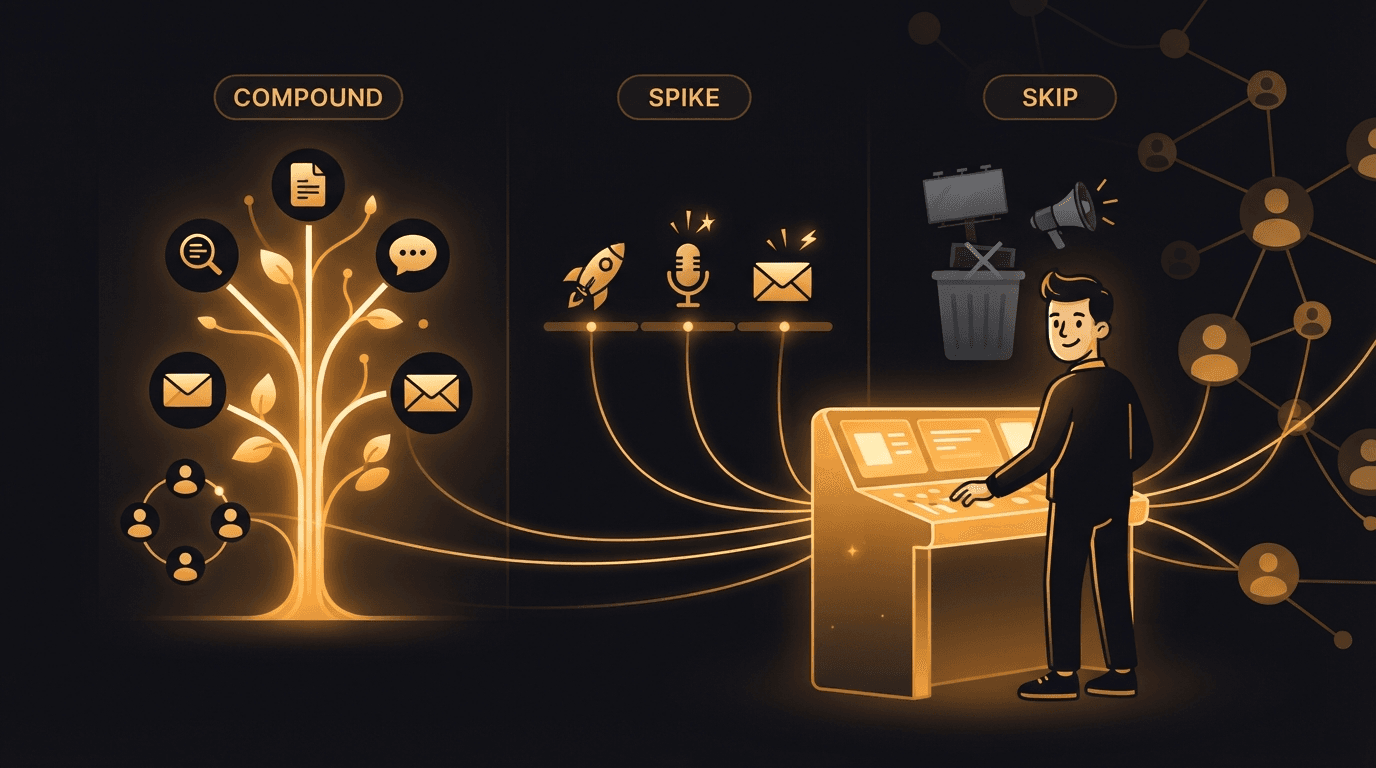
A micro SaaS marketing strategy names one buyer, estimates how many of them exist, and runs only as many channels as that number supports. For a niche under about 1,000 buyers, I would write to them directly. Up to 10,000, add the communities they use. Above that, add pages that answer their searches.
A small product does not need a large audience. It needs the right few hundred or few thousand people to know it exists. That changes the work. Advice written for funded software companies assumes a big market with money and staff behind the product. A solo founder usually has none of that. This guide starts with a count, because the count tells you what to leave out. It sits under the wider plan for SaaS marketing on no budget.
What does a small niche change about marketing?
It makes reach less important than accuracy. In a small market, a thousand visitors from outside it are worth very little, and ten conversations with the right people can settle the headline and the price.
It also means you can start by hand. Paul Graham's essay Do Things that Don't Scale argues that startups nearly all have to recruit users manually at first, and that starting in a deliberately narrow market is like keeping a fire contained so it gets hot. A micro SaaS begins inside that contained space. I would use it.
The money math is smaller too. Kevin Kelly's 1,000 True Fans was written about creators rather than software, but the habit of working backward from income to a number of paying people carries over well.
How big is your niche, really?
I estimate it in three steps. A rough number is enough, because you only need to know which row of the table you are in.
- Count a base group. Use something countable: businesses of one type, users of the tool you plug into, members of the main communities for that job. The U.S. Small Business Administration keeps a market research guide with free public data sources.
- Apply the filter. Guess the share that has the problem often enough to pay for a fix. Guess low, and write down why.
- Check it against the target. Divide the monthly revenue you want by the price. That is the customer count. Then divide it by the niche size to see what share of the market you would need.
Here is an invented example to show the arithmetic. You make a scheduling add-on for independent dog groomers. Say you find a base of 20,000 grooming businesses and guess that a quarter of them have the problem. The niche is 5,000. You want $2,000 a month at $20, so you need 100 customers, which is 2% of the niche. That row says run two channels. If the same sum had required 40% of the niche, the fix would be a higher price or a wider buyer, and no channel would rescue it. The sum also ignores cancellations, so treat 100 as the number you have to keep, not the number you sign once.
| Buyers in the niche | Channels | Which ones | Why |
|---|---|---|---|
| Under 1,000 | 1 | Direct, named outreach | You can list a large share of the buyers by name, so write to them. |
| 1,000 to 10,000 | 2 | Outreach, plus the communities they already use | Too many to message one by one, few enough that a handful of places reach them. |
| 10,000 to 100,000 | 3 | All of the above plus search pages | There are likely enough searches about the problem to reward writing the answers. |
| Over 100,000 | 3 | The same three, aimed at one segment | Cut the audience down before you add a channel. |
I set these bands as a planning rule of thumb. I have not measured them as benchmarks. If you have under five marketing hours a week, cap yourself at two channels whatever the row says.
Where does your niche already gather?
I look for places that exist without me. The thing to find is repeated questions, because a repeated question is demand you can answer today.
01The tool they already use
If your product sits beside another one, look at that product’s forum and its help threads. People describe their problem there in their own words.
02The place they ask peers
A subreddit or a Discord server, sometimes a trade forum. Search the problem, not the product category, and note where the same question keeps coming back.
03The people they already follow
It might be a newsletter or a single person who posts useful things about this job. A mention from them reaches buyers who would never search for you.
04The search box
Type the problem the way a buyer would say it. The results show which pages already answer it and where the answer is thin.
I would keep a short list with a link, a rough size and the last time someone asked about the problem. For chat servers, the guide to finding users in Discord communities has a quick way to judge whether one is worth joining.
Which three channels are worth the time?
Direct outreach comes first. Existing communities come second, and narrow search pages third. Each one feeds the next: conversations supply the words. Communities test them. Pages keep answering after the laptop is closed.
01Direct, personal outreach
Write to one person about one thing they said or do. Ask a question about the problem before you mention the product. This is the channel that teaches you the wording for the other two.
Watch: Replies, and calls booked from them.
02One or two communities, every week
Answer questions where the answer helps even if nobody clicks anything. Read each community’s rules first. Show the product when it is the honest answer to the question asked.
Watch: People who ask you a follow-up, or search your product name.
03Pages that answer narrow searches
One page per real question, such as the setup guide for the tool you sit beside. A narrow query has fewer searchers and fewer competitors.
Watch: Impressions first, then clicks, then signups from that page.
For the outreach side, use the steps in getting your first 10 paying customers. To compare more options before you commit, the list of marketing channels for indie hackers covers what each one costs in time.
A new product also lacks outside proof. The Favors.dev apps directory gives it a public page, and Favors.dev itself is a founder marketing co-op I built around a points economy: members earn points by doing verified favors for each other, such as feedback and shares, and spend them to get help back. Other founders are not automatically your buyers, so I treat it as a place for feedback and visibility, and count customers separately.
What should a micro SaaS skip entirely?
Skip anything that charges you, in money or hours, to reach people who are not in the niche. Each item below has a condition for coming back to it.
| Skip for now | Reason | Revisit when |
|---|---|---|
| Broad paid ads | You pay to reach people outside the niche, and a small budget ends before it teaches much. | You know which message converts and what a customer is worth. |
| A post on every social network | Thin posting in five places builds no familiarity in any of them. | One account brings signups you can trace. |
| Head-term SEO | A one-person site is unlikely to outrank large publishers on a broad phrase. | Your narrow pages already rank and earn clicks. |
| Chasing press | A general audience contains very few of your buyers. | A trade outlet your niche reads has a reason to cover you. |
| A community of your own | An empty room needs daily work before it gives anything back. | Customers are already asking to talk to each other. |
Launch platforms are a middle case. A launch day can bring feedback and a listing that stays online. It rarely reaches a trade niche like the groomers above, so I would plan it as an extra and keep the weekly channels running.
What does a 30 day micro SaaS marketing plan look like?
One week to count, one to talk, one to rewrite, and the last nine days to publish and decide. The numbers are targets for effort, which you control. They are not promises about results.
Days 1 to 7
Define the buyer and count them
Write one sentence naming who the product is for and what they are doing when they need it. Estimate the niche with the steps above. List 30 real people or accounts who match, and the places you found them.
Done when: A niche estimate with its band, plus a list of 30 names.
Days 8 to 14
Talk to them
Send five short, personal messages a day on working days. Ask how they handle the problem now and what annoys them about it. Copy their phrases into a document.
Done when: 25 messages sent and the replies saved word for word.
Days 15 to 21
Fix the page and start the second channel
Rewrite the headline using the words from the replies. If the band calls for two channels, pick one community and answer three questions there. If it calls for one, send another 25 messages.
Done when: A new headline and a week of activity you can count.
Days 22 to 30
Publish one answer and read the results
Write one page for the question that came up most. Then count replies and paying customers by source. Keep the source that produced conversations and drop the one that produced nothing.
Done when: One published page and a written keep or drop decision.
If the outreach week gets no replies at all, I would change the list or the message before changing channels. Silence from 25 people usually means you wrote to the wrong people or asked for too much. If you have replies but nobody wants a fix, go back to customer discovery questions and check the problem itself.
At day 30, keep one sheet with a row for each source. I would record conversations and paying customers next to the hours spent. I would run the winning source for another month before adding anything. A small niche can be used up, so also note how many names are left. When a list of 1,000 is nearly worked through, that is the signal to widen the buyer or add the next channel.
Frequently asked questions
What is a micro SaaS marketing strategy?
It is a plan for getting a small, narrowly aimed software product found by the few people who need it. It names the buyer, estimates how many there are, picks one to three channels that reach them, and sets a way to tell which channel is working.
How do you market a micro SaaS with no budget?
Spend time where money would otherwise go. Write to likely buyers one at a time, answer questions in the communities they use, and publish pages for the narrow questions they search. Add paid channels only after you know what a customer is worth.
How do you get your first micro SaaS customers?
Start with people you can name. Ask about the problem, offer to set the product up for them, and charge once it does the job. Search traffic and communities usually take longer, so run them alongside the direct work.
How many marketing channels should a micro SaaS use?
As a rule of thumb, one if your niche is under about 1,000 buyers, two up to about 10,000, and three beyond that. If you have only a few hours a week for marketing, stay at one or two whatever the size.
Is SEO worth it for a micro SaaS?
It can be, when you target specific questions instead of broad category phrases. If people do not search for the problem at all, outreach and communities will do more than search pages.