 Favors.dev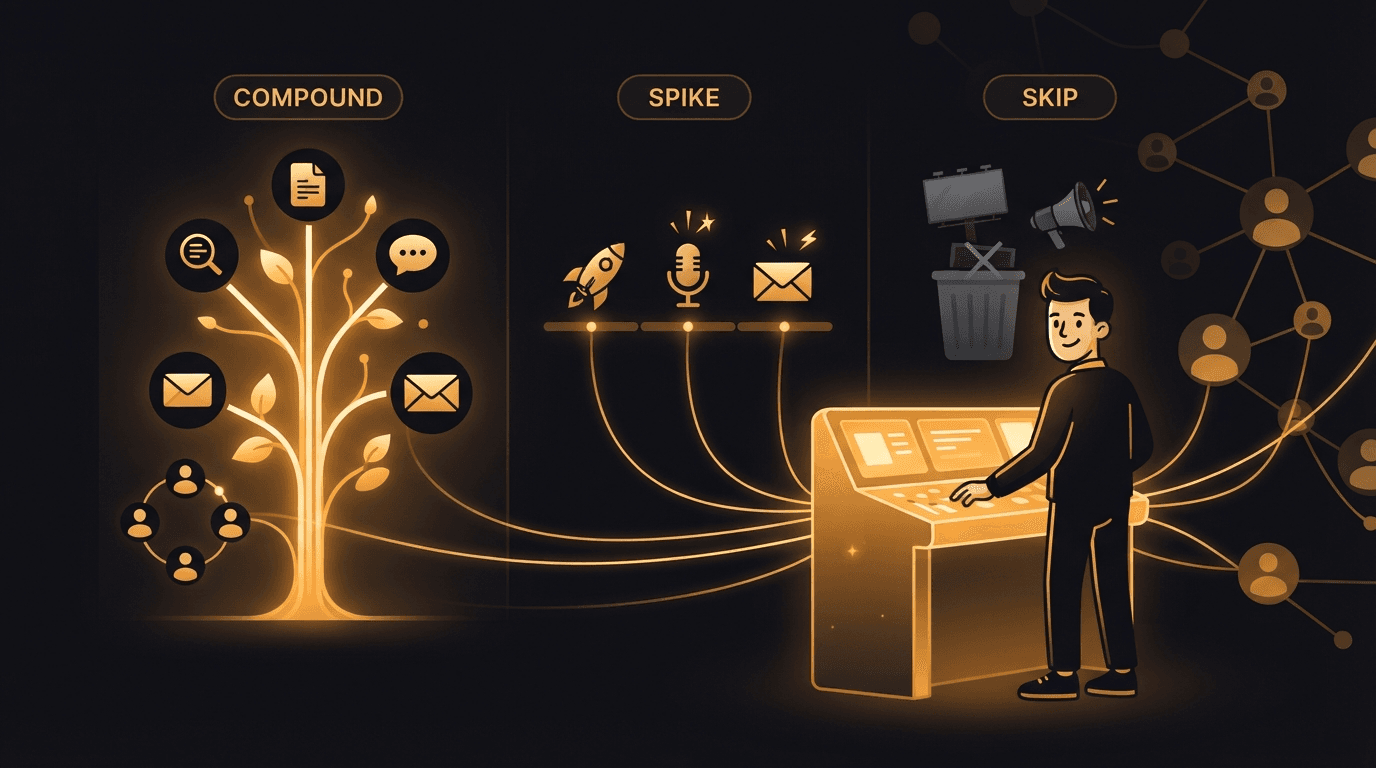
The best marketing channels for an indie hacker are the ones that cost effort instead of money and compound instead of evaporating: answer-engine content, community participation, an email list, and reciprocity — trading marketing favors with other founders. Launches and podcast guesting are useful spikes on top of that base. Paid ads are usually a mistake before you've found product-market fit.
Every "7 channels for indie hackers" post lists the same tactics in the same order and calls it a strategy. This one ranks the whole menu on the two axes that actually matter when you're a one-person team — and it's honest about the channels you should skip, and the one channel every other list forgets. The centerpiece is a scorecard you can bookmark and come back to.
How to choose channels when you're the whole team
When you're the founder, the engineer, the support desk, and the marketer, your scarcest resource isn't money — it's hours. So rank channels by money-vs-effort is only half the picture. The axis that separates winners from time-sinks is whether a channel compounds. A ranking page, a review, a backlink, and an email subscriber all keep working while you sleep and stack on top of last month's work. A paid click, a one-day launch spike, and a single viral post are gone by morning and start from zero again tomorrow.
The second thing that trips up solo founders is spreading too thin. The mistake most indie hackers make isn't picking the wrong channel — it's picking five and executing none of them well. One channel worked seriously beats five channels dabbled in. You cannot be everywhere; you can build a repeatable system around two channels you actually execute. This guide sorts every channel into three buckets so you know which two to start with.
The master channel scorecard
Here's the full menu, scored on effort, time to payoff, whether it needs an audience you don't have yet, and — the column that decides your priority order — which bucket it's in. Compounds is your base, Spike is fuel you add on top, and Skip for now is what to leave until later.
| Channel | Bucket | Effort | Time to payoff | Needs audience? | Best for |
|---|---|---|---|---|---|
| SEO / answer-engine content | Compounds | High, sustained | Slow — 3–9 mo | None | Capturing intent, getting cited by AI answers |
| Reciprocity / peer favors | Compounds | Medium | Fast — days | None | Reviews, feedback, backlinks, launch support |
| Community participation | Compounds | Medium, daily | Medium — weeks | None | Trust, first users, Reddit/IH distribution |
| Email list / newsletter | Compounds | Medium | Medium — weeks | Builds one | The one audience you own outright |
| Build in public | Compounds | Medium, daily | Slow — months | Builds one | Reputation, watchers who convert later |
| Directory listings | Compounds | Low, one-time | Slow — months | None | First backlinks, the SEO floor |
| Launch platforms | Spike | High, one day | Spike — 48 hr | Helps a lot | Product Hunt, Show HN — a burst of eyes |
| Newsletter swaps | Spike | Low per swap | Spike — days | Partner's | Borrowing a peer's list for free |
| Podcast guesting | Spike | Medium | Spike + tail | Host's | Authority + a named-author backlink |
| Paid ads | Skip for now | Money, not time | Instant, then gone | None | Scaling a proven offer — not finding one |
| Mass cold DMs / outreach | Skip for now | High, manual | Low, one-off | None | A dozen design partners, not scale |
| Short-form video at volume | Skip for now | Very high | Random | Builds one | Only if video is genuinely your medium |
Read the Bucket column top to bottom and your quarter plans itself: build on the Compounds rows, add a Spike when you've got a base to amplify, and don't touch the Skip rows until an organic channel is already working.
Compounding channels (the base you build on)
These are the channels a solo founder lives or dies by, because they need no budget, most need no prior audience, and every hour you put in keeps paying out. Start here.
Answer-engine content (SEO that gets cited). Content is still the highest-leverage channel for a one-person team: one post that ranks brings qualified readers for years. What changed is the target. AI referrals to the top 1,000 websites passed 1.13 billion visits in a single month in 2025 (up 357% year over year, with ChatGPT driving more than 80% of them) — yet those engines still send publishers under 1% of their referral traffic even when they cite you. The prize is shifting from the click to the citation. So write to be named inside the answer: lead each section with the answer, use question-shaped headings, keep your entity naming consistent. This is the discipline I break down in answer engine optimization for startups.
Reciprocity — the channel every other list forgets. Look at what answer engines actually cite and you find a pattern: Similarweb's data and the 5W State of AI Citations 2026 show ChatGPT leaning heavily on reviews and community discussion (Reddit and Wikipedia alone make up over a quarter of its US citations), while Perplexity rewards attributed, named-author content. Reviews, testimonials, community mentions, and editorial backlinks — the precise currencies you can earn from other founders— are the exact signals these engines cite. That's why reciprocity is the one channel that produces distribution on day one with no audience and no budget: the review or backlink you earn comes from someone with a real account and a real website, and you pay for it with help instead of cash.
Community participation.Show up where founders and your buyers already gather — Reddit, Indie Hackers, a focused Discord — and be useful before you ever mention your product. Trust banks up over weeks, and it's the cheapest moat a solo founder has. It pairs with reciprocity: a community is where the trading happens.
An email list. Email is the only audience you own outright — no algorithm sits between you and your subscribers. It builds slowly, but a launch to 300 warm subscribers beats a cold launch to strangers every time.
Build in public and directory listings round out the base: building in public compounds reputation and creates watchers who convert later, and directory submissions are the low-effort SEO floor — your first legit backlinks. Both are covered in the build-in-public playbook.
Spike channels (bursts, not a base)
Spike channels deliver a burst of attention on a specific day and then fade. They're genuinely valuable — but only when you fire them on top of a base, so the spike lands somewhere and some of it sticks.
Launch platforms. Product Hunt, Show HN, and the directory circuit still run on free and cheap channels — Product Hunt Upcoming, Indie Hackers Launch, Reddit, plus low-cost paid options like BetaList (~$129) and EarlyAccess.io (~$49). The catch is arrival: a launch amplifies momentum you bring, it doesn't create it. Line up support first — which is exactly what a launch calendar and rally is for.
Newsletter swaps and podcast guestingboth borrow someone else's audience for an afternoon of work. Swaps trade a mention with a peer whose list is your size; guesting puts you in front of a host's audience and leaves behind a named-author backlink AI engines like. Neither needs a following of your own — they need a partner willing to reciprocate, which is the whole point of a founder network.
The channels to ignore (for now)
"For now" is doing real work in that heading. None of these are evil; they're just the wrong tool this early, and time spent on them is time stolen from channels that would actually compound.
Paid ads
A scaling tool, not a discovery tool. Ads multiply a funnel that already converts — pre-PMF you're paying to learn what customer conversations teach for free, and the traffic vanishes when the budget does.
Mass cold outreach
Hand-written DMs to a dozen ideal design partners: great. Automated blasts to a scraped list: a fast way to burn your domain reputation and your name. Doesn't scale, and you don't need scale yet.
Short-form video at volume
TikTok and Reels can work, but the production tax is brutal for one person and the payoff is a coin flip. Only worth it if video is genuinely the medium you think in.
There's a timing tailwind worth naming here. Only 14% of marketers currently track AI-search citations, even though 65% name AI-driven search as their biggest challenge and 89% of brands already appear in AI answers (GoodFirms, 2026). The founders who invest their hours in the compounding, citation-earning channels right now are moving into a lane most of the market hasn't figured out how to measure yet.
A simple channel-selection framework
You don't need a spreadsheet. Run every channel through three questions, in order:
1. Does it compound?
If the work keeps paying out after you stop — a ranking page, a backlink, a subscriber — it belongs in your base. If it resets to zero tomorrow, it's a spike at best. Start with two compounding channels, not five of anything.
2. Does it need an audience I don't have?
If a channel assumes followers, a list, or a budget you lack, it's not a starting channel — it's a later one. Pick a first channel that works from zero: content or reciprocity both do.
3. Can I run it every week without burning out?
A channel you can sustain for 90 days beats a clever one you abandon in three weeks. Match the channel to your actual temperament — writer, talker, or helper — not to what worked for someone else.
Nearly every answer points at the same shortlist: content, community, email, and reciprocity as the base; a launch or a swap as the spike. That's not a coincidence — it's what falls out when you rank channels for one person with no budget and no audience, which is exactly the situation the solo-founder GTM strategy and the no-budget marketing playbook are built around.
The channel that surprises people is reciprocity, because it's the only one made of other founders. Ad-hoc "support my launch" groups collapse — the askers outnumber the givers and the givers burn out — which is the exact problem Favors.dev was built to fix: a founder marketing co-op where a points economy enforces reciprocity. You earn points by helping other founders launch and spend them to get the same help back, and you can't spend what you haven't earned — so free-riding is mathematically impossible and every favor is verified before points move.
How to tell if a channel is working (and when to quit)
Choosing channels is the easy half. The half that actually decides whether you get traction is knowing what "working" looks like early enough to keep going — and being honest enough to stop when it isn't. Solo founders usually get this backwards in both directions: they kill compounding channels at week three because there's no revenue yet, and they keep flogging dead ones for months because the vanity number is still creeping up.
The fix is to judge each channel on a leading indicator that moves weeks before the lagging one does, and to know in advance how long the channel needs before its verdict means anything.
| Channel | Don't judge it on | Watch this instead | Give it |
|---|---|---|---|
| SEO / answer-engine content | Traffic, rankings | Impressions rising in Search Console, even at page 3 | 8–12 weeks before you judge it |
| Community participation | Signups attributed to the community | People reply to you by name; someone DMs you unprompted | 4–6 weeks |
| Reciprocity / peer favors | Traffic from the favor itself | Reviews, backlinks and feedback actually landing — the assets persist | 2–3 weeks |
| Email list | List size | Open and reply rates holding as the list grows | 6–8 weeks |
| Build in public | Follower count | Repeat commenters; people referencing an earlier update | 8–12 weeks |
| Launch platforms | Upvotes, ranking on the day | What's still arriving in week 2, and the backlink you kept | Judge at day 14, not day 1 |
Notice what the middle column has in common: every one of those signals is a sign that a specific human noticed you, not that a number went up. That's deliberate. At indie-hacker scale the volumes are too small for statistics to mean anything — ten people arriving is noise, but one stranger replying to you by name is evidence.
The quit rule.Give a channel its full window with an honest, weekly cadence. At the end of it, ask one question: did the leading indicator move at all? Not "did it pay off" — did it move. If yes, keep going; compounding channels are supposed to look unimpressive right up until they don't. If it's flat after a full window of real effort, quit it and move the hours to your other channel. And quit properly rather than tapering: a channel you half-run is worse than one you dropped, because it still costs the attention.
One caveat that saves a lot of wasted quarters — a flat leading indicator usually means the channel is fine and the messageisn't. Before you blame the channel, check whether you'd pass the positioning test in founder-led marketing explained. Switching channels with fuzzy positioning just gets you ignored somewhere new.
Frequently asked questions
What are the best marketing channels for indie hackers in 2026?
The best marketing channels for a one-person team are the ones that cost effort instead of money and compound instead of evaporating: answer-engine content (SEO that also gets cited by AI), community participation, an email list, and reciprocity — trading marketing favors with other founders. Launches and podcast guesting are useful spikes on top of that base, but they're moments, not a foundation. Paid ads are usually a mistake before product-market fit. The winning move isn't running all of them; it's picking two compounding channels and executing them consistently for 90 days.
How many marketing channels should a solo founder run at once?
Two — maybe three once those are running on rails. The most common mistake indie hackers make isn't choosing the wrong channel; it's choosing five and executing none of them well. A single channel worked seriously beats five channels dabbled in. Pick one compounding channel that needs no audience (content or reciprocity) and one place to show up daily (a community), get both to a repeatable cadence, and only then add a third.
Which marketing channel works with no audience and no budget?
Reciprocity. Every other channel either needs money (ads), an existing audience (social, email, swaps), or months of runway before it pays off (SEO). Trading favors with other founders needs none of those: the review, share, feedback, or backlink you earn comes from someone who has a real account and a real website, and you pay for it with help instead of cash. It's the only channel that produces distribution on day one, which is why it's the backbone of a solo founder's plan.
Is SEO still worth it for indie hackers with AI Overviews everywhere?
Yes, but the goal has shifted from the click to the citation. AI referrals to the top 1,000 sites passed 1.13 billion visits in a single month in 2025, yet those engines still send publishers under 1% of their referral traffic even when they cite you. So write to be named inside the answer, not just to rank: lead each section with the answer, use question-shaped headings, and earn the off-page signals — reviews, community mentions, backlinks — that engines actually cite. Content is still the highest-leverage channel for a solo founder; it just does double duty now.
How long should I give a marketing channel before quitting it?
Give it the window the channel actually needs, then judge it on a leading indicator rather than revenue. Reciprocity shows up in 2–3 weeks, community in 4–6, email in 6–8, and content or build-in-public in 8–12 — a launch is judged at day 14, not on the day. At the end of the window ask only whether the leading signal moved at all: impressions creeping up in Search Console, someone replying to you by name, a review or backlink actually landing. If it moved, keep going, because compounding channels look unimpressive right until they don't. If it's completely flat after a full window of honest weekly effort, quit it outright and move those hours to your other channel — a half-run channel is worse than a dropped one because it still costs attention.
Do paid ads work for bootstrapped indie hackers?
Rarely before product-market fit. Ads are a scaling tool, not a discovery tool: they multiply a funnel that already converts. Pre-PMF you don't yet know who buys or why, so you're paying to learn what a week of customer conversations would teach you for free — and the traffic vanishes the moment you stop paying. Nail your organic and reciprocal channels, confirm the unit economics, then consider ads to pour fuel on a fire that's already lit.