 Favors.dev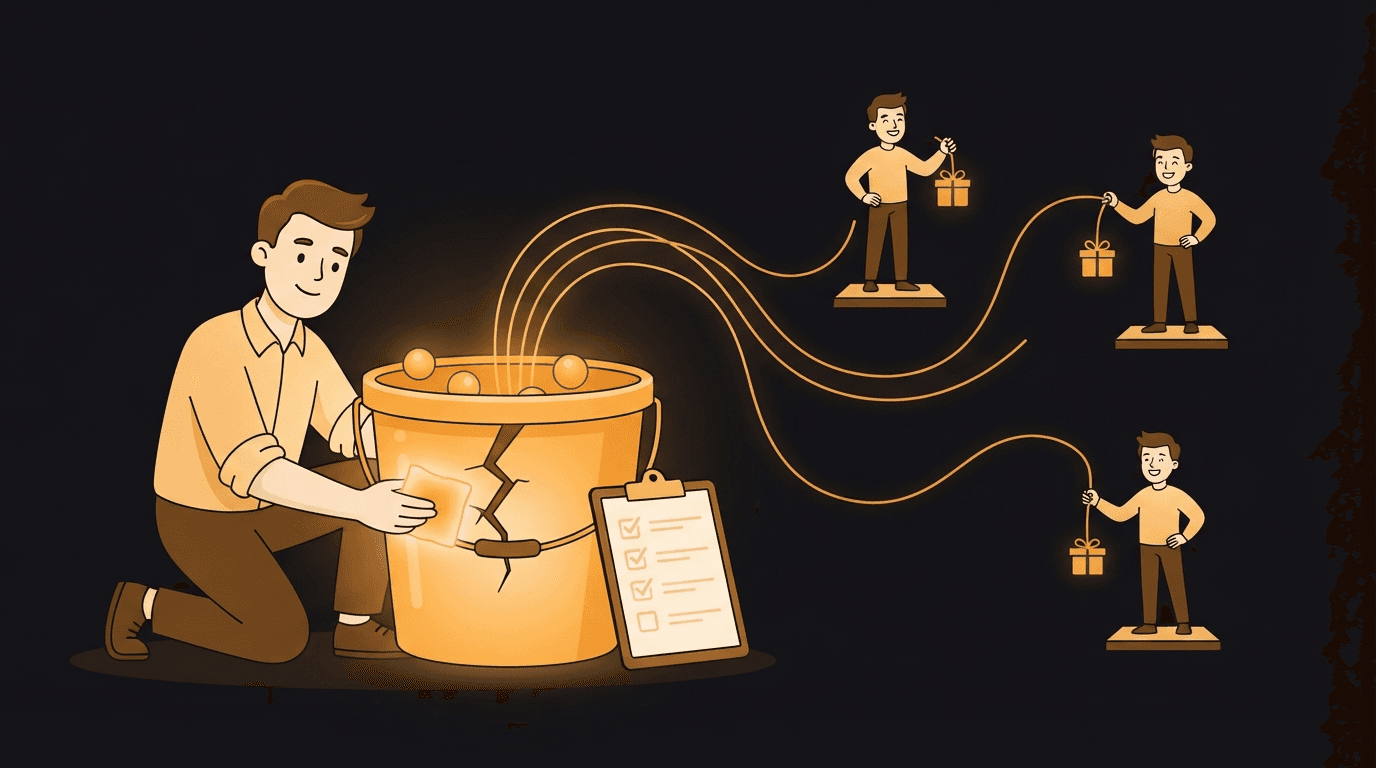
A SaaS referral program is a system that rewards existing customers for bringing in new ones. For an early-stage product, the right first version is manual: ask happy customers for one name right after they get a result, track each referral in a spreadsheet, pay a reward in account credit once the new user activates, and thank the referrer personally. Build it only after retention is stable, because a referral program multiplies whatever your product already does to the people who try it.
That last clause is where early referral programs go wrong. The usual advice is written for companies with thousands of customers, a growth team, and a software budget. It tells you which platform to buy and how to design a referral page. It rarely tells you the uncomfortable part, which is that most tiny products do not yet have anything worth referring, and no incentive fixes that.
This playbook is for the other case: a solo founder or a small team with dozens or a few hundred customers. It covers an honest readiness checklist, a referral program you can run this week with zero code, incentives that fit indie margins, and the one measurement that tells you whether any of it worked.
Is your SaaS ready for a referral program?
You are ready when people stay, not when you reach a customer count. A referral program is a multiplier. Point it at a product that keeps users and it compounds. Point it at a product that loses them and it spends your best customers' reputations sending their friends into the same leak.
Call it the leaky-bucket rule. Every referred user lands in the same bucket as everyone else. If that bucket drains, a referral program does not just fail to grow you. It burns the one channel that trades on trust, and trust does not refill on your schedule. A customer who recommends you to a friend who churns in a week will think twice before recommending anything of yours again.
The reason referrals are worth the wait is that personal recommendations carry weight nothing else does. In Nielsen's 2021 Trust in Advertising study, 88% of global respondents said they trust recommendations from people they know more than any other channel. That trust is exactly what you are borrowing when a customer refers someone. It is also why the timing matters so much: you only get to borrow it a few times before the lender starts keeping track.
If you are still working toward stable retention, you are not locked out of referrals. You are locked out of a program. Asking a delighted customer for an introduction by hand works at any stage, and the first 100 users playbook treats every early user as exactly that kind of one-to-one conversation.
The referral-readiness checklist
Run your product against these eight checks before you design a single reward. Each one comes with a way to check it in under an hour, using data you already have or a few emails. They are my working rules for a small product, not industry benchmarks, so treat the scoring as a guide to what to fix next.
Referral readiness, eight checks
- Your retention curve flattensPlot the share of each monthly signup cohort still active over time. A curve that levels off means some people found a lasting reason to stay. A curve sliding toward zero means the bucket leaks.
- Someone already recommended you, unpromptedAdd a free-text “How did you hear about us?” field at signup. Named people in the answers are the word of mouth a program would amplify.
- You can name the activation momentFinish the sentence “A new user is getting value once they have ______.” If you cannot, a referred user will not get there either.
- Customers would miss youAsk your ten most active users how they would feel if the product disappeared tomorrow. Shrugs are a retention answer, not a referral answer.
- Churn reasons are about fit, not failureRead your last cancellation replies. “Not for us” is fine. “It broke” or “I never figured it out” means fix the product first.
- The first week works without youSign up with a fresh email and try to reach activation with no help. Referred users arrive expecting their friend’s experience.
- You can afford the reward many times overPrice the reward at your real marginal cost and multiply it by a good month. If that number makes you nervous, pick a different reward.
- You have time to thank people personallyBlock an hour a week. At this stage the thank-you is worth more than the reward, and nobody else will send it.
All eight
Run the concierge program below this week.
Most of them
Ask for introductions by hand, and fix the misses first.
A few
Skip referrals for now. Retention is the growth project.
The two checks founders skip are the activation moment and the unassisted first week. Both are onboarding problems wearing a referral costume. If a new user cannot reach value without you, the fix is an onboarding email sequence that walks them to their first win, and it will do more for referred users than any reward you could offer them.
How do you run a referral program with no software?
Run it by hand: a personal ask at the right moment, a named code or link, a spreadsheet, a reward applied on activation, and a thank-you you write yourself. I call this the concierge referral program. It handles early volume easily, costs nothing to build, and teaches you what the automated version should do before you pay for one.
Here is the full standard operating procedure. It assumes nothing beyond email, your billing tool, and a spreadsheet.
- 01Wait for a winAsk right after a customer reaches a real result: they replied to say thanks, renewed, or hit a milestone inside the product. Asking at signup asks them to vouch for something they have not seen yet.
- 02Ask one person, one questionSend a short personal email: “Is there one person you know who is stuck on the same problem you had?” One name is easy to think of. “Share with your network” is not.
- 03Make forwarding effortlessInclude a two-line note they can forward as is, plus a personal link or promo code with their name in it. A named code doubles as your tracking.
- 04Log it the same dayOne row per referral in a spreadsheet, using the columns below. If it is not in the sheet, it did not happen, and you will forget who to thank.
- 05Welcome the referred user by nameSend a personal note that mentions who sent them. It tells the new user they are expected and tells the referrer, later, that you treated their friend well.
- 06Reward on activation, not on signupApply the reward once the referred user reaches your activation moment or makes a first payment. Rewarding signups pays for accounts, not customers.
- 07Close the loop with the referrerTell them their friend is set up and that the reward is applied. Then say thank you like a human. This message is what earns a second referral.
- 08Review the sheet monthlyCount asks, referrals, activations, and who is still around at 30 and 90 days. Ten minutes a month is the whole reporting stack.
The spreadsheet needs eight columns and nothing more.
| Column | What goes in it |
|---|---|
| Referrer | Who sent them |
| Referred | Name and email of the new user |
| Asked on | Date you made the ask |
| Signed up | Date they created an account |
| Activated | Date they hit the activation moment |
| Reward | What you gave, and to whom |
| Active at 30 / 90 days | Yes or no, filled in later |
| Notes | Anything they said about why they came |
Step three deserves a closer look, because it is where most manual programs stall. Customers are willing to refer and then do not, simply because writing the message is work. Hand them the words. The same principle that makes a forwardable intro blurb work applies here: two lines about what the product does and who it helps, written so your customer only has to add a name and press send.
Step six is the one that protects you. Rewarding on signup invites throwaway accounts, and it rewards the wrong behavior even when nobody is gaming it. Rewarding on activation means you only pay for referrals that became users, and the reward arrives when your referrer's friend has actually had a good experience, which is the moment a thank-you lands best.
If you run a waitlist before launch, you already have the raw material for this. The waitlist marketing playbook covers the pre-launch version of referral mechanics, where the reward is a better place in line rather than a discount.
What referral incentives fit indie margins?
Credits beat cash, and status beats both, at least early on. Account credit costs you your marginal cost instead of its face value, and it is only worth anything to someone who keeps using the product. Status and access, like early features or a direct line to the founder, cost your attention, which at this stage is the scarcest and most convincing thing you can give.
| Incentive | What it costs you | Abuse risk | Where it fits |
|---|---|---|---|
| Cash or gift cards | Full face value, every time | High, attracts people who want the money | Rarely right below a few hundred customers |
| Account credit or free months | Your marginal cost, which is usually small | Low, only valuable to people who stay | The default for subscription products |
| Plan upgrade or extra usage | Near zero for most software | Low | Usage-based products with a clear limit |
| Status and access | Your time and attention | None | Early communities, tools with power users |
The strongest argument for a modest reward comes from the most careful study of referral programs I know of. Philipp Schmitt, Bernd Skiera and Christophe Van den Bulte tracked roughly 10,000 customers of a German bank for almost three years, and the executive summary of their Journal of Marketing study on referral programs and customer value reports that referred customers were worth at least 40 euros more than comparable customers. Against a 25 euro referral fee, the bank earned a return of roughly 60%. The fee did not need to be large to pay for itself. It needed to go to the right people.
That study also found the program was less beneficial with older customers, which is a useful reminder that a reward attracts a particular kind of referral. Cash attracts people who want cash. Credit attracts people who want more of your product. For a small SaaS, the second group is the only one you can afford.
A practical rule: size the reward so you would happily give it to your best customer for no reason at all. If it feels like a bribe, it will read like one to the friend receiving the ask. If it feels like a thank-you, it will too. And if you are still settling on pricing, sort that out first with the early SaaS pricing guide, because a credit is only as meaningful as the price it comes off.
Double-sided or single-sided rewards?
Double-sided rewards, where both the referrer and the new user get something, usually work better for paid products. The reason is social rather than financial. A single-sided reward makes the ask look like your customer is earning off a friend. A double-sided one turns the same message into a gift, which is far easier to send.
| Factor | Single-sided | Double-sided |
|---|---|---|
| Who gets rewarded | Only the person who refers | The referrer and the new user |
| How the ask feels | Like the referrer is earning off a friend | Like the referrer is handing over a gift |
| Cost per activated referral | One reward | Two rewards, or one split in two |
| Best fit | Audiences who refer for status, not rewards | Paid products where the friend has to decide to pay |
Dropbox is the example everyone cites for a reason: it rewarded both sides in its own product currency, extra storage, which cost it little and was only valuable to people who used Dropbox. That is the pattern worth copying, not the scale. If a double-sided reward strains your margins, split one reward into two halves rather than dropping the new user's side. The gift framing is doing most of the work.
Single-sided still has a place. In communities and free tools, people often refer for status or because the product genuinely helps the friend, and a reward can even cheapen that. When the thing being shared is a good reputation, recognition is the reward.
When should you graduate to referral software?
Graduate when the spreadsheet costs you more time than the referrals are worth, or when referrals start arriving from people you have never spoken to. Both mean the program has outgrown the personal touch that made it work, and automation is now protecting your time rather than replacing your judgment.
- The logging takes over. If updating the sheet and applying credits eats more than an hour or two a week, the manual version has done its job.
- Strangers are referring. Once referrers are customers you do not know personally, a self-serve referral link inside the product beats a personal email you cannot scale.
- Rewards need to apply themselves. When you are manually creating credits in your billing tool every week, connect a referral tool to billing instead.
- You want affiliates, not customers. Paying creators and partners a recurring commission is a different program with different tooling, taxes, and payout rules.
When you get there, the category includes tools like GrowSurf, Rewardful, FirstPromoter and ReferralHero, several of which connect directly to Stripe. Pick one that rewards on a payment or an event you define, not on signup, and move your spreadsheet rules into it unchanged. You spent months learning what works. The software should enforce that, not replace it with its defaults.
How do you measure a referral program?
Measure whether referred users stay longer than everyone else. Sign ups and referral counts tell you the program is running. Retention of the referred cohort against your baseline tells you whether it is worth running, and whether your best customers are sending you the kind of people you want.
- Referral rate: the share of active customers who referred anyone this quarter. It tells you whether the ask is reaching people.
- Activation rate of referred users: the share who reached your activation moment, compared with all signups.
- Referred retention against baseline: the share of referred users still active at 30 and 90 days, next to the same number for every other signup from the same months.
- Repeat referrers: how many referrers sent a second person. A second referral is the clearest sign the first one went well.
The baseline comparison is the point. The bank study found that referred customers' early margin advantage eroded over time, while their loyalty advantage persisted. If that pattern holds for you, first-month revenue will understate what referrals are worth, and retention at 90 days will show it. Keep the launch metrics you already track and add this one comparison beside them.
Be honest about sample size. A dozen referred users is a story, not a result. Keep the cohorts running for a few months before you draw conclusions, and read the notes column, because at small numbers the reasons people give for signing up tell you more than a percentage can.
There is a quieter payoff worth tracking too. Referred users tend to be the ones who leave named reviews, answer community threads, and mention you in public, because someone they trust brought them in. Answer engines lean on exactly that material: ChatGPT draws heavily on community and review sources, and Perplexity favors attributed, named-author content. A referral program that brings in engaged people feeds the testimonials and reviews that make you findable later.
How Favors.dev meters its own referrals
I built these rules into Favors.dev, a founder marketing co-op that runs on a points economy: founders earn points by doing verified marketing favors for each other and spend them to get help back. Its referral program follows the same logic as the concierge version, just enforced by the ledger.
Readiness first
Your invite link shows up once you have earned your first favor, so members refer something they have actually used.
Paid on activation
A referral pays when the new founder completes a verified favor for someone other than the person who invited them. A signup alone pays nothing.
Credits, both sides
The referrer earns 200 points, rising by 100 with each activated invite up to 500, plus 5% of the new member's earnings for 90 days. The new founder gets a 50 point head start.
Every rule there came from the same failure mode this playbook is built to avoid: rewarding the invitation instead of the outcome. The points only buy help from other founders, so they carry no value to anyone who is not there to trade favors. That is credit as an incentive, taken to its logical end.
Frequently asked questions
When should a startup launch a referral program?
Launch a referral program once retention is stable, not once you have a certain number of customers. The practical signals are a cohort retention curve that flattens instead of sliding toward zero, at least a few customers who already recommended you without being asked, and an activation moment a new user can reach without your help. Before those are true, a referral program sends your best customers' friends into a product that loses them. You can still ask happy customers for introductions by hand at any stage. That manual version is the right first referral program for most early SaaS products.
What is a good referral incentive for a small SaaS?
Account credit or free months usually beat cash for a small SaaS. Credit costs you your marginal cost rather than its face value, and it only has value to someone who keeps using the product, which filters out people chasing a payout. A plan upgrade or extra usage works the same way. Status and access, such as early features or a direct line to the founder, cost almost nothing and suit early communities well. Whatever you choose, pay it when the referred user activates or makes a first payment, not when they sign up.
Are double-sided referral rewards better than single-sided?
Double-sided rewards usually work better for paid products, because the referrer is passing on a gift rather than earning from a friend, which makes the ask easier to send. They cost more per referral, so many small companies split one reward into two smaller halves. Single-sided rewards can work when people refer mainly for status or because the product is genuinely useful to the friend, which is common in communities and free tools. Test the version that fits your margins, and reward on activation either way.
How do you track referrals without referral software?
Use a spreadsheet and a named promo code or personal link for each referrer. Log one row per referral with the referrer, the referred user, the date you asked, the signup date, the activation date, the reward given, and whether the new user is still active at 30 and 90 days. Ask every new signup how they heard about you, since many referrals arrive without the code. A manual system like this handles the volume of an early SaaS comfortably, and it gives you a personal reason to thank every referrer.
Do referred customers really retain better?
There is good evidence that they can. A study by Philipp Schmitt, Bernd Skiera and Christophe Van den Bulte, published in the Journal of Marketing in 2011, tracked about 10,000 customers of a German bank for almost three years. Referred customers were more loyal, and that difference persisted over time, while their early margin advantage faded. That is one bank, not a software company, so treat it as a reason to measure your own referred cohort against your baseline rather than as a promise.