 Favors.dev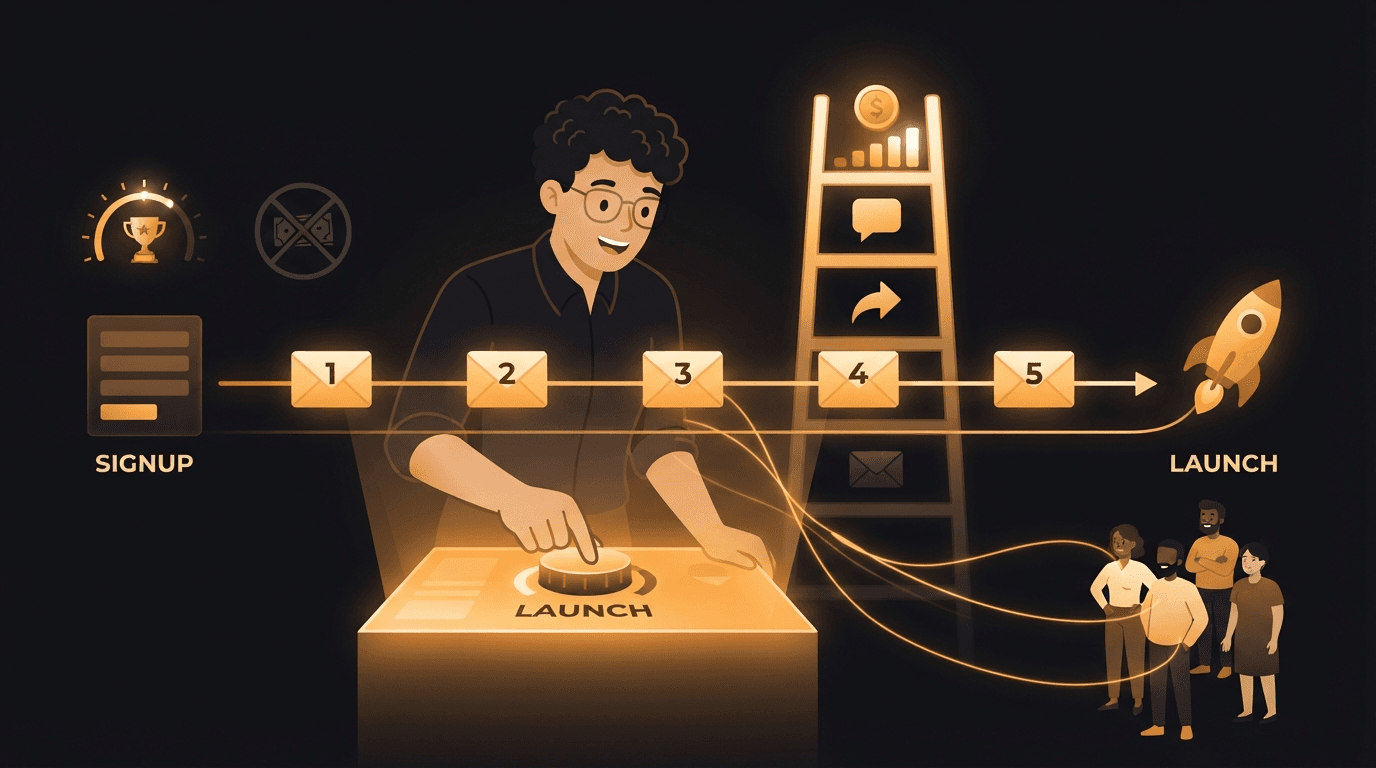
Waitlist marketingis the practice of collecting interested people before a product exists and warming them up until it does. Done properly it's a pre-launch engine with four jobs: proving there's demand, recruiting people to interview, building an audience you own outright, and assembling a crowd for launch day. Done the usual way it's an email field on a landing page, a number that goes up, and a list of strangers who've forgotten you by the time you ship.
Almost every guide on this topic is published by a company that sells waitlist software, which tilts the advice in a predictable direction: more signups, more referral widgets, more of the thing they charge for. This is the version written by someone with no waitlist product to sell. It optimizes for the number that actually matters — how many people open the launch email and act — and it includes the piece every one of those guides leaves out: the five emails you send between signup and launch day, written out so you can copy them.
What does a waitlist actually validate?
A waitlist validates interest in your pitch, not demand for your product. That distinction is the difference between a founder who ships to a warm room and one who spends six months building against a number that meant nothing. Signups are not uniform units of evidence — some cost the person four seconds, some cost them money — so the useful move is to grade them.
Here is the ladder I use, weakest signal at the bottom. Every mechanic in the rest of this playbook exists to move people up it.
They gave you an email address
Your headline worked.
This is a measurement of your landing page, not your product. A signup costs four seconds and nothing else, which is exactly why a big number here feels so good and predicts so little.
They answered one question after signing up
They have the problem, in their own words.
A single open field — “what are you using for this today?” — separates people with a live, expensive problem from people who liked your copy. The answers also become your positioning language.
They referred someone
They'll spend social capital on you.
Sharing an unreleased product with a colleague is a small reputational bet. It's the cheapest strong signal on this ladder, which is why referral mechanics are worth building even at tiny scale.
They replied to a real email from you
They'll give you their time.
Time is the scarcest thing your future users have. A back-and-forth thread with a stranger on a waitlist is worth more than a thousand unopened confirmations.
They paid, pre-paid, or put down a deposit
Willingness to pay — the only thing a waitlist usually can't tell you.
This is the top of the ladder and the rung almost every waitlist skips. If your product will cost money, a founding-member pre-order at a discount converts a demand question into a revenue answer months before launch.
Notice how far a bare signup sits from the top. This is why a 10,000-person waitlist can convert worse than a 300-person one: the big list was optimized for the cheapest possible action, and the small one was optimized for conversation. If you only take one thing from this post, make it the habit of asking every new signup a question — the answers are simultaneously your validation, your positioning copy, and your launch-day contact list.
Why “join the waitlist” is the weakest offer you can make
Because it asks for something and promises nothing. “Join the waitlist” describes a queue — the reader's side of the trade is waiting. The fix is not a better button color; it's naming a specific thing the person receives, and receives soon.
Three offers that consistently outperform the generic one, in ascending order of effort:
- The dated early access.“First 100 people get access in September” beats “get notified at launch” because it contains a number and a month. Both are promises you can keep.
- The founding-member term.A permanent price, a permanent badge, or a lifetime tier for early signups. This is the only kind of scarcity that isn't theater: you're bound by it afterwards, publicly.
- The useful artifact. The thing you built for yourself on the way to the product — a template, a teardown, a dataset, a checklist. It delivers value on day one, which means the relationship starts with you giving rather than asking.
The last one is worth dwelling on, because it changes what the waitlist is. If the signup delivers something immediately, the list becomes an audience rather than a queue, and audiences forgive slipped launch dates in a way queues do not.
One thing to skip: countdown timers on the landing page, fake “37 spots remaining” counters, and any scarcity you can't enforce. Founders reading your page are the most manufactured-urgency-literate audience on the internet, and the same honesty rule applies here as everywhere else in zero-budget marketing: the tactic that requires you to lie is never the one that was working.
Where do the first signups actually come from?
You recruit them one at a time, by hand, from people you can already reach — and then you earn the next tier by helping other founders first. There is no growth loop that starts from zero; a referral mechanic needs referrers, and a launch needs an audience to launch to.
The order that works for a solo founder with no following:
- People you can name.Not a broadcast — individual messages to people you already know have the problem. Paul Graham's Do Things That Don't Scale is the canonical argument for this, and it applies to a waitlist exactly as it applies to users: you can't wait for people to come to you, and the manual version teaches you things the form never will.
- Communities you were already in. Not communities you joined this week to post a link. The free channels that still work for pre-launch — Product Hunt Upcoming, Indie Hackers, and the relevant corners of Reddit — are the same ones that work for getting your first 100 users, and they all reward participation history over launch-day enthusiasm.
- Borrowed audiences. A newsletter swap with a founder at your stage costs nothing and puts you in front of a list that already trusts the sender. This is the fastest legitimate way to add a few hundred qualified signups, and it's covered in depth in the guide to launching with no audience.
- Paid listings, last.Pre-launch directories charge in the region of $50 to $130 for a featured placement, and they can be worth it once the page converts. They are a bad first move and a reasonable fourth one — never buy traffic to a landing page you haven't already watched a real person use.
There's a reason the list is ordered by relationship rather than reach. An email list is the last piece of distribution a founder genuinely owns, and that has become more valuable, not less, as search has turned answer-first. AI platforms sent 1.13 billion referrals to the top 1,000 websites in June 2025, up 357% year over year according to Similarweb data reported by TechCrunch — a real shift, but one that still sits next to 191 billion referrals from Google Search in the same month, and one where the answer increasingly replaces the click. Every channel that routes through an algorithm can be re-weighted next quarter. The addresses on your waitlist can't.
Which referral mechanics are worth building solo?
Two of the five are worth your time; the other three cost more than they return at pre-launch scale. The deciding question is never “does this work?” — they all work at some size — but “does this work before I have a crowd, and can I run it without writing code I'll throw away?”
| Mechanic | What it promises | What it costs you | Verdict |
|---|---|---|---|
| Milestone rewards | Unlock something concrete at 3, 5, or 10 referrals | A counter and a manual fulfillment list | build The best effort-to-payoff ratio. You can run it out of a spreadsheet for the first few hundred people. |
| Founding-member tier | The first N signups get a permanent price or badge | A number you commit to in public | build Zero code. The scarcity is real because you're bound by it, which is the only kind that survives contact with customers. |
| Position jumping | Move up the list for every friend you bring | A ranked list, per-user share links, and a live position display | buy Genuinely effective, but only worth it if your waitlist tool ships it out of the box. Building it yourself is a week you owe the product. |
| Public referral leaderboard | Top referrers displayed by name | Live ranking, moderation, and a fraud story | skip Needs a crowd to look like anything but an empty room. Revisit after a few thousand signups, not before. |
| Cash or gift-card bounty | Get paid per referral | Payouts, fraud policing, and tax questions | skip Attracts people who want the bounty, not the product. It poisons the one number your waitlist was supposed to measure. |
You will see enormous referral numbers attached to the famous examples — the file-storage company, the stock-trading app, the razor brand. Those campaigns were real, but the specific figures get recycled between marketing blogs without a traceable primary source, and they were run by funded teams with paid acquisition underneath them. I'm not repeating the numbers here, and you should discount any playbook that treats them as a baseline you can hit alone.
The five emails between signup and launch day
Five sends, spread across however long your build takes, each with exactly one job. This is the part of waitlist marketing that decides whether launch day works, and it's the part almost every guide skips — including the ones ranking above this post today. Copy the skeletons, replace the braces, delete anything that isn't true for you.
Subject: You're in — one quick question
- You're on the list for {product}. I'm {name}, and I'm building it on my own, so this email is genuinely from me.
- Here's what to expect: roughly {cadence} updates, no marketing filler, and an email the day access opens.
- One question, and it's the only one I'll ask: what are you using for {problem} today, and what's the worst part of it?
- Just hit reply. I read all of them.
Why: The reply request is the whole point. Every response moves someone from rung one to rung four of the ladder above, and gives you the objection list for your launch copy.
Subject: What {product} looks like so far
- A screenshot, a 30-second screen recording, or a single before/after.
- One paragraph on the decision behind it — what you almost built instead, and why you didn't.
- What's next, in one line.
Why: Show the thing. A build-in-public update to a waitlist outperforms the same update on social media, because these people already raised their hand.
Subject: Which of these two should ship first?
- Two real options you're genuinely torn between. Not a survey — two links, one click each.
- A sentence on what you'll do with the answer.
Why: A binary choice gets 10× the responses of an open-ended survey, and it hands you a decision you were going to have to make anyway. Reply to everyone who explains their pick.
Subject: {product} opens {day}
- The date, the time, and exactly what happens when it opens.
- What early access includes, and what it costs (say the number — surprises at the door kill conversion).
- One ask: if this is for you, reply with a “yes” so I know to look out for you on the day.
Why: The pre-commitment email is the one most founders skip. Every “yes” you collect here is a person you can follow up with individually on launch day without it feeling like spam.
Subject: It's live — here's your link
- The link, in the first line, above everything else.
- Two sentences on what to do first once they're in.
- The honest deadline: the founding-member price, the seat count, or the window — whichever one you can actually enforce.
- How to reach you if it breaks.
Why: One send in the morning, one short nudge to non-openers the next day, then stop. A waitlist that gets emailed five times on launch day converts worse and unsubscribes harder than one that gets emailed twice.
The cadence between sends matters less than the fact that there is one. Every two to four weeks is a reasonable default. What kills waitlists is the silent stretch — collect addresses in spring, go heads-down, then announce a launch in autumn to people who have no memory of signing up.
The deliverability floor nobody mentions
A dormant list is a spam-complaint machine. People who've forgotten you don't unsubscribe — they hit the spam button, and that number follows your domain everywhere. Google's email sender guidelines ask senders to keep reported spam rates below 0.30% (and advise aiming under 0.10%), and require bulk senders to authenticate with SPF, DKIM, and DMARC and to support one-click unsubscribe. Set those up on the day you publish the signup form, not the week you launch — and treat the regular update email as the thing that keeps you under the threshold, because a list that hears from you is a list that remembers consenting.
How do you convert a waitlist on launch day?
You sequence it: email the list first, before any public announcement, and give the people who waited a genuine head start. The waitlist is the one audience that is already yours — spending it on the same announcement everyone else gets is the most common way founders waste months of accumulated goodwill.
The order that works:
- Waitlist first, alone, for a few hours.Early access is only a reward if it's early relative to something.
- Then the public surfaces. Directories, communities, and the platform launches — the sequencing for which is laid out in the launch directories guide and the launch-day checklist.
- Then the individual follow-ups.Everyone who replied “yes” to email four, contacted personally, once. This converts better than every other line item combined, and it scales to roughly the number of real conversations you had — which is the whole argument for optimizing conversations over signups.
- One nudge to non-openers the next day. Then stop.
The gap this exposes is the one a waitlist can't close on its own. Your list will open, some will click, and a handful will convert — but a launch also needs people who will write a review, leave a comment on the directory listing, file the bug your onboarding has, and be visibly present on the day. Waitlist signups are prospects. They are not, and were never going to be, a launch crowd.
That's the part Favors.dev handles. It's a founder marketing co-op: you earn points by doing verified marketing favors for other founders — real testing, honest feedback, reviews from people who actually used the thing — and spend them to pull the same help back when it's your turn. The points economy means nobody can spend what they haven't earned, so the founders who show up for your launch on the calendar are people you've already helped. Build the waitlist for demand; build the crowd separately, in advance, by being useful.
Frequently asked questions
Do waitlists actually work for startups?
Yes, but as a pre-launch engine rather than a demand oracle. A waitlist reliably does three things: it gives you an owned audience you can reach without paying a platform, it gives you a set of people to interview before you build the wrong thing, and it gives you a crowd to point at a launch on day one instead of launching to strangers. What it does not reliably do is predict revenue. Signups measure the appeal of your landing page; only a payment, a deposit, or a signed pilot measures willingness to pay.
How many waitlist signups do you need before launching?
There is no honest universal number, and any guide that gives you one is guessing. The useful threshold isn't a signup count at all — it's whether you have enough qualified conversations. If 20 to 30 people on your list have replied to you describing the problem in their own words, you know enough to launch and your launch-day email has real people behind it. A list of 5,000 addresses that has never replied to anything is a worse position than a list of 200 that talks back.
How often should you email a waitlist before launch?
Every two to four weeks, and never fewer than once a month. The failure mode for solo founders is silence: you collect addresses in March, go heads-down, and blast a launch announcement in September to people who have completely forgotten you. That list will bounce, ignore, and mark you as spam — and under Google's bulk sender guidelines a spam-complaint rate above 0.30% starts affecting delivery to every Gmail address you own. Regular, short, honest updates are a deliverability strategy as much as a marketing one.
Should you charge for a spot on your waitlist?
Charging for a place in line is usually a bad idea; charging for the product early is usually a good one. A paid queue position sells nothing of value and reads as a gimmick. A founding-member pre-order — a real discount on the real product, refundable, with a clear ship window — is different: it moves people to the top rung of the evidence ladder and answers the willingness-to-pay question that a free waitlist can't. Only do it if you're confident you'll ship, and make refunds trivially easy.
What's a good waitlist-to-customer conversion rate?
Ignore the benchmark numbers that circulate on this question — the ranges you'll see quoted in waitlist-tool blog posts are self-reported, unsourced, and drawn from wildly different products and list-acquisition methods. The only rate that matters is your own, segmented by where the signup came from. Tag every signup with its source, then compare launch-day conversion by segment. A referral from an existing signup and a click from a paid directory listing will convert differently by an order of magnitude, and that gap is the actual finding.