 Favors.dev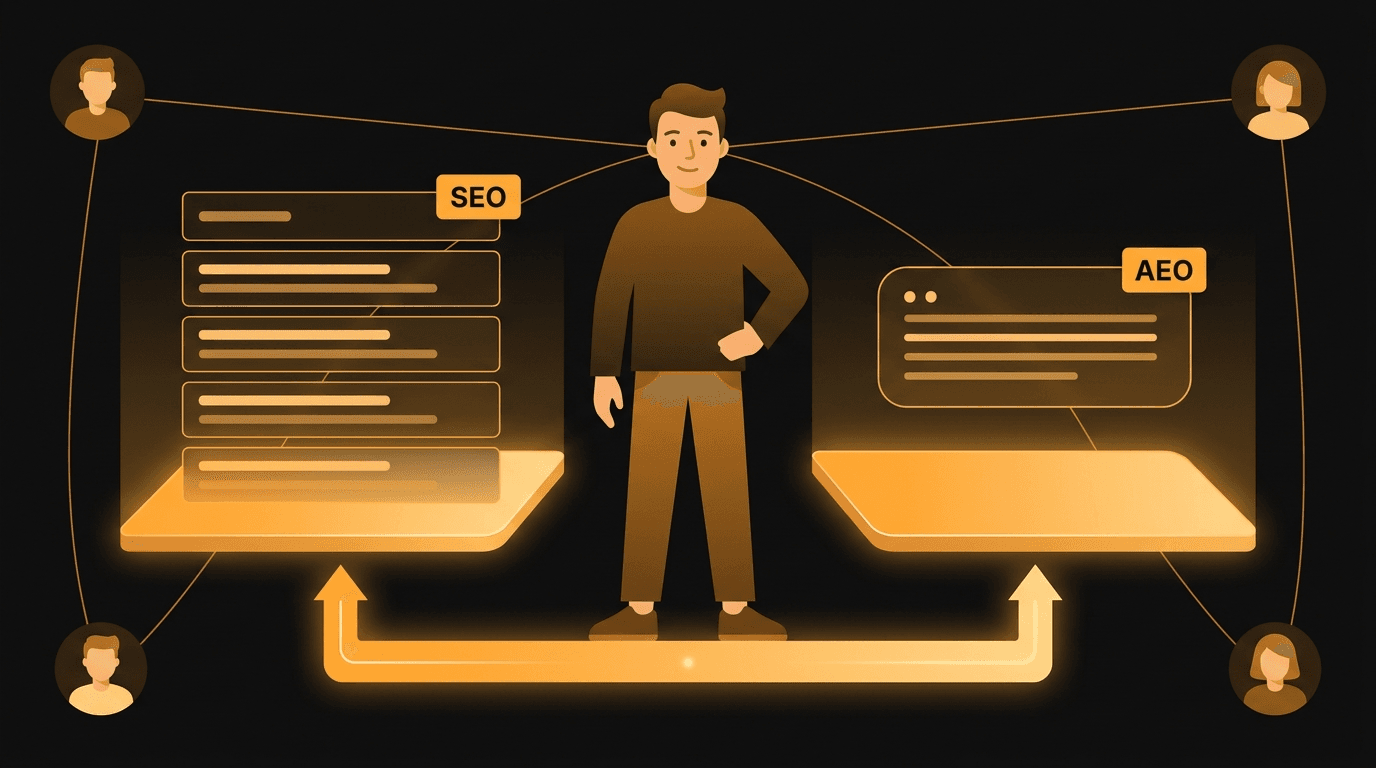
AEO vs SEO is the wrong framing for a rivalry that doesn't exist. They're the same discipline with a different output surface: SEO optimizes for a ranked list of links, answer engine optimization (AEO) optimizes for the synthesized answer that now sits on top of it. Same foundation — useful content, a crawlable site, real authority — a new finish line.
That's not a hot take. In May 2026 Google published official guidance calling optimization for its generative AI features "still SEO"(Google Search Central, via Search Engine Journal). So before you let an "AEO is the new SEO" headline scare you into throwing out your fundamentals, here's the clean comparison — what changes, what doesn't, and where a solo founder should actually spend the next quarter.
AEO vs SEO: the 30-second answer
SEO gets you ranked; AEO gets you cited; they run on the same engine. Search engine optimization is the work of earning a position in a list of results. Answer engine optimization is the work of getting your brand named inside the AI-generated answer — in ChatGPT, Perplexity, or Google's AI Overviews — that increasingly answers the question before the list ever loads.
The reason you can't cleanly separate them is that both are powered by the same ranking and quality systems. An engine can't cite a page it can't crawl, won't quote a source it doesn't trust, and trusts pages roughly the way classic search already does. So AEO isn't a replacement project that makes your SEO obsolete. It's a layer you add on top of work that still matters. The acronyms — AEO, GEO (generative engine optimization), AI SEO — all point at that same layer. Pick whichever you like; the work is identical. (For the founder's full field guide to that layer, see answer engine optimization for startups.)
AEO vs SEO, side by side
Here's the whole comparison in one table. Read it down the middle and a pattern jumps out: almost every row is the same input pointed at a different output. The exceptions — the rows where something genuinely shifts — are the ones worth your attention.
| SEO | AEO | |
|---|---|---|
| The core question | “Where does this page rank?” | “Is this brand named in the answer?” |
| The prize | A click from a ranked link | A citation inside a generated answer |
| Where you appear | The list of ten blue links | The synthesized answer above — or instead of — the links |
| What you optimize | Pages that cover a topic end-to-end and earn authority | Passages that answer one question cleanly, in a quotable shape |
| Signals that decide it | Backlinks, content depth, technical health, on-page relevance | The same — plus the reviews, community discussion, and named-author mentions an engine already trusts |
| How you measure it | Rankings, organic clicks, impressions | Citations, share of voice, branded mentions inside answers |
| Time to payoff | Months — authority compounds slowly | Months — built on the same authority, surfaced faster once you’re a trusted source |
| Where it still wins | Transactional, commercial, and local intent | Informational, research, and verification intent |
Sources: Google Search Central AI-optimization guidance (2026); Seer Interactive AIO CTR study (2025).
Notice the "signals that decide it" row. SEO and AEO draw from the same well of authority signals — backlinks, content quality, technical health. AEO just leans harder on a few off-page ones, because an answer engine, unlike a SERP, has to choose a single source to quote and wants social proof that it picked the right one. Hold that thought; it's where founders win.
Is SEO dead in 2026?
No — SEO grew an answer layer; it didn't die. The "SEO is dead" panic comes from one real data point and a lot of extrapolation. The real data point: in a September 2025 snapshot, Seer Interactive's September 2025 CTR update found that informational queries showing an AI Overview had an organic click-through rate of about 0.61%, versus about 1.62%for queries without one — across roughly 3,100 queries and 42 organizations. That's a genuine drop in clicks on AI-Overview queries.
User behaviour points the same way. Pew Research Center's browsing-data study of 900 U.S. adults found people clicked a traditional result on 8% of visits that showed an AI summary, against 15% without one. A link inside the summary itself got clicked on just 1% of visits. So the click shrinks, and the little that is left goes to the sources the answer names.
But two things keep it from being an obituary. First, it's a moving target: that figure was a low snapshot and has partly rebounded since, so treating 0.61% as a permanent number is a mistake. Second, and more important, Google itself just told everyone the fundamentals still hold. Its guide to optimizing for generative AI features says there is no separate optimization frameworkfor AI search — the same content quality, crawlability, and authority that ranked you still decide whether you're surfaced in an answer. It even named the tactics you can skip: llms.txt files, content chunking, AI-specific rewriting, and special schema aren't needed for its generative features.
So the honest read on "is SEO dead" is: the part of SEO that was thin, keyword-stuffed pages chasing a click is in trouble. The part that was earning genuine authority and writing the clearest answer on a topic has never mattered more — because that's exactly what gets quoted.
What carries over vs what's genuinely new
If you already do real SEO, most of your work transfers untouched. A short, honest inventory of what carries over and what actually changes:
Carries over unchanged
- Useful, original content with a first-hand point of view
- Crawlable, fast, well-structured pages
- Real authority earned through backlinks and reputation
- Clear topic relevance and consistent entity naming
Genuinely new
- The prize moved from the click to the citation
- Answer-first passages beat slow-build long-form for extraction
- Off-page weight tilts toward reviews, community, and named authors
- A new metric to watch: your share of voice inside AI answers
The left column is why "learn AEO from scratch" is mostly a sales pitch. The right column is real, but notice how small and cheap it is: lead with the answer, write question-shaped headings, and watch a new metric. The single change that takes actual work isn't on either list as a tactic — it's the shift in off-page weight. That deserves its own section.
The off-page signals both disciplines share
Here's the part the cookie-cutter "AEO vs SEO" comparisons skip entirely: the hardest-to-fake signals are off-page, and they feed both ranking and citation. An answer engine has to commit to a source, so it leans on the proof that you're trusted by people other than yourself — and those signals differ by engine. ChatGPT leans on community and review sources like Reddit and G2; Perplexity rewards named-author, attributed articles; Google's AI Overviews still track closely with classic organic authority (Similarweb; 5W State of AI Citations 2026).
Look at that list — reviews, community answers, named-author articles, editorial backlinks — and notice what it has in common: none of it is something you can write on your own site. It has to come from other people. That's the same off-page wall that makes classic link-building hard, and it's exactly where a solo founder usually stalls. The engine-by-engine breakdown lives in how to get cited by ChatGPT & Perplexity, but the strategic point is simpler: the signals that win AEO are the same ones that have always won SEO, just weighted differently. Earn them once and you compound on both surfaces.
Where founders should spend the next quarter
Spend it building authority that ranks andgets cited — because, as the comparison makes clear, that's one investment, not two. Concretely, for a solo founder over a quarter:
- Get the on-page layer right once.Answer-first sections, question-shaped headings, clean structure, consistent entity naming. It's an afternoon per important page and it serves both surfaces. Skip the exotic schema and llms.txt rabbit holes Google says you don't need.
- Put your best answer on a page that compounds. A focused directory listing on a domain whose authority keeps climbing is an appreciating asset — it ranks over time and becomes a citable source as the host grows.
- Deliberately earn the off-page signals. Reviews, named-author features, and editorial backlinks are the currency of both ranking and citation. This is the slow part — unless you have a way to trade for them.
That last point is the one founders get stuck on, and it's the specific problem Favors.dev was built to solve. It's a founder marketing co-op with a points economy: you earn points by doing verified favors for other founders — honest reviews, featured articles, testimonials, structured feedback — and spend them to get the same back, and you can't spend what you haven't earned. The high-value featured-article actionearns the editorial backlinks that lift both your organic authority and your odds of being cited by Perplexity and AI Overviews, while review actions feed the community-and-review signals ChatGPT favors. The same reciprocity, in other words, pays off on both sides of the AEO-vs-SEO table. It's the engine behind a no-budget SaaS marketing plan that compounds instead of evaporating.
Frequently asked questions
What is the difference between AEO and SEO?
SEO (search engine optimization) is the work of ranking a page in a list of search results; AEO (answer engine optimization) is the work of getting your brand named inside the AI-generated answer that increasingly sits above — or instead of — that list. They share one foundation: useful content, crawlable pages, and real authority. The difference is the finish line. SEO chases the ranked click; AEO chases the citation. Google's own 2026 guidance treats AEO and GEO as part of SEO, not a separate discipline.
Is SEO dead in 2026?
No. SEO grew an answer layer; it didn't die. In May 2026 Google published official guidance stating that optimizing for its generative AI features is 'still SEO' and that the same fundamentals — original content, a crawlable site, real authority — still apply. Click-through rates on queries that show an AI Overview did drop sharply in a Sept 2025 Seer Interactive snapshot (about 0.61% with an AI Overview vs 1.62% without), but that's a moving target that has partly rebounded since, and it reflects redistribution of attention, not the end of search.
Should I do AEO or SEO first?
Do them as one project, starting from SEO fundamentals. There's no separate AEO toolchain to install first — the same crawlable, authoritative, genuinely-useful page is the prerequisite for both ranking and being cited. Once those basics are in place, the AEO-specific layer is cheap: lead each section with a direct answer, write headings the way people ask questions, and go earn the off-page signals (reviews, community mentions, named-author articles) that decide whether an engine treats you as a source.
Do I need special schema or an llms.txt file for AI search?
No. In its May 2026 guidance Google explicitly said llms.txt, content chunking, AI-specific rewriting, and special schema are not needed for its generative AI features. Standard structured data (Article, Organization, FAQPage) still helps machines parse who wrote a page and what it's about, so it's worth keeping — but treat it as ordinary good practice, not an AI hack. Most 'AEO checklists' selling exotic schema tactics are solving a problem the search engines say doesn't exist.
Ranking or getting cited — which matters more for a small startup?
Both, but a small, specific startup can often get cited faster than it can outrank an incumbent. Answer engines pick sources that are clear, credible, and consistent — not the ones with the biggest domain or ad budget. A focused page with a handful of honest reviews and a few named-author mentions can be the best available answer to a narrow question. That's why founders should build the same authority that ranks while deliberately earning the off-page signals that get them cited.