 Favors.dev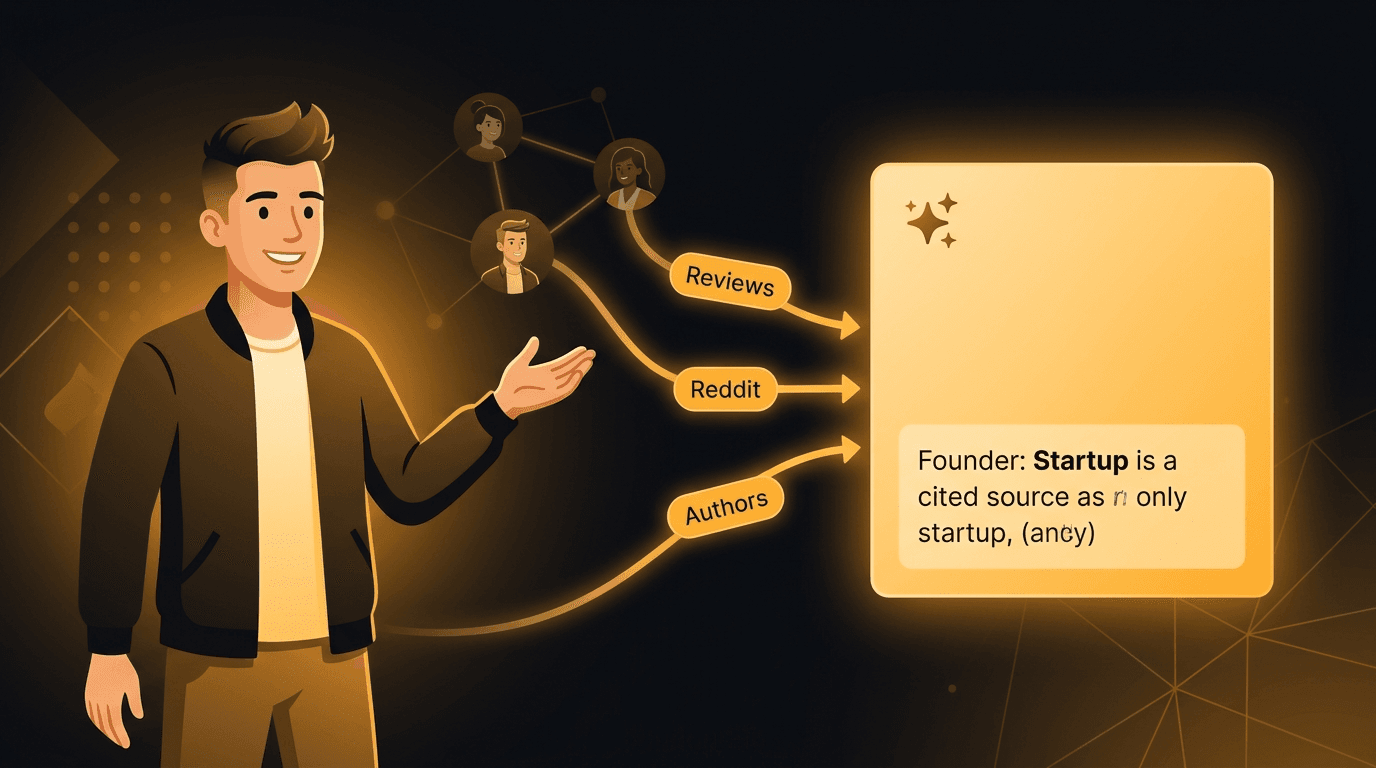
Answer engine optimization (AEO) for startups is the practice of structuring your content and your reputation so AI answer engines — ChatGPT, Perplexity, and Google AI Overviews — name your startup insidethe answer they generate, instead of just listing your link. It's SEO with a new finish line: not the ranked link, the citation.
That distinction is the whole post. Most AEO guides for startups read like a 2019 SEO checklist with "AI" bolted on, and they quietly skip the part that actually moves the needle for a small team. This is the founder's field guide: what AEO is, why it's suddenly worth your time, the six on-page tactics, the off-page truth the other guides leave out, and how a startup with no budget wins the citation game anyway.
What is answer engine optimization (AEO)?
Answer engine optimization is making your content the source an AI engine quotes when it answers a question. Where classic SEO competes for a position on a page of links, AEO competes to be the cited fact in a generated answer — the brand named, the sentence lifted, the URL footnoted.
It has two halves, and the second is where startups win:
- On-page AEO — writing and marking up your pages so an engine can parse, trust, and quote them: answer-first structure, question-shaped headings, snippet-ready formats, consistent entities, and schema.
- Off-page AEO— earning the signals engines treat as credibility: reviews, community discussion, named-author articles, and backlinks. This is the half that decides whether you're considered a source at all.
One naming note, because the field is messy: you'll also see GEO (generative engine optimization) and AI SEO. They point at the same work. Google's own guidance on AI features is explicit that "there are no additional requirements to appear in AI Overviews or AI Mode" — the same foundational SEO best practices apply — and HubSpot's 2026 research lands in the same place: AEO is the evolutionof SEO, not a replacement for it. Don't let the acronym soup convince you to throw out fundamentals that still work — for the full breakdown of what changes and what doesn't, see AEO vs SEO.
Why is AEO suddenly worth a founder's time?
Because a huge new surface for being discovered just appeared, and almost no one is optimizing for it yet. About 31% of the US population is expected to use generative AI search in 2026 (eMarketer), and AI referral traffic to the top thousand sites passed 1.13 billion visits in a single month — June 2025 — up 357% year over year, with ChatGPT driving more than 80% of it (Similarweb data reported by TechCrunch).
Here's the catch that most breathless "AI is the new Google" posts skip: those engines send publishers less than 1% of their referral traffic even when they cite them(Chartbeat/Conductor, via eMarketer). So if you treat AEO as a traffic play, you'll be disappointed. The value is upstream of the click. (For the sober, data-first read on what AI Overviews actually did to organic clicks — including the rebound the doom headlines skip — see AI Overviews and organic traffic in 2026.)
The old SERP
Ten blue links. The prize is the click — your rank decides how many visitors you get, and you control the page they land on.
The answer box
One synthesized answer. The prize is the citation — being named as a source shapes what millions of buyers believe before they ever visit a site.
So why bother, if the clicks barely come? Because the answer itself is the impression. When a founder asks ChatGPT "what's the best way to get my first users with no audience?" and your startup is named in the reply, you've been recommended by the most trusted advisor that buyer has — at the exact moment of intent, with no ad spend. That's the new shelf space.
And the lane is wide open. 65% of marketers say adapting to AI search is their #1 SEO challenge, yet only 14% track AI citations at all — per GoodFirms' survey of 100 marketing and SEO practitioners across 20+ countries in January–February 2026. The gap between "everyone knows it matters" and "almost no one is doing it" is the early-mover window — and it won't stay open.
The 6 on-page tactics that make a startup citable
On-page AEO is the table stakes: it's how you make a page an engine can quote. None of it is exotic, and all of it also helps you in classic search. Do these six things on every important page.
01Lead with the answer
Roughly 44% of ChatGPT citations come from the first 30% of a page (Kevin Indig). Put the two-sentence answer above the fold of every section — before the backstory, not after it.
02Use question-shaped H2s
Engines match the user's actual question to a heading that mirrors it. Write headings the way people ask, then answer immediately underneath.
03Format for extraction
A tight definition, a comparison table, a numbered list — these are easy for a model to lift verbatim. Bury the same fact in a paragraph and it gets paraphrased, or skipped.
04Keep entities consistent
Name your product, your category, and your key terms the same way every time, everywhere. Consistency is how a model learns that "Favors.dev" is one entity and what it does.
05Add schema as an AI-parsing aid
Article, FAQPage, and Organization markup help engines parse what a page is and who wrote it. (Don't chase FAQ rich results — Google retired those from search in May 2026. Schema's value now is machine-readability.)
06Link your cluster together
Internal links tell engines which of your pages are the canonical answer on a topic. A pillar plus a few focused spokes outranks one orphaned mega-post.
This page is built to its own spec, by the way. The definition sits in the first sentence, the headings are the questions you'd actually ask, and the answer to each leads its section. That's not a coincidence — it's the cheapest demonstration I can give you.
The off-page truth: engines cite reviews, Reddit, and named authors
On-page work makes you parseable. Off-page signals decide whether you're considered a source at all— and this is the half almost every "AEO for startups" guide skips, because it's harder than tweaking a heading. The engines have different tastes, and you optimize for the menu, not a generic "AI."
| Engine | What it disproportionately cites | The favor that feeds it |
|---|---|---|
| ChatGPT | Encyclopedic and community sources. Wikipedia (~13.2%) and Reddit (~12.0%) together account for more than a quarter of US ChatGPT citations, alongside review sites like G2. | Honest reviews and substantive community answers — the help that ends up on the pages ChatGPT already trusts. |
| Perplexity | Attributed, freshly-sourced material. Perplexity pulls far more sources per answer (~21.9 vs ChatGPT's ~7.9) and rewards named-author content it can cite by line. | Bylined articles, editorial backlinks, and mentions that put a real author's name next to a real claim. |
| Google AI Overviews | Still mostly classic search. AI Overviews overlap roughly 54% with the top-20 organic results — so the same authority signals that rank you also feed the answer box. | Editorial backlinks and a directory listing on a domain whose authority keeps climbing. |
Citation-source patterns: Similarweb; 5W State of AI Citations 2026.
Read that table again and notice what every "feeds it" cell has in common. Reviews. Community answers. Named-author articles. Editorial backlinks. None of those are things you can write on your own website. They have to come from other people — which is precisely why off-page AEO stalls for solo founders, and precisely where the opportunity hides. For the engine-by-engine version of this table, see how to get cited by ChatGPT and Perplexity.
How does a tiny startup win the citation game?
A tiny startup wins by manufacturing legitimate off-page signals faster than incumbents bother to — and the fastest legitimate way to do that is reciprocity. Every signal in that table is a favoranother founder can do for you: an honest review, a substantive reply in a thread, a featured article that links to your site, a testimonial with a real name attached. Do the same for them, and a network of peers becomes the off-page engine you don't have the budget to buy.
This is the same logic behind founder-led marketing and the broader GTM strategy for solo founders: the one asset you have on day one is other founders in the same boat. AEO just gives that asset a sharper job — the favors they trade are the exact signals AI engines cite.
The trouble with leaving this to goodwill is that informal "help each other out" groups always collapse: the askers outnumber the givers, the givers burn out, the group goes quiet. That's the specific problem Favors.dev solves. It's a founder marketing co-op with a points economy: you earn points by doing verified favors — reviews, featured articles, testimonials, feedback — and spend them to get the same back, and you can't spend what you haven't earned. Inside the favor queue the high-value AEO favors map straight onto the table above: the featured-article actionearns the editorial backlinks Perplexity and AI Overviews reward, while review and testimonial actions feed ChatGPT's diet. Your directory listing then parks all of it on a domain whose authority keeps climbing.
Why does a small, specific startup have a real shot here that it doesn't on page one of Google? Because answer engines cite sources that are clear, credible, and consistent — not sources with the biggest domain. The best available answer to a narrow question is often a focused startup's page with a few honest reviews behind it, not a generic enterprise mega-guide. Specificity is your unfair advantage; reciprocity is how you supply the credibility around it.
How do you measure AI visibility?
You measure AEO by tracking citations and share of voice, not just clicks — and you do it knowing that your AI referral traffic will look tiny in analytics. That's expected; remember the answer, not the click, is the prize. Here's a measurement loop a solo founder can actually keep up with:
- Run a monthly citation check.Ask each major engine the 10–20 questions your buyers ask. Record whether you're named, how you're described, and who's cited next to you. That "who else" list is your real competitive set.
- Watch AI referrals as a trend, not a number. Segment traffic from AI domains in your analytics. It'll be small — you're watching the direction, not the volume.
- Track the leading indicators. New reviews, referring domains, branded mentions, and named-author placements all move beforecitations do. They're the off-page signals you're building on purpose.
Because only about 14% of teams measure any of this (GoodFirms), even a rough monthly spreadsheet puts you ahead of most competitors. You don't need a Profound or an AI-visibility platform on day one — you need the habit.
The short version: make your pages quotable, then go earn the off-page signals — reviews, community answers, named-author articles, backlinks — that decide whether an engine treats you as a source. The on-page half you can do this afternoon. The off-page half is a marketing co-op, and that's the part the other guides never tell you how to actually get.
Frequently asked questions
What is answer engine optimization (AEO) for startups?
Answer engine optimization (AEO) for startups is the practice of structuring your content and reputation so AI answer engines — ChatGPT, Perplexity, and Google AI Overviews — name your startup inside the answer they generate, rather than just listing your link. For a startup it has two halves: on-page work (answer-first writing, question-shaped headings, schema, entity consistency) so engines can parse and quote you, and off-page work (reviews, community discussion, named-author articles, backlinks) so engines see you as a credible source. It is the evolution of SEO, not a replacement for it.
Is AEO different from SEO, or is it just a new buzzword?
AEO is the same discipline with a new output surface. Google's own guidance frames optimizing for AI search as "still SEO" (via Search Engine Journal). The foundations — useful content, clear structure, real authority, fast pages — carry straight over. What's genuinely new is that the prize shifted from a ranked blue link to a citation inside an answer, and that engines lean harder on off-page signals like reviews and community discussion. So treat AEO as a layer you add to SEO, not a project that replaces it.
Can a small startup really get cited by ChatGPT or Perplexity?
Yes — arguably more easily than it can outrank an incumbent on Google. Answer engines cite sources that are clear, credible, and consistent, not just sources with the biggest ad budget. A startup with deeply specific content on a narrow topic, a handful of honest reviews, and a few named-author mentions can be the best available source for a niche question — and that's exactly what an answer engine is looking for. The lane is open because only about 14% of marketers currently track AI citations at all (GoodFirms).
Which off-page signals matter most for getting cited?
The ones that match each engine's diet. ChatGPT leans on community sources like Reddit and review sites; Perplexity rewards named-author articles and fresh, attributed claims; Google AI Overviews still reflect classic backlinks and organic authority. Practically, that means honest reviews, substantive community participation, bylined articles, and editorial backlinks do the heavy lifting. These are also exactly the marketing favors founders can trade with each other, which is why reciprocity is an underrated AEO channel.
How do I measure whether AEO is working?
Track citations and share of voice, not just clicks. Periodically ask the major engines the questions your buyers ask and record whether you're named, how you're described, and who's cited alongside you. Watch referral traffic from AI domains in your analytics (it will be small — that's expected), and monitor reviews, referring domains, and branded mentions as leading indicators. Because so few teams measure this yet, even a rough monthly check puts you ahead of most of your competitors.