 Favors.dev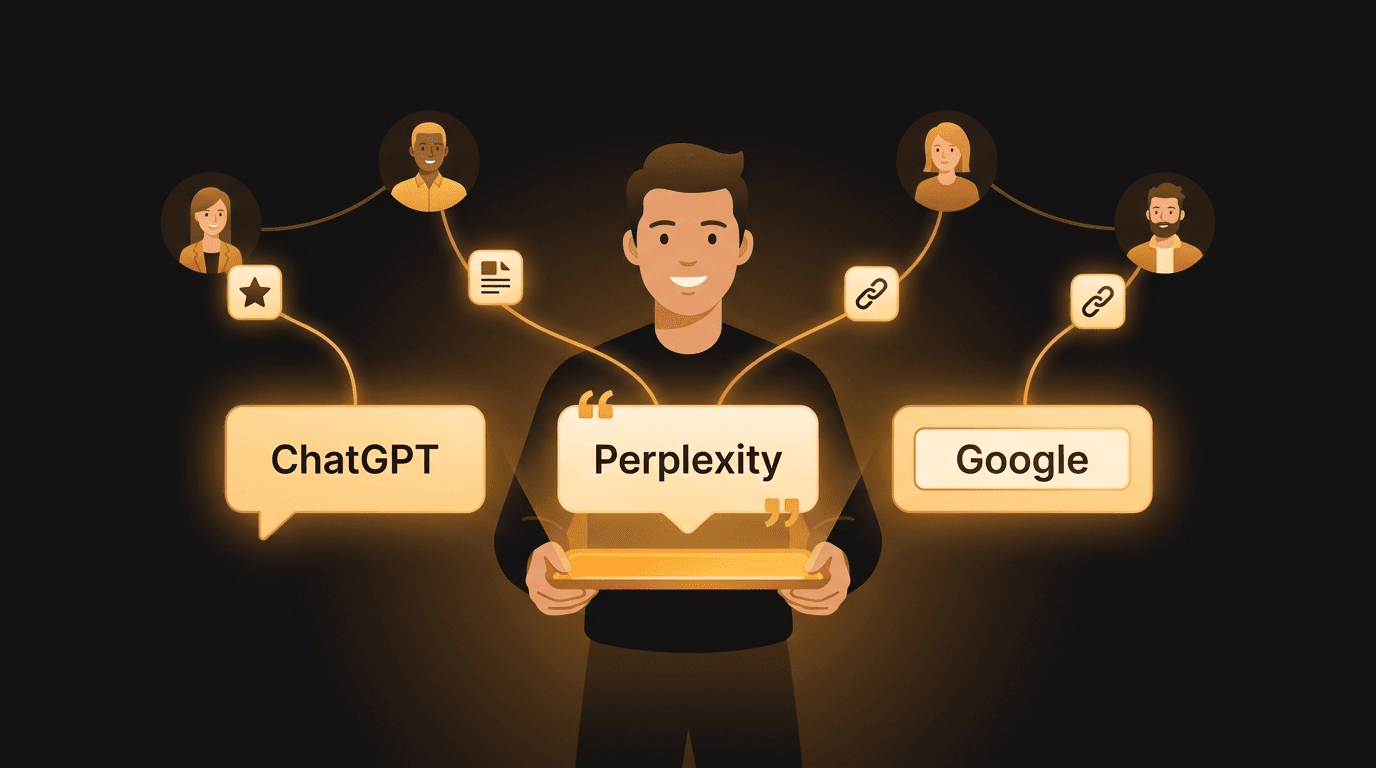
To get cited by ChatGPT and Perplexity, stop optimizing for a generic "AI" and start feeding each engine the kind of source it actually quotes. ChatGPT leans on encyclopedic and community sources (Wikipedia, Reddit, review sites); Perplexity rewards attributed, named-author content it can cite by line and refresh often. Same goal — be the sentence the answer is built from — but a different menu at each restaurant.
Almost every "get cited by AI" guide treats the engines as one blob and stops at on-page tactics: write answer capsules, add schema, done. That's table stakes, and it's the easy half. The half that decides whether you're considered a source at all is off-page — and it's the half a founder with no network has no obvious way to earn. This guide covers both: the per-engine diet, an engine-by-engine checklist, and the one move that lets a tiny startup manufacture legitimate mentions without a PR budget.
Why is getting cited the new ranking?
Because the answer, not the click, is now the prize — and being named inside that answer is the new front-page slot. AI referral traffic to the top thousand sites passed 1.13 billion visits in a single month (June 2025), up 357% year over year, with ChatGPT driving more than 80% of it (Similarweb data, reported by TechCrunch). Yet those engines send publishers less than 1% of their referral traffic even when they cite them (Chartbeat/Conductor, via eMarketer).
Google's own results tell the same story. Pew Research Center tracked 900 U.S. adults through their real browsing and found a link inside an AI summary was clicked on just 1% of visits where one appeared. The citation is what you win. The click is a bonus.
Read those two numbers together and the strategy writes itself. If you chase AEO as a traffic play, you'll be disappointed — the clicks barely come. The value is the citation itself: when a buyer asks an engine a question and your startup is named in the reply, you've been recommended by the most trusted advisor that person has, at the exact moment of intent, with no ad spend. That's why "how do I get cited" replaced "how do I rank" as the question that matters.
If you want the full field guide to this shift, start with the pillar: answer engine optimization for startups. This post zooms into one chapter of it — the engine-by-engine citation tactics.
Why do ChatGPT and Perplexity cite different sources?
Because they're built differently. ChatGPT answers largely from what it already "knows" and reaches for a small set of trusted, encyclopedic and community sources when it does cite. Perplexity runs a live web search on every query, reranks the results, and cites a much larger set of fresh, attributed pages. So the same article can be perfect for one and invisible to the other. Here's the menu at each:
| Engine | What it leans on | Sources / answer | The favor that feeds it |
|---|---|---|---|
| ChatGPT | Encyclopedic and community sources. Wikipedia (~13.2%) and Reddit (~12.0%) together account for more than a quarter of US ChatGPT citations, alongside review sites like G2. | ~7.9 | Honest reviews and substantive community answers that land on the pages ChatGPT already trusts. |
| Perplexity | Attributed, freshly-sourced material. It runs a live web search for every query and rewards named-author content it can cite by line — pulling far more sources per answer. | ~21.9 | Bylined articles, original data, and editorial backlinks that put a real author's name next to a real claim. |
| Google AI Overviews | Still mostly classic search. AI Overviews overlap roughly 54% with the top-20 organic results, so the same authority signals that rank you also feed the answer. | varies | Editorial backlinks and a directory listing on a domain whose authority keeps climbing. |
Citation-source patterns and sources-per-answer: Similarweb; 5W State of AI Citations 2026.
One number deserves a second look. Perplexity cites roughly 21.9 sources per answer versus ChatGPT's ~7.9 (Similarweb). More slots means more chances to be one of the cited — but only if your content is fresh and attributable, which is precisely what Perplexity screens for. The engines aren't competing for the same content; they're rewarding different work.
How do you get cited by ChatGPT?
Get cited by ChatGPT by being clear and self-contained on the page, and credible in the community off it. The strongest predictor anyone has measured is the answer capsule: a tight, 120–150 character statement, placed right after a question-shaped heading, that resolves the query on its own. One analysis of cited blog posts found a clear answer capsule in the large majority of them, and that capsules carrying citations almost never contained links — so keep them quotable and unencumbered.
But on-page polish only gets you parsed. What gets you trustedis the company you keep. Wikipedia and Reddit together account for more than 25% of US ChatGPT citations (Wikipedia ~13.2%, Reddit ~12.0%; 5W State of AI Citations 2026), and review platforms like G2 and Capterra feed its credibility check. You can't edit yourself onto those — you earn your way there with honest reviews and genuinely useful community answers. That's off-page work, and it's where most founders stall.
How do you get cited by Perplexity?
Get cited by Perplexity by being fresh, attributed, and answer-first. Because it searches live and cites the most sources of any major engine, the wins compound — but it filters hard for three things. Freshness: recency matters more on Perplexity than almost anywhere; pages start losing ground once they age past a couple of months, so refresh your important content on a schedule. Attribution: a real author byline next to a real claim is exactly what its reranker rewards — which is why a named author (like the byline on this post) is an AEO tactic, not a formality. Answer-first:if your page doesn't answer the question in roughly the first 100 words, the engine moves on.
On top of that, Perplexity's reranker favors external authority: editorial backlinks, original research that gets referenced, and a healthy review presence for commercial queries. Schema helps it parse you — pages with FAQPage, Product, or ItemList markup get cited measurably more often than identical pages without it. Treat that markup as a machine-readability aid, though, not a rich-results play: Google retired FAQ rich results from search in May 2026.
How do you get cited in Google AI Overviews?
Get cited in Google AI Overviews by winning classic SEO — because that's still mostly what they reward. AI Overviews overlap roughly 54% with the top-20 organic results (Similarweb), so the backlinks, referring domains, and on-page clarity that rank you are the same signals that put you in the answer. Google says so itself: its guide to optimizing for generative AI features tells site owners to prioritize effective SEO over AEO hacks, and lists llms.txt files and content chunking as things they can ignore. There's no separate game here: rank in the top 20 for the query, structure the page for extraction (question H2s, a tight definition, a comparison table), keep it fast and crawlable, and you're in contention.
The one durable lever a startup can pull is host authority. A link on a domain whose authority keeps climbing inherits that trust over time — which is the quiet case for parking a listing on a growing directory rather than only on your own young domain.
The per-engine citability checklist
Here's the whole thing on one screen. Each engine gets its own column because the work genuinely differs — print this, and run the column that matches where your buyers are asking.
ChatGPT
Win the encyclopedic + community lane.
- Open each section with a 120–150 character answer capsule — a clean, self-contained statement an engine can lift verbatim.
- Earn honest reviews on G2, Capterra, or Trustpilot — review platforms feed ChatGPT's credibility check.
- Get substantive, genuinely useful answers onto Reddit threads in your niche (no link drops).
- Keep your product, category, and key terms named the same way everywhere so it learns you're one entity.
- Add original data or a named framework — owned insight is the second-strongest citation predictor.
Perplexity
Win the attributed, fresh-source lane.
- Publish bylined articles — a real author name next to the claim is what Perplexity rewards.
- Refresh content regularly; recency hits harder here than almost anywhere, and stale pages slip fast.
- Lead with the answer in the first ~100 words, or the engine moves to the next result.
- Add FAQPage, Product, or ItemList schema as a machine-parsing aid (not for rich results).
- Earn editorial backlinks and citations from credible publications — its reranker favors external authority.
Google AI Overviews
Win it the way you'd win classic SEO.
- Rank in the top 20 organic results — AI Overviews overlap ~54% with them.
- Build editorial backlinks and referring domains; classic authority still drives this surface.
- Use clear, extractable structure: question H2s, tight definitions, comparison tables, lists.
- Park your link on a high-authority host (like a growing directory) so it inherits domain trust.
- Keep pages fast and crawlable — the SEO fundamentals carry straight over.
Notice how much of every column lives off your own website. Reviews. Reddit answers. Named-author articles. Editorial backlinks. You can do the on-page items this afternoon — the off-page ones are the real work, and they can't be written by you about you.
How does a founder with no network earn mentions?
A founder with no network earns mentions by trading favors with other founders — because every off-page signal those engines eat is a favor another founder can do for you. An honest review. A substantive reply in a thread. A featured article with your byline and a link. A testimonial with a real name attached. Do the same for them, and a network of peers becomes the off-page engine you don't have the budget to buy.
This is the same logic behind founder-led marketing and behind doing SaaS marketing on no budget: the one asset you have on day one is other founders in the same boat. Getting cited just gives that asset a sharper job — the favors they trade are the exact signals AI engines quote.
The trouble with leaving this to goodwill is that informal "help each other out" groups always collapse: the askers outnumber the givers, the givers burn out, the room goes quiet. That's the specific problem Favors.dev solves. It's a founder marketing co-op with a points economy: you earn points by doing verified favors and spend them to get the same back, and you can't spend what you haven't earned. Inside the favor queue the high-value citation favors map straight onto the diet table above — the featured-article actionearns the named-author backlinks Perplexity and AI Overviews reward, while review and testimonial actions feed ChatGPT's community-and-reviews diet. That's how a startup with no network becomes citable: not by waiting to be discovered, but by manufacturing legitimate mentions one favor at a time.
Frequently asked questions
How do you get cited by ChatGPT?
You get cited by ChatGPT by matching its source diet on two fronts. On-page: open each section with a short, self-contained answer capsule (roughly 120–150 characters) the model can lift verbatim, use question-shaped headings, keep your entity names consistent, and add original data or a named framework. Off-page: earn the signals ChatGPT leans on, which are heavily encyclopedic and community-based — honest reviews on sites like G2 and Capterra, and substantive answers in relevant Reddit threads. Wikipedia and Reddit alone account for more than a quarter of US ChatGPT citations (5W State of AI Citations 2026), so community credibility matters as much as your own page.
How is getting cited by Perplexity different from ChatGPT?
Perplexity runs a live web search for every query and cites far more sources per answer (~21.9 vs ChatGPT's ~7.9, per Similarweb), and it rewards a different diet: attributed, named-author content and fresh, credibly-sourced material. Practically, that means a real byline next to your claim, regular content refreshes (recency matters more on Perplexity than almost anywhere), original data, and editorial backlinks from credible publications its reranker trusts. ChatGPT leans encyclopedic and community; Perplexity leans editorial and attributed. Optimize for the menu, not a generic 'AI.'
Do I need schema markup to get cited by AI engines?
Schema helps, but as a machine-parsing aid, not a rich-results play. Article, FAQPage, and ItemList markup make it easier for engines to understand what your page is, who wrote it, and which parts are the answer — and analyses have found schema-enabled pages cited noticeably more often than identical pages without it. Just don't expect FAQ rich results in Google's search pages: those were retired in May 2026. Treat schema as a way to make your content more machine-readable for AI answers, which is where its value lives now.
Can a small startup with no audience really get cited?
Yes — arguably more easily than it can outrank an incumbent on Google. Answer engines cite sources that are clear, credible, and consistent, not the ones with the biggest ad budget. A focused startup with deeply specific content, a few honest reviews, and a handful of named-author mentions can be the best available source for a narrow question. The lane is wide open: only about 14% of marketers track AI citations at all (GoodFirms, early 2026). The hard part isn't the on-page work — it's earning the off-page mentions, which is exactly where trading favors with other founders comes in.
How do I check whether I'm being cited?
Run a monthly citation check: ask each major engine the 10–20 questions your buyers actually ask, and record whether you're named, how you're described, and who's cited alongside you. That 'who else' list is your real competitive set. Then track the leading indicators that move before citations do — new reviews, referring domains, named-author placements, and branded mentions. Because so few teams measure any of this, even a rough monthly spreadsheet puts you ahead of most competitors.