 Favors.dev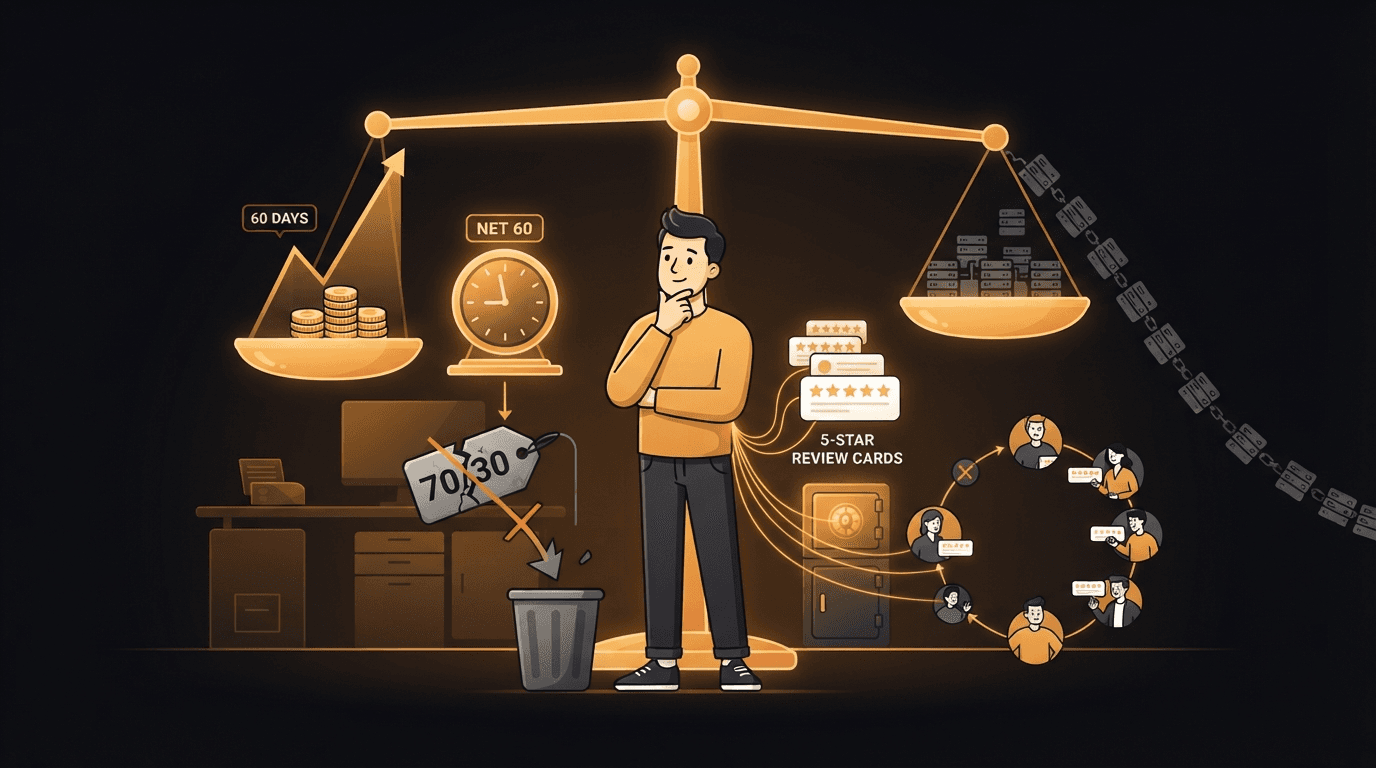
A lifetime deal is worth it when you need cash and early users more than you need the future subscription revenue you're selling— and when your marginal cost per user is close to zero. It's a bad trade when your costs scale with usage, when you're already growing on subscriptions, or when a thousand new users in a fortnight would bury one person in support tickets.
That's the whole verdict. The rest of this post is the part nobody shows you: what the split actually is (it's not what everyone repeats), when the money reaches your bank account (later than you think), and a line-by-line model of a hypothetical $59 deal so you can see how a $59,000 headline becomes a much smaller number with a multi-year tail attached.
How do lifetime deal marketplaces actually work?
A lifetime deal marketplace sells your software once, at a deep discount, in exchange for a cut of the revenue and a burst of distribution. You don't pay to list. The marketplace fronts the audience, the email sends, the ad spend, the deal page, and the customer support; you supply the product, the codes, and the redemption flow. AppSumo, the largest of them, runs campaigns on a 60-day window and states it has an audience of roughly 1.5 million entrepreneurs.
Mechanically the trade is simple: you convert future recurring revenue into present-day cash, and you convert the marketplace's audience into your user base. Both sides of that sentence have a cost. The revenue you sell is your best revenue — the compounding kind. The users you gain are the ones who explicitly chose never to pay you again.
One thing worth calibrating before you fantasize about the campaign page: acceptance is not automatic. AppSumo's own seller page puts its acceptance rate at around 10%, and the revenue ranges it advertises per 60-day campaign carry a footnote most founders skim past — the figures are based on the top 50% of partners within each category. That's a survivorship filter printed in the marketing itself. Read the ranges as "what a good campaign looks like," never as an expectation.
Does AppSumo really take 70%?
Nobody outside a signed agreement knows.Search this question and you'll find a dozen founder blogs stating "you keep 30%" as settled fact. It isn't a published term. AppSumo's Partner Terms defer the revenue percentage entirely to each partner's individual Promotion Agreement — the terms say AppSumo pays the Revenue Share "under each applicable Promotion Agreement" and never name a number. AppSumo's own explainer is equally explicit that the rate depends on campaign duration, price point, product vertical, whether it's a new or repeat campaign, and market demand.
This matters more than a pedantic correction. If the split is set per-deal, then the split is negotiable— and every founder who walks in believing 70/30 is a law of physics negotiates like it is. The 30-vs-40 gap in the model below is worth $5,000 on a single modest campaign, which is more than most founders earn from three months of the content marketing they'd rather be doing.
When does the money actually reach you?
Two to three months after the sale — by design. AppSumo's Partner Payments Policy sets payouts on a Net 60 end-of-month basis: payment is initiated during the first week of each month that occurs two full months following the sales. The reason is the refund window. Unless a listing states otherwise, the refund window for products is 60 days, and the policy is blunt that revenue shares "will not include any amounts refunded by AppSumo to customers" and that refunds "may reduce current or future payments."
The timing trap
Your campaign dashboard shows a big number on day one. Your bank account shows nothing for roughly two months, then shows a refund-adjusted fraction of it. Founders who plan a hire, a contractor, or a runway extension off the dashboard number end up bridging a gap they didn't know existed. Model the cash on the date it clears, not the date it's earned.
The same clause has a quieter consequence: your support burden starts on day one and your revenue starts in month three. For sixty days you are running a free product for a thousand strangers. Staff that period — even if "staffing" means clearing your calendar.
What does a $59 lifetime deal really net you?
Here's the model nobody publishes. Every figure below is a labeled assumption for a hypothetical campaign, not a benchmark— I'm not going to invent a "typical" refund rate or quote a split that isn't published. The point isn't the numbers; it's the shape they make. Scenario A assumes you keep 30% of net revenue. Scenario B assumes you negotiated 40%.
| Line item | A · 30% share | B · 40% share |
|---|---|---|
| Gross sales1,000 codes at $59 — the number you'd screenshot for X. | $59,000 | $59,000 |
| Less platform member discountsAssumed 5% blended. Marketplaces discount for their own members — confirm the exact mechanics in your agreement. | −$2,950 | −$2,950 |
| Less refundsAssumed 10%. The standard refund window is 60 days, and refunded sales are excluded from your revenue share. | −$5,605 | −$5,605 |
| Net revenue collectedWhat the platform actually banks on your product. | $50,445 | $50,445 |
| Your revenue shareScenario A assumes you keep 30%. Scenario B assumes you negotiated 40%. The real number is set in your Promotion Agreement. | $15,134 | $20,178 |
| Less year-one carry costAssumed $4 per retained user per year in infrastructure plus support, across 900 users who didn't refund. | −$3,600 | −$3,600 |
| Net after year oneStill healthy. This is the number founders remember. | $11,534 | $16,578 |
| Net after year threeSame users, same costs, no new revenue from them. This is the number founders forget. | $4,334 | $9,378 |
| Year the payout is fully consumedAt a flat $3,600/year carry, with zero support-cost growth. Support costs rarely stay flat. | Year 4.2 | Year 5.6 |
Read the last three rows together and the real trade appears. The campaign that "did $59,000" put somewhere between $15k and $20k in your account, two months late — and then quietly spends it back over four to six years keeping a thousand non-paying users online. That's not an argument against lifetime deals. It's an argument for knowing which number you're actually being paid.
What a lifetime deal genuinely buys you
The honest case for running one is strong, and it isn't mainly about the money.
Non-dilutive cash on a known date.No investor, no equity, no board seat. For a bootstrapped founder, a five-figure payment that arrives without a term sheet is genuinely rare, and it's the reason most LTD campaigns happen at all.
A year of user research compressed into a fortnight. Deal buyers are unusually engaged and unusually blunt. They will find your onboarding dead ends in 48 hours. If you're pre-product-market fit, that concentration of real usage is worth more than the payout — though you can get a cleaner version of it, on demand and without selling anything, by collecting structured pre-launch feedback first.
A wall of reviews and social proof.This is the asset with the longest half-life. A campaign can move you from three reviews to three hundred, and review volume is now doing double duty: it's classic social proof, and it's a citation source for answer engines. Similarweb's analysis of the most-cited domains in LLM answers found Wikipedia at 13.15% and Reddit at 11.97% of US ChatGPT citations, with community and opinion platforms collectively around 9% — the engines are reading what real users say about you, not what your homepage says about you.
Distribution you can't buy at your stage.An established marketplace has an email list your ad budget cannot rent. That's the same reason a well-sequenced run through startup launch directories works: someone else already assembled the audience, and you're borrowing it for a week.
What it costs you afterward
Every cost of a lifetime deal is deferred, which is exactly why founders underweight them.
Permanent marginal cost.A lifetime user with a usage-based backend is a subscription you pay on their behalf, forever. If your product transcodes video, calls a paid API per action, or stores files indefinitely, run the three-year number before anything else. For a genuinely zero-marginal-cost product the math is survivable; for a usage-heavy one it's a slow bleed with a fixed start date.
Support that never expires.One founder, a thousand new users, and a support queue that doesn't care that the revenue stopped in month three. This is the cost that actually kills solo LTD campaigns — not the economics, the hours.
A permanent price anchor.Your $59 tier is now searchable forever. Every future prospect who finds it will read your $29/month plan against it. You can grandfather, cap, and bound your way around this, but you can't delete it.
A roadmap constituency that will never pay again. Lifetime buyers are loud, organized, and often the most vocal group in your feedback channels. Build for them and you build for people whose revenue contribution is already banked.
The refund window cuts both ways
Because the standard window is 60 days and refunds are deducted from sales totals, a campaign that looks like a hit in week two can settle materially lower. Partners are also responsible for revoking refunded codes and cutting off access — a small operational task that becomes real work at volume. Build the revocation path before you launch, not after the first chargeback report.
Who should run one — and who absolutely shouldn't
Skip the pros-and-cons list and answer the actual question. If three or more items in the left column are true of you, a lifetime deal is a defensible move. If even one item in the right column is true, the trade is probably against you.
Run one if
- You need non-dilutive cash inside 90 days and you know exactly what you'll build with it.
- Your marginal cost per user is genuinely near zero — no per-seat API bills, no video transcoding, no storage that grows forever.
- You're pre-product-market-fit and starved of the thing money can't buy: hundreds of opinionated users hammering your product in the same week.
- You have almost no reviews, and the review count is the thing blocking your next tier of buyers.
- You can cap the codes, bound the tiers, and say no to the upsell when it's over.
Don't if
- Your unit economics are usage-based. Every lifetime user is a permanent line item on someone else's invoice — yours.
- You're already growing on subscriptions. You'd be selling your best future revenue at a 90% discount to fund a quarter.
- You're selling to enterprise. Your future buyers will find the $59 tier and anchor to it forever.
- You're a solo founder with no support capacity. A thousand new users in two weeks is a support event, not a marketing event.
- You need the cash this month. Marketplace payouts are deliberately delayed past the refund window.
The pattern underneath both columns: a lifetime deal is a good idea when what you're short of is capital, and a bad idea when what you're short of is proof. Proof is cheaper to earn than to buy with margin — which is the whole argument for the reciprocal channels in the launch platform roundup and for banking your first honest reviews before a deal crowd ever arrives.
The other side of the table: should you buy a lifetime deal?
Everything above is written from the seller's chair. Plenty of founders arrive at this question from the other one, wallet open, looking at a specific deal and wondering whether it is a bargain or a way to lose $69. The useful thing is that both seats are looking at the same economics, so the seller-side maths above is the best buyer-side checklist there is.
You are not buying software. You are buying a bet on the company surviving. "Lifetime" means the lifetime of the product, not yours. The deal is worth what you get before the company shuts down, pivots, or quietly stops shipping. That reframes the question from "is this tool good" to "will this business still be here in three years", which is a very different thing to research and a much better predictor of regret.
Read what the seller just did to their own runway.The P&L above shows how little of the headline price reaches the founder after platform share, refunds and payment timing. A company running an LTD has taken cash up front in exchange for serving those accounts indefinitely at no further revenue. That is survivable for a business with other income and dangerous for one without. Sellers with a functioning subscription business use LTDs for distribution; sellers without one are sometimes using it for oxygen. You can often tell which from whether the product had paying customers before the deal.
Find the boundary of the word "lifetime". The section above tells sellers to bound what lifetime includes, and good ones do. Before buying, find that boundary and read it literally: which tier is frozen, what usage limits apply, whether future modules are included or sold separately, and what happens on acquisition. Vague terms are not generosity. They are an unresolved argument you will be having later, from the weaker position.
Check the refund window and treat it as the real trial. The credible deals come with a defined return period, and the only sensible use of it is to genuinely deploy the tool inside that window rather than filing it away for a project that starts next quarter. The most common way to lose money on a lifetime deal is not a bad product. It is buying something you never got round to implementing.
Discount the reviews you are reading. Deal-day reviews are written in the first flush by people who just spent money and want to have chosen well, and buyers are frequently offered perks in exchange for leaving one. Reviews written a year later, by people with nothing left to gain, are worth ten of them. Where an incentive exists it is supposed to be disclosed, which is the premise behind the FTC's endorsement guidance, and its absence on a wall of five-star reviews posted within a week of each other is information in itself.
The honest summary for a buyer: a lifetime deal is good value for a tool you would otherwise pay for monthly, from a company with revenue that does not depend on the deal, at a price you can afford to write off entirely. Anything else is a lottery ticket with a login.
How to run an LTD without wrecking your pricing
If you've decided the trade is worth it, five decisions do most of the damage control.
1. Cap the codes and mean it.A hard ceiling turns an open-ended liability into a bounded one. It also gives you a credible scarcity story you didn't have to manufacture.
2. Bound what "lifetime" includes. Define it as the current feature set at stated usage limits, on the current infrastructure. Future modules, future add-ons, and future usage-priced features sit outside the tier. Write this on the deal page in plain language — the ambiguity is what generates years of arguments.
3. Negotiate the split before anything else.Since the percentage lives in your Promotion Agreement rather than in public terms, it's a conversation, not a form field. Ask what drives it and what would move it.
4. Have the subscription offer live before the campaign ends.The point of the cash is to outrun the debt. Deal buyers who love the product are your warmest possible audience for a paid upgrade — but only while the campaign is still fresh in their inbox. If you're still figuring out how to close your first paying customers, do that work before the campaign, not after.
5. Arrive with reviews already banked. This is the one founders always do backwards. A deal page with a handful of existing reviews converts better and sets the tone for the hundreds that follow; a deal page with zero reviews hands the narrative to whoever posts first. On the Favors.dev queue you can earn honest reviews from founders who actually use the product — you help other founders first, then spend what you earned to get reviewed back, and the whole exchange is verified before any points move. Your project's directory page collects them in one place that keeps ranking long after a 60-day campaign ends.
None of that replaces a lifetime deal. It changes what the lifetime deal has to accomplish — which is the difference between a campaign that buys you a year and one that buys you a support obligation.
Frequently asked questions
Are lifetime deals worth it for SaaS founders?
Sometimes — a lifetime deal is worth it when you need non-dilutive cash and early users more than you need the future subscription revenue you're giving up, and when your marginal cost per user is close to zero. It's a bad trade when your costs scale with usage, when you're already growing on subscriptions, or when a thousand new users in two weeks would bury you in support. Treat it as selling a slice of future revenue at a steep discount to buy runway, feedback, and reviews today.
How much does AppSumo take from partners?
AppSumo does not publish a fixed split. Its Partner Terms defer the revenue percentage to each partner's individual Promotion Agreement, and AppSumo's own explainer says the rate depends on campaign duration, price point, product vertical, whether it's a new or repeat campaign, and market demand. The widely-repeated '70/30' figure is folklore rather than a published term — which also means the number is negotiable, so get yours in writing before you commit.
When does AppSumo pay partners?
On a Net 60 end-of-month basis. AppSumo's Partner Payments Policy states it initiates payment during the first week of each month that occurs two full months following the sales, because the standard refund window is 60 days and refunded sales are excluded from your revenue share. In practice, money earned in week one of a campaign lands in your account roughly two to three months later — plan your runway around that, not around the launch-day dashboard.
Can a lifetime deal ruin your SaaS pricing?
It can, in two ways. First, it anchors your product's perceived value at the deal price, and that price is permanently searchable. Second, it fills your roadmap with users who will never pay again but will vote loudly on what you build next. The founders who survive it cap the number of codes, bound what the lifetime tier includes (usage limits, no future add-ons), and have the subscription offer live and priced before the campaign ends.
What's the best alternative to running a lifetime deal?
If what you actually need is early users, feedback, reviews, and social proof — rather than a cash injection — you can earn those without selling your future revenue. Directory launches, community launches, and trading marketing favors with other founders produce the same proof at the cost of effort instead of margin. Run the lifetime deal when you specifically need the cash; use the cheaper channels when you need the proof.
Should you buy a lifetime deal?
Only if you would otherwise pay for the tool monthly, the company has revenue that does not depend on the deal, and you can afford to write the money off entirely. The key reframe is that you are not buying software, you are buying a bet on the company surviving: 'lifetime' means the lifetime of the product, not yours, so the deal is worth whatever you get before the business shuts down, pivots or quietly stops shipping. Read the boundary of the word literally before paying, since which tier is frozen, what usage limits apply, whether future modules are included, and what happens on acquisition are the terms you will be arguing about later from the weaker position. Then use the refund window as a real trial by deploying the tool inside it, because the most common way to lose money on a lifetime deal is not a bad product, it is buying something you never got round to implementing.
Are lifetime deal reviews trustworthy?
Treat deal-day reviews with heavy scepticism. They are written in the first flush by people who just spent money and want to have chosen well, and buyers are frequently offered perks in exchange for leaving one. Reviews written a year later, by people with nothing left to gain, are worth ten of them, so sort for the oldest rather than the highest. Where an incentive was given it is supposed to be disclosed under the FTC's endorsement guidance, and a wall of five-star reviews posted within a few days of each other with no disclosure anywhere is itself information. The most useful review question is not whether the tool is good but whether the reviewer is still using it.