 Favors.dev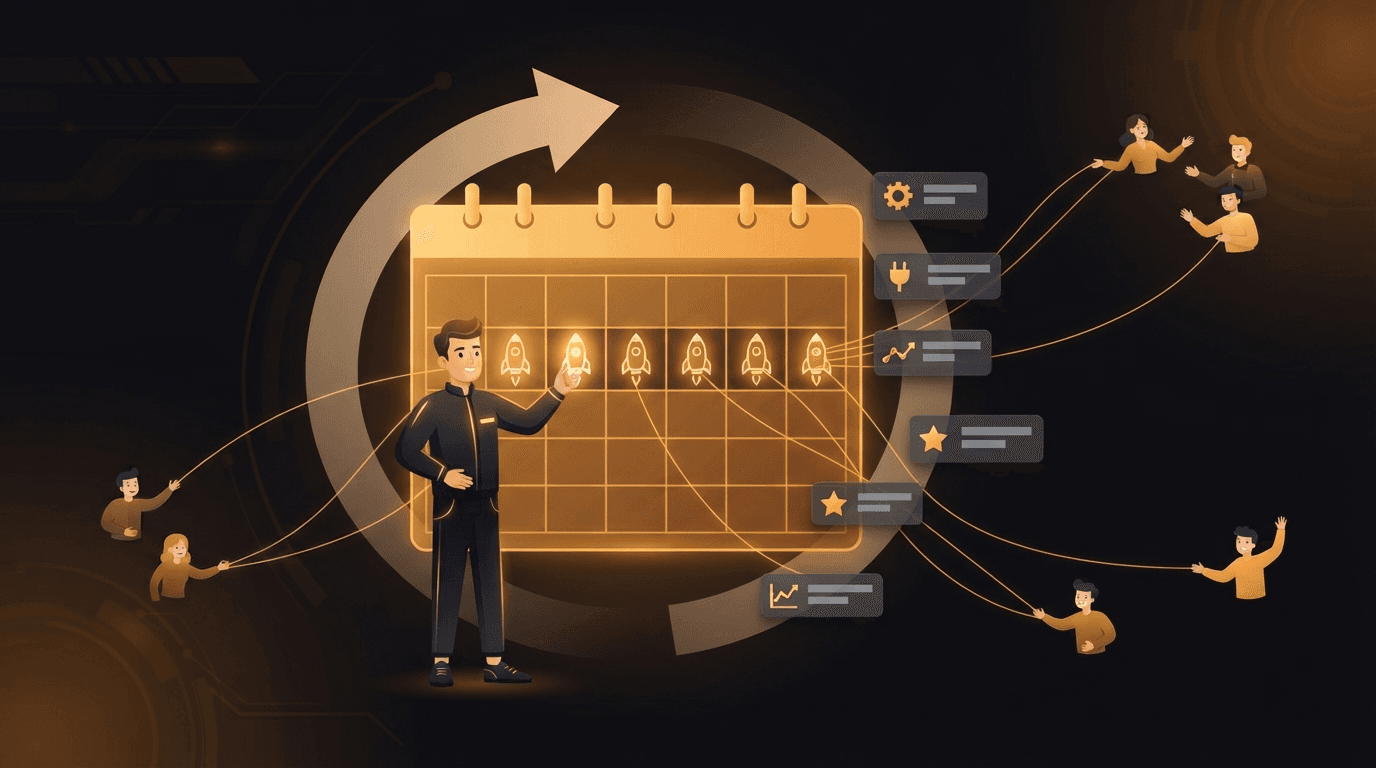
You should launch something every four to six weeks, and the reason you don't is that you think a launch has to be big. One launch day a year is a strange way to run distribution for a product you work on every week. You ship continuously and you announce discontinuously, so the announcement has to carry twelve months of work in a single afternoon — and if that afternoon goes badly, you wait another twelve months. Nobody would design that on purpose. We inherited it from companies that had a press cycle and a launch budget, then kept the ritual after dropping the budget.
The alternative isn't launching harder. It's launching smaller and more often, on a cadence you can hold with one pair of hands, rotating which room you walk into so no room hears from you twice in a quarter. This post is the system I run: what counts as a launchable moment, how to scope one to fit six weeks, the rotation that keeps it from being spam, and a thirteen-week calendar you can copy.
How often should you launch?
Every four to six weeks, with a substance gate on each slot. That window is not arbitrary. It is short enough that no single launch has to be decisive, and long enough that something real can be built between them — which is the whole test, because a cadence with nothing new in it is just a posting schedule.
The clearest public example of a cadence run deliberately is Supabase. In their own writeup of how they launch, they describe running Launch Week three times a year on a three-month cycle, shipping one major feature or announcement every day of that week — and, the part founders miss, they say plainly that they rarely hold features back for it. Features ship when they're ready. Launch Week is the amplification layer, an arbitrary deadline they set for themselves because a deadline organizes everything else. They credit that rhythm with 47% month-on-month database growth over eighteen months.
A solo founder cannot ship five announcements in five days, three times a year. But the mechanism worth stealing was never the volume. It is this: the calendar comes first, and the work fills it. A date you committed to publicly generates scope discipline that no amount of intending to ship ever produces.
What does single-launch thinking cost you?
It costs you most of what you build, because everything that isn't the one big thing gets shipped silently. That's the tax, and it's paid in four ways.
You under-use finished work.The integration you spent a week on, the API you exposed for yourself, the free tool you built to test something — each of those is a first impression for someone who has never heard of you, and each went out as a changelog line because it didn't feel like a launch. It doesn't have to feel like one. It has to be new to a stranger.
You put a year of variance on one day. Launch outcomes carry enormous randomness: what else posted that morning, whether someone with reach happened to be awake, whether the feed liked your thumbnail. One launch a year means your distribution is a single sample from a very noisy distribution. Eight means you get the average, and the average is knowable.
You let the crowd go cold. The people who show up for a launch are the people you have been useful to recently. Twelve months of silence between asks means starting from nothing every time, and rebuilding a crowd costs far more than maintaining one.
You stay invisible in the layer that's replacing the click. AI referral traffic to top websites reached 1.13 billion visits in June 2025, up 357% year over year on Similarweb data reported by TechCrunch, with ChatGPT accounting for more than 80% of it — and yet AI still sends under 1% of publisher referral traffic even when it cites the source. The click is shrinking; the mention is the asset. Mentions accumulate from being written about repeatedly, in different places, over time. One annual launch produces a single cluster of coverage. A quarterly cadence produces four.
What counts as a launchable moment?
A launchable moment is any change a stranger could try. That is the whole definition, and it is deliberately broader than “major feature” and much narrower than “anything we shipped.” Run your backlog and your last three months of commits through this inventory once and you will usually find two or three moments you already built and never announced.
| Where moments come from | What it looks like | It qualifies when… |
|---|---|---|
| A feature | The thing users kept asking for. The setting that removes the reason people churned. | A stranger can try it without reading a changelog first — and it changes what the product does, not how it looks. |
| An integration | You now connect to a tool that already has its own audience and its own directory of add-ons. | That tool's users become plausible customers of yours. An integration nobody was blocked on is a changelog line. |
| A new surface | A mobile app, a CLI, a public API, a browser extension, a self-hosted build. | Almost always. A new surface is a new first impression for people who bounced off the old one. |
| A free artifact | A calculator, a template, a public dataset, a benchmark, a teardown built from what you already know. | It stands alone without your product. If it only makes sense to existing users, it is documentation. |
| A milestone with a thing attached | Open-sourcing the core, shipping a genuinely usable free tier, publishing the roadmap. | There is something new to try. A number with no door behind it is news, not a launch. |
| A repositioning | Same code, different buyer, different promise. The pricing page changes who it is addressed to. | Someone who correctly walked away from v1 would now reach a different conclusion. |
The right-hand column does the real work. Without it, this is a license to announce everything — the failure mode people correctly associate with “always be launching.” The gate is not effort, and it is not novelty to you. It is whether a person who has never used your product could do something today they couldn't do last month. A redesign fails that test. A public API passes it easily. Whether a change is big enough to justify a full second launch rather than a moment is a different question, and the eligibility test for it is in how to relaunch your product.
How do you scope a moment to fit six weeks?
Scope backward from the announcement, not forward from the idea. Write the one sentence you would put on the launch page first. If you can't write it, the moment isn't defined yet, and building for three weeks will not define it. If you can, that sentence tells you exactly what has to exist — and, more usefully, what doesn't.
Three rules keep a moment inside the window:
- Sixty seconds, or it's two moments.If you can't demo it in a minute without saying “and we also,” you have bundled. Split it. Two clear moments six weeks apart beat one muddled one, and you get two calendar slots out of the same work.
- Two weeks of build, four of everything else. Building is the part that expands to fill available time. Cap it at a third of the cycle and the rest goes to what actually produces the launch: lining up people, writing, the artifact, and the follow-up afterward.
- Nothing on the critical path you don't control. A moment that depends on another company approving your listing, a partner co-announcing, or an app store review is not a six-week moment. Those are real, and they belong in the slot after next, with slack built in.
One more thing that sounds soft and isn't: put the date in public before you start. Announce it on the launch calendar, tell the three people whose opinion you care about, and let the date do the scoping. The reason the Supabase mechanism works is that the deadline is external and the work bends to it. Working alone, the date is the only external thing available.
How do you rotate surfaces so nobody fatigues?
Send each moment to a different audience. This is what separates a cadence from spam, and it is almost entirely mechanical: every launch surface has a refractory period, some written down and some purely social. A rotation that respects all of them means no single group hears from you more than once or twice a year, even though you are launching eight times.
| Surface | Gap | Best moment for it | Cost of going early |
|---|---|---|---|
| Product Hunt | 6 months | Your biggest moment of the quarter — a new surface or a repositioning. | The relaunch request goes to a human reviewer, and a redesign or a pricing change is explicitly not enough. Spending the slot early costs you the one that mattered. |
| Hacker News (Show HN) | ~1 year per link | Technical moments: an API, an open-source release, something you built that is interesting on its own. | A thin Show HN gets answered in the top comment, permanently, in public. There is no quiet failure here. |
| Launch directories | Rolling, per site | Every moment, spread out. Most sites accept a genuinely new version; several ask outright if you have been listed before. | Enforcement is reputational rather than automated. The people running these sites are founders, and they remember. |
| Newsletters & communities | Goodwill, not policy | Moments with a story: what broke, what you learned, what you changed because of it. | Nothing stops you, which is the danger. Turning up only when you need something is the fastest way to stop being a member and start being a banner ad. |
| Your own list | Monthly at most | Anything worth an email that a subscriber would be glad to read on a Tuesday. | Unsubscribes and silence, both invisible until the launch you actually needed them for. |
The six-month figure is not folklore. Product Hunt's help center on relaunching asks makers to wait at least six months between posts for the same product or company, requires a significant update alongside the wait, applies the same gap to products sharing a root domain, and routes early requests to a human reviewer. Read that as scheduling information: Product Hunt can absorb at most two of your moments a year, so the other six need somewhere else to go. The full map of where — which directories take what, and in what order — is the startup launch directories guide, and the working list lives on the launch directories hub.
The last two rows decide whether any of this works. Communities and your own list have no policy, which founders read as permission and should read as exposure — there is no error message when you overdraw goodwill. The founders for whom the fourth announcement of the year still lands are the ones running a build-in-public practice in between, because the announcements are a small fraction of what those people have seen from them.
Why does each launch make the next one bigger?
Because launches leave residue, and the residue outlasts the traffic spike. Four things survive a launch day: the people who tried it, the pages that now link to you, the search queries you started ranking for, and the founders who showed up because you showed up for them. All four are inputs to the next launch, which is why the eighth one is not eight times the work of the first.
The link and citation layer compounds hardest right now, and that's where the timing advantage sits. GoodFirms surveyed over a hundred digital marketing professionals across twenty-plus countries in early 2026 and found that 65% call adapting to AI-driven search their single biggest SEO challenge, 43% are actively implementing generative-engine optimization, and only 14% track AI visibility at all. Most of the field knows the ground moved and is not yet measuring where it landed. A founder producing four fresh, linkable, quotable events a year accumulates exactly the material those systems pick up, at a moment when most competitors are producing one.
The fastest-compounding part, though, is the least technical. Every launch is an ask, and asks are funded by what you did for other people beforehand. That is the constraint that actually binds a solo founder's cadence — not platform policy, not build speed, but whether there is anyone to call. It's why I built Favors.dev as a founder marketing co-op with a points economy: you earn points by doing verified marketing favors for other founders — real testing, honest feedback, reviews from people who actually used the thing — and you spend those points when your own moment arrives. You can't spend what you haven't earned, which turns the quiet weeks between launches into the part of the cycle that does the work. Sorting out which moments actually produced anything is its own discipline, covered in the launch metrics that matter.
What does a quarterly launch calendar look like?
Thirteen weeks, three moments, three different surfaces, one retro. Here is the template I run. Copy the shape, not the specifics — the only structural rules are that build blocks are shorter than they feel like they should be, and that no two consecutive launches go to the same audience.
Build moment one, bank favors
Pick the largest item off the inventory and scope it to two weeks. In the gaps, help three other founders launch — that is the crowd for week three, and it has to exist before you need it.
Launch on the big surface
Product Hunt or Show HN, whichever fits the moment. One day, one artifact, one clear sentence about what a stranger can now do.
Build moment two, work the fallout
Answer everything the launch surfaced. Turn the three most useful replies into the next moment. Keep helping — the reciprocity does not pause between launches.
Launch on directories and communities
A smaller, wider push: the directories you have not submitted to, the two communities where you are actually a regular, a build-in-public post with the numbers attached.
Build moment three, publish the artifact
The free artifact belongs here — a template, a calculator, a dataset. It takes longer than a feature and it keeps earning after launch day, which is why it gets the long block.
Launch to your list and newsletters
The one email a quarter your subscribers are glad to get, plus the newsletters and podcasts where the artifact is the pitch rather than the product.
Retro and refill the inventory
One afternoon. Which moment produced qualified visitors, which produced applause, and what the next three moments are. Then the quarter starts again.
Two things about this calendar surprise people. The first is how little of it is building — roughly a third. That ratio is not a concession to marketing; it is what a launch actually costs once you stop counting only the code. The second is that the reciprocity block sits inside the build weeks rather than in some separate marketing time. Helping other founders launch is not an interruption to the cadence. It is the part that makes week three work.
The one-line version
Something a stranger can try, every four to six weeks, to a different room each time, with the weeks in between spent being useful to the people you'll want in the room next time. That is the whole strategy. Everything above is scaffolding for holding it when the quarter gets messy.
Frequently asked questions
How often should you launch a product?
Every four to six weeks, if you scope launches to fit that window. The mistake is treating a launch as one enormous annual event that has to carry a year of distribution. A better model is a smaller launchable moment on a repeating cadence: a new surface, an integration, a free artifact, a repositioning. Supabase runs three Launch Weeks a year and ships one announcement a day through each of them, which works out to a steady public rhythm rather than a single spike. A solo founder cannot run that volume, but the shape holds: something a stranger can try, roughly every month and a half, rotated across different surfaces.
What is a continuous launch strategy?
A continuous launch strategy is a marketing cadence in which a founder ships a launchable moment — a change a stranger could actually try — every four to six weeks, rotating across launch surfaces, instead of concentrating every distribution effort into one launch day. It treats the launch as a repeating operating rhythm rather than a one-time event. The two constraints that make it work are scoping (each moment must be small enough to build and announce inside the window) and rotation (no single audience hears from you more often than that audience tolerates).
Is “always be launching” bad advice?
It is bad advice taken literally and good advice taken structurally. Launching constantly with nothing new attached trains everyone who follows you to skip your announcements, and it burns platform slots you cannot get back — Product Hunt asks for six months between posts for the same product, and it wants a significant update alongside the wait. What is right about the idea is the underlying claim: your distribution should not depend on one day going well. The workable version is a fixed cadence with a real substance gate on each slot, not a permanent state of announcement.
How many times can you launch on Product Hunt?
As often as every six months, with conditions. Product Hunt's help center asks makers to wait at least six months between posts for the same product or company, requires a significant update alongside that gap, and applies the same rule to products sharing a root domain. If you want to post sooner, you submit a relaunch request describing what changed and a human reviews it. New UIs and pricing changes are named as not significant. That is why Product Hunt is the anchor of a rotation rather than the whole of it: at best it absorbs two moments a year, and a quarterly cadence produces more than that.
Does launching too often annoy your audience?
It annoys them when the announcement is louder than the change, not when it is frequent. The limiter is not a number of launches per year; it is the ratio between how much attention you ask for and how much is genuinely new. Rotating surfaces solves most of this arithmetic: if three moments in a quarter go to three different audiences, no single group hears from you more than once. Your own email list is the exception that needs real discipline, because there is no policy stopping you and no signal when you have overdrawn it.