 Favors.dev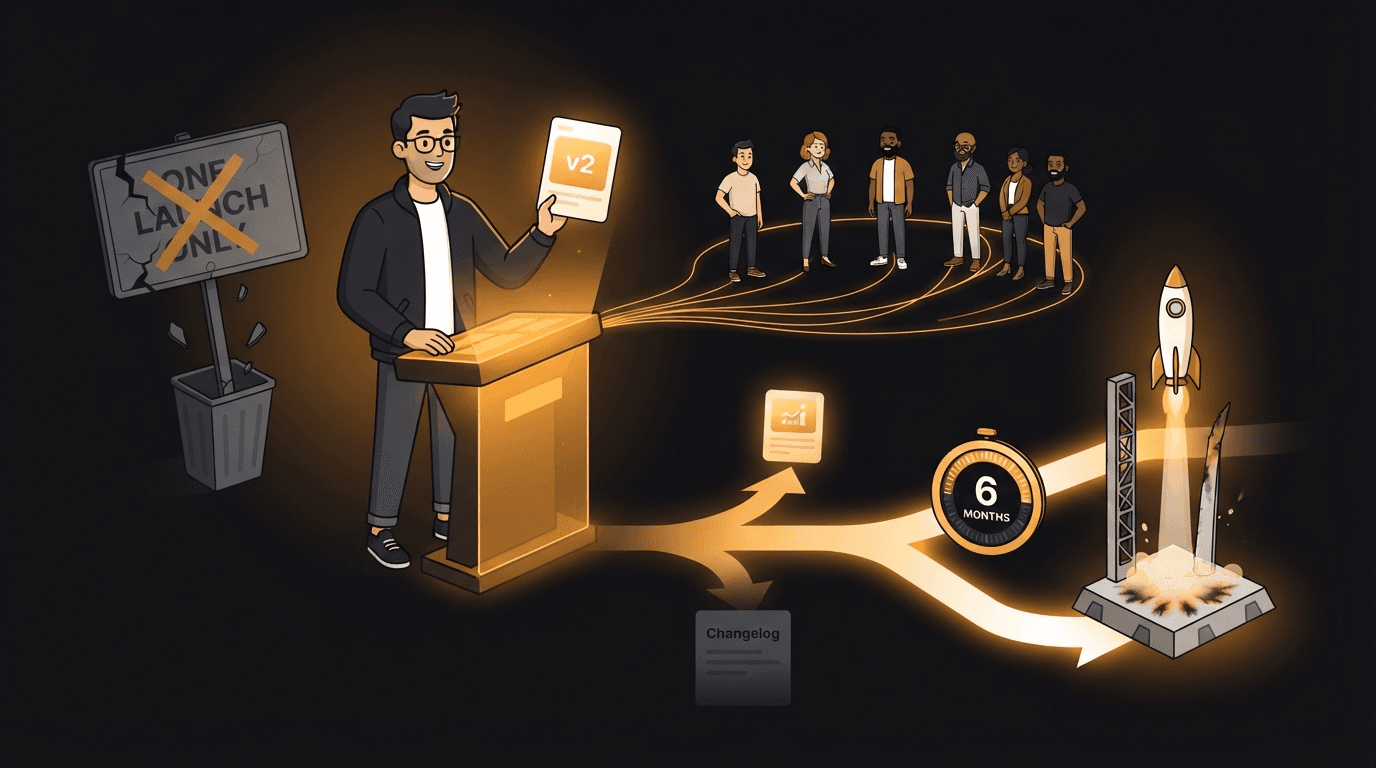
You can relaunch the same product, and every major launch surface says so in writing. Product Hunt asks for six months between posts and a significant update. Hacker News treats a major overhaul as a legitimate new Show HN. BetaList hands every startup two slots on purpose. The “you only get one launch” rule that governs so much founder anxiety isn't a rule at all — it's a misremembered version of a much narrower one, and it costs indie founders more distribution than almost any other belief in this business.
What's actually true is more useful and more demanding: you get as many launches as you have things worth launching. The whole problem is telling those apart. This guide is the eligibility test I use — what counts, what each platform actually permits, and a three-way decision that ends with you shipping quietly, posting an update, or clearing the calendar for a real relaunch.
Can you launch the same product twice?
Yes — with conditions that vary by surface, none of which are “never again.” The clearest statement comes from Product Hunt's own help center on relaunching, which asks makers to wait at least six months between posts for the same product or company, requires a significant update alongside that, and describes exactly what happens if you try sooner: the system detects the relaunch, prompts you to describe what changed, and a human reviews it before approving the post. That is a permission process, not a prohibition.
So where did the myth come from? Three places, and each of them is a real thing that got over-generalized. The first is the six-month gap itself, which founders hear once, round up to “you can't relaunch,” and then repeat. The second is the launch-day adrenaline economy: a launch feels like a one-shot event because it is exhausting, so people treat the exhaustion as evidence of scarcity. The third is genuine — plenty of founders have relaunched badly, gotten a flat response, and concluded the platform punished them, when what actually happened is that they announced a redesign with a rocket emoji and the audience correctly declined to care.
The consequence of believing the myth is that founders sit on real news. I've watched people ship a mobile app, a full rebuild, or a repositioning that changes who the product is for — and post it as a tweet, because they “already used their launch.” That is a distribution asset thrown away out of superstition. The opposite failure is just as common and easier to spot: relaunching every six weeks until nobody opens the email.
What actually counts as relaunch-worthy?
A change is relaunch-worthy when it changes the answer to “who is this for and what does it do,” not when it changes how much work you did. Effort is not the unit. I've shipped six-week features nobody outside the product cared about and two-day changes that made an entirely new kind of person a customer. The second is a launch; the first is a changelog entry, no matter how tired I was.
Relaunch-worthy
- A new platform for the same product — a mobile app, a desktop client, a public API, a self-hosted build
- A rebuild that changes what the product is for, not just how it looks
- A repositioning: same code, different buyer, different promise
- The feature that unlocks a new job — the one users kept asking for that makes a different person a customer
- A milestone with a story behind it: open-sourcing the core, a real free tier, a public dataset
Post it, don't launch it
- A redesign — a new UI is explicitly named as not significant on Product Hunt
- Pricing changes, new plans, a discount, a promo
- Point releases and bug-fix batches
- An integration, unless that integration makes you a new product to a new audience
- “We hit 1,000 users” — a milestone with nothing new to try is news, not a launch
The right-hand column is where most founders get into trouble, because everything in it feels significant while you're building it. A redesign in particular is the great trap: it consumes months, it's the most visible change you can possibly make, and it is the single example Product Hunt names as not qualifying. The reason is sound. A new UI changes the experience for people already using the product and changes nothing at all for the stranger who never got far enough to have an opinion about your UI.
One useful reframe: a relaunch needs a new promise, not new work. If the sentence you'd put on the launch page is the same sentence as last time with adjectives upgraded, you don't have one yet. If it's a different sentence aimed at a different person — “now it runs offline,” “now it's a Mac app,” “now it's for teams” — you do.
What are the relaunch rules on each platform?
Every surface has a different answer, and only some of them are written down. Here's what each platform actually permits, sourced from its own documentation where documentation exists.
| Surface | Relaunch? | The actual rule | What it costs you |
|---|---|---|---|
| Product Hunt | Yes, with a gate | At least six months between posts for the same product — and products sharing a root domain are held to the same gap. Inside six months you're prompted to describe what changed and a human reviews it before the post goes up. | Approval isn't a homepage slot. A relaunch can be accepted and still land quietly. |
| Hacker News (Show HN) | Yes, for a real overhaul | New features and point releases generally aren't substantive enough for a Show HN; a major overhaul probably is. A link can be resubmitted if it hasn't had significant attention in about a year — but deleting and reposting the same story is not okay. | The thread is permanent and public. If the delta is thin, someone says so in the top comment. |
| BetaList | Twice, by design | Each startup gets two features — once pre-launch and once at launch — with at least a few weeks between them. Products that launched a while ago or already got real press coverage are out of scope. | Spend the second slot on the actual launch. A v1.1 burns it for nothing. |
| Smaller launch directories | Usually, quietly | Most accept a genuinely new version, and most have no written policy at all. Read the submission form — several ask outright whether you've been listed before. | Enforcement is reputational rather than automated. The people running these sites are founders, and they remember. |
| Your own list and communities | Always — and that's the trap | No policy exists, so nothing stops you. The limiter is that every send spends goodwill you had to earn, and asking the same forty people to show up twice in a quarter is a withdrawal, not a favor. | Unsubscribes and silence, both of which are invisible until the launch you actually needed them for. |
Two rows deserve expanding. On Hacker News, the official Show HN rules draw the line at substance rather than novelty: new features and point releases generally aren't substantive enough, while a major overhaul probably is. Separately, the site FAQ permits a small number of reposts when a story hasn't had significant attention in the last year or so, and asks you not to delete and repost the same submission. The etiquette side of an HN launch — titles, the first comment, surviving the thread — is in the Show HN launch guide, and it applies unchanged to a second attempt.
BetaList is the interesting one, because its policy is explicitly a two-launch policy. BetaList's submission criteria state that each startup gets two opportunities to be featured — once pre-launch and once during launch — with at least a few weeks between them, and that products which launched a while ago or already picked up significant press coverage are out of scope. Read that as a design instruction: it is telling you to hold your second slot until you have an actual launch, not to burn it on the in-between. Where each of these sits in a full submission sequence is mapped in the startup launch directories guide, and the specific alternatives worth a second submission are in the Product Hunt alternatives roundup.
Ship quietly, post an update, or relaunch?
Three questions decide it, in order. Fail any one of them and you drop to the tier below — which is a demotion in volume, not in value. Most shipped work belongs in the quiet tiers, and founders who accept that get more out of the loud one.
Would a stranger who bounced last time change their mind because of this?
If no, you're posting an update. This is the only question that separates the two, and it's the one founders skip.
Can you demo the change in under sixty seconds without saying “and we also”?
If no, you have a batch of improvements, not a launch. Hold it, keep shipping, and bundle it into something with a single sentence attached.
Has it been six months on that surface — or is the change big enough to survive a review?
If no, post the update now and bank the relaunch. Spending a slot early on a thin story is the most expensive mistake in this whole post.
And here are the three places you can land. The brightness is the point: each tier costs roughly ten times the effort and ten times the goodwill of the one before it.
Ship it quietly
When
The change is real but only matters to people already inside the product.
What it looks like
Changelog entry, an in-app note, one line in your next update email. That's the whole campaign.
Post an update
When
Existing users will be pleased and a handful of strangers might be curious — but nobody switches products over it.
What it looks like
Where you already have standing: your list, your product page, the communities you're a regular in, a short build-in-public post. No new submissions, no crowd, no launch day.
Run a full relaunch
When
Someone who looked at v1 and correctly walked away would reach a different conclusion today.
What it looks like
New submissions on the surfaces that allow it, a launch day on the calendar, assets rebuilt around the new promise, and people lined up who intend to actually try it.
The middle tier is the one nobody talks about and the one that solves most cases. “Post an update” is not a consolation prize; it's how you keep a product visible between launches without spending anything you'll need later. Product pages take updates. Directory listings take updates — refreshing your entry on the apps directory or the launch directories you already submitted to costs an afternoon and keeps a live page accurate. Communities take updates, if you're a regular rather than a visitor.
How do you tell the “what's new” story?
Lead with the new job the product can do, and never with the list of things you built. The changelog dump is the default failure mode of relaunch copy: eleven bullet points, each individually true, adding up to no reason for anyone to click. A stranger reading your relaunch has one question — what can I do now that I couldn't do before? — and the version numbers are not an answer.
Four moves that consistently work:
- Name what it replaces.“This replaces the spreadsheet you keep for X” orients people faster than any feature description, because it tells them which shelf you go on.
- Say what was wrong with v1 out loud.“The first version made you configure everything up front and most people quit at step two” buys more credibility than a paragraph of benefits, and it pre-empts the sharpest comment in the thread. Candor is the cheapest asset a solo founder has.
- Don't re-tell the origin story.The people who heard it the first time will skim, and the people who didn't are here for the product. One sentence of context, then the new thing.
- Ship one artifact, not five.A sixty-second demo of the new capability only — no logo reveal, no roadmap, no gallery of screens you redesigned. If the demo needs narration to make sense, the change isn't as clear as you think it is.
Then run it like a launch, because it is one. Everything in the launch-day checklist applies to a second launch unchanged, and if the update is big enough to justify more than a day, the five-day launch week works better on a relaunch than on a first launch — you already know which surfaces converted last time, so you can weight the week toward them instead of guessing. The Product Hunt mechanics themselves, including the relaunch request, are covered in the 2026 Product Hunt guide.
How often is too often?
The binding constraint isn't the platforms — it's your crowd. Product Hunt's six months is a floor you'll rarely hit anyway; the number that actually limits you is how many times a year you can credibly ask the same forty people to show up. My working answer, running several products at once: two real relaunch events a year per product is comfortable, three is the ceiling, and anything past that means I'm substituting announcements for progress.
That constraint is worth stating plainly because it's the part no platform policy covers. Every launch spends social capital. A first launch spends whatever you've banked from being useful to other people; a relaunch spends it again, from the same account, with less novelty attached. If you did nothing for anyone between launch one and launch two, there is no crowd — not because anyone is punishing you, but because there's nothing there to draw on.
This is the piece of relaunch strategy that no checklist fixes, and it's the reason I built Favors.dev. It's a founder marketing co-op with a points economy: you earn points by doing verified marketing favors for other founders — real testing, honest feedback, reviews from people who actually used the thing — and you spend those points to get help back. You can't spend what you haven't earned, which is exactly the discipline a relaunch needs. The months between launch one and launch two are when you bank it. Put the date on the launch calendar the way you would a first launch — the calendar doesn't care which number it is, and neither do the people who show up.
A sane relaunch cadence for one person
Quiet ships continuously. Updates monthly, wherever you already have standing. Relaunches twice a year, timed to the two changes that genuinely moved who the product is for. Between them, spend the time earning the crowd rather than warming it — the founders who help you in November are the ones you helped in July.
Frequently asked questions
Can you launch on Product Hunt twice?
Yes. Product Hunt's own help center asks makers to wait at least six months between posts for the same product or from the same company, and notes that products sharing a root domain are held to the same gap. If you want to relaunch sooner, the system detects it and prompts you to describe what has changed since the last launch; their team reviews that before approving the post. The condition is substance: a new mobile app or a complete redesign with new functionality counts, while new UIs and pricing-plan changes are explicitly listed as not significant. Approval also isn't a promise of a homepage feature.
How long should you wait between launches?
It depends on the surface, not on a universal rule. Product Hunt sets a six-month floor for the same product. Hacker News allows a story to be resubmitted if it hasn't had significant attention in roughly a year, and treats a major overhaul as a legitimately new Show HN. BetaList gives each startup two features with a few weeks between them. For your own email list and communities there is no policy at all — the honest test is whether you'd open the email if someone else sent it.
Does relaunching hurt your credibility?
Only when the delta is thin. Nobody objects to a founder shipping something substantial and telling people about it; that's the job. What damages you is the third launch in five months for a redesign and two integrations, because it teaches everyone who follows you that your announcements aren't worth reading. Credibility is spent by the gap between how loud the announcement is and how much actually changed — not by the number of launches.
Can you relaunch on Hacker News?
Yes, if the change is big enough. The official Show HN rules say new features and point releases generally aren't substantive enough, while a major overhaul probably is — so a rebuild or a genuinely new thing you made can be posted even if an earlier version was shown before. For reposting the identical link, the site FAQ allows it when the story hasn't had significant attention in about a year, and asks you not to delete and repost the same submission. Both paths assume you're around to discuss it in the thread.
What's the difference between a product relaunch and a product update?
The audience. An update is addressed to people who already know you: it lives in a changelog, an in-app note, and an email to existing users, and it succeeds if those users notice. A relaunch is addressed to people who don't know you or who already decided against you: it needs a new submission, a new first impression, and a reason for a stranger to reconsider. Sending a relaunch-sized campaign about update-sized news is the most common way founders burn their launch surfaces.