 Favors.dev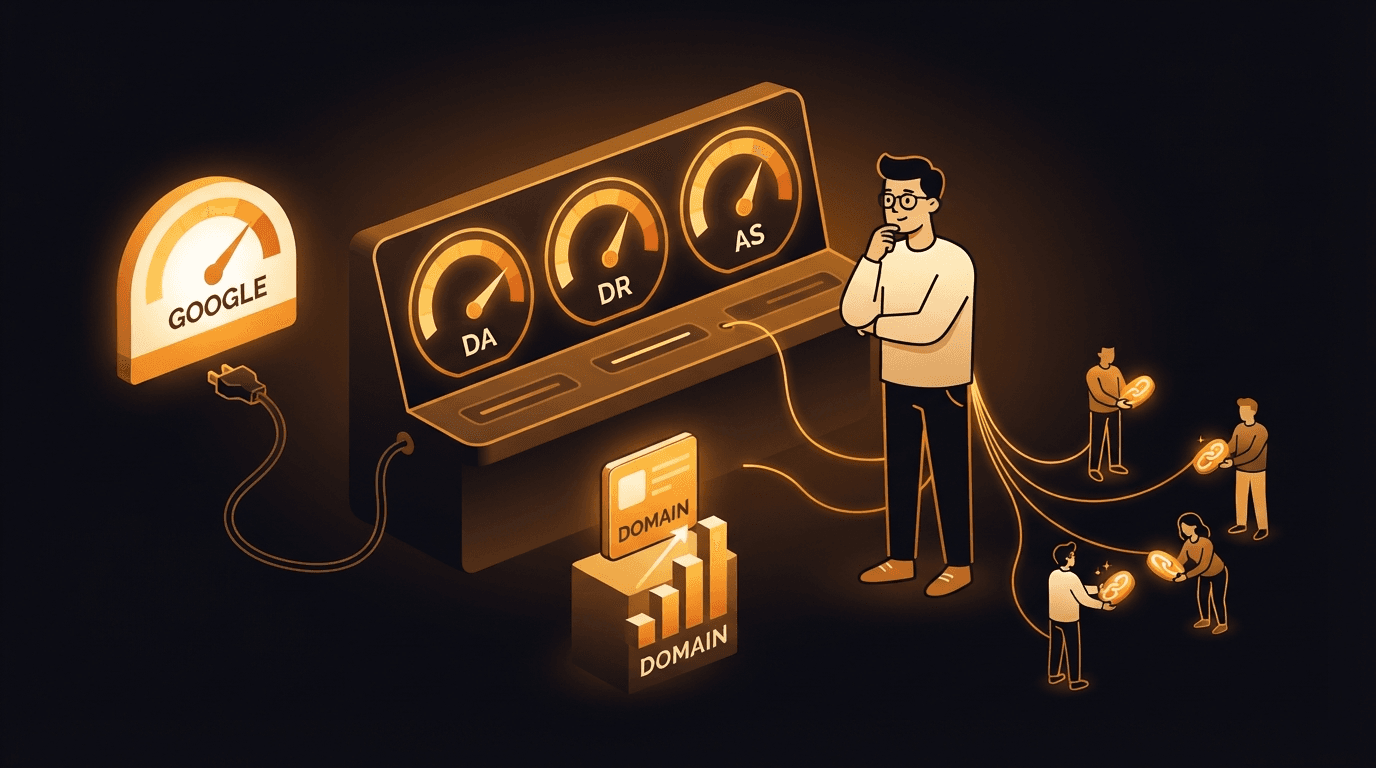
Domain authority is a third-party score that predicts how well a website is likely to rank, based mostly on the quality and quantity of sites linking to it. It runs 1 to 100, higher is stronger — and, crucially, it is invented by SEO tool companies, not by Google. The number in your dashboard is an outside estimate of your site's strength, not a dial Google turns.
That one distinction is where most founders go wrong. They watch a vendor's number like it's a credit score Google reads before ranking them. It isn't. Below is what the score actually is, how the three big versions differ, the only honest way to move it, and a quirk that matters for anyone earning links on a young startup: the same link can be worth more next year than it is today.
What is domain authority?
Domain authority is an SEO metric that estimates a domain's overall ranking strength on a 1-to-100 scale, calculated primarily from its backlink profile — how many other sites link to it, and how trusted those sites are. It was coined by Moz, and the term is now used loosely to mean "how strong is this site's link authority." It is a competitive-analysis gauge: useful for sizing up a rival's link profile at a glance, useless as a lever you pull on your own rankings.
The single most important fact about it: Google does not use domain authority.Google's John Mueller has said, plainly and repeatedly, that Google doesn't use Domain Authority — or Domain Rating, or Authority Score — for crawling, indexing, or ranking, because those are metrics from SEO companies, not Google. The 2024 Search documentation leak did surface an internal signal named siteAuthority, but that is Google's own thing, built from content quality, links, and click data — and you will never see its value. The number in your tool and the signal in Google's systems are two different objects that happen to share a name.
DA vs DR vs Authority Score (and why none are Google's)
There isn't one "domain authority." There are three well-known versions, one per major SEO tool, and they disagree with each other by design. Here's what each actually measures:
Domain Authority (DA)
Moz
1–100, logarithmic
A machine-learning prediction of how likely a domain is to rank, trained against real Google results using dozens of link-based signals.
Domain Rating (DR)
Ahrefs
0–100, logarithmic
The strength of a site's backlink profile — essentially the size and quality of the domains linking to you. The most transparent of the three: it measures links, and only links.
Authority Score
Semrush
0–100, logarithmic
A blended score mixing link power, organic-traffic estimates, and a spam factor. Broader than DR, and just as much a Semrush house metric.
Because Moz, Ahrefs, and Semrush each run their own crawler, their own link index, and their own formula, the same website can show DR 55, DA 40, and an Authority Score of 48 all at once. That is not an error to reconcile — the scores were never meant to match. Line them up and the one column that stays constant is the one that matters most:
| Metric | Owner | What it's built from | Used by Google? |
|---|---|---|---|
| Domain AuthorityMoz | Low — model is a black box | Link-based ML model | No |
| Domain RatingAhrefs | High — links, clearly | Backlink profile only | No |
| Authority ScoreSemrush | Medium | Links + traffic + spam signal | No |
| SiteAuthorityGoogle (internal) | None — never exposed | Content, links, click data | Yes, but you can't see it |
The "used by Google" column is all "no" until you reach Google's own hidden signal — which you can't see or optimize directly anyway. So treat DA, DR, and Authority Score as three different weather forecasts for the same sky. Handy for a quick read, worth cross-checking, never worth obsessing over a single decimal.
You don't have to take my word for the "not Google's" part, and you shouldn't. Moz's own documentation for Domain Authority states flatly that DA is not a Google ranking factor and has no effect on the SERPs. And Google's published guide to its ranking systems names seventeen of them — BERT, RankBrain, neural matching, link analysis and PageRank, freshness, reviews, spam detection and the rest — and not one is a site-wide authority score you can look up in a toolbar. When the vendor and the search engine agree on something, it's usually safe to stop arguing about it.
DA rankings: what actually counts as a good score?
This is the question underneath most searches for the topic, and the honest answer is more useful than the number people are hoping for: there is no universally good DA, because the score is relative by construction. Moz says so itself — a 30 can be exceptional in one industry and unremarkable in another, so the only meaningful comparison is against the specific sites already ranking for the terms you want.
Three facts make that concrete, all of them from the metric's owner rather than from SEO folklore:
- Every new website starts at 1. Not zero, not a starting grant — 1. If your four-month-old startup reads 8, nothing is wrong with your site.
- The scale is a fixed number of seats, not a ladder. Because DA is graded on a curve against every other domain, if a giant like Facebook acquired a billion new links, everyone else's score would fall without a single link changing on their own site. Your score can drop while your SEO improves.
- That's why 20 → 30 is far easier than 70 → 80. The established domains occupy the high seats, so the top of the range is crowded and the bottom is not. Progress is not linear and it was never meant to be.
The practical consequence for a founder: stop tracking DA as a score-out-of-100 and start tracking it as a gap. Pull the DA of the five pages currently ranking for your main term. If they sit at 25 and you're at 8, that gap is a rough estimate of how much link-earning stands between you and page one — which is a planning number you can act on. "Is 20 good?" is not.
Domain authority vs domain reputation — not the same thing
Worth heading off, because founders bump into it constantly and the names are almost identical: "domain reputation" is an email deliverability term, not an SEO one. It has nothing to do with Moz, Ahrefs, backlinks, or ranking.
Domain reputation is what Gmail thinks of your domain as an email sender. Per Google's Postmaster Tools documentation, it is a rating of the quality of the domains and IP addresses used to send email, determined by sending behaviour, and it is reported in four bands — High(very low spam rates, complies with Gmail's sender guidelines, rarely marked as spam), Medium (mostly legitimate, occasional spam), Low (a history of significant spam; likely to be marked as spam) and Bad (almost always marked as spam or rejected outright).
The reason this matters to you specifically is that a solo founder runs both systems off one domain. Blast a cold-outreach campaign from your main domain, collect spam complaints, and you can drag its sending reputation to Low — which does nothing whatsoever to your Moz DA, and quietly stops your onboarding emails, password resets and receipts from landing in the inbox. Two scores, one domain, entirely separate failure modes. If someone tells you your "domain reputation is bad," find out which one they mean before you go build backlinks at an email problem.
What actually moves it: links from trusted domains
Every version of the score is, at its core, a measure of your backlink profile — so the only thing that durably moves it is earning links from domains that are themselves trusted and relevant. Not more links. Better ones. A single editorial link from a respected site in your niche moves the needle more than fifty scraped directory drops, and it does it without the risk.
This is also why the "increase your DA in 30 days" offers are a trap. The score is a lagging indicator; it reflects a link profile that took months to build. Anyone promising a fast jump is selling you private-blog-network links, link exchanges, or paid placements — the exact things that spike a vendor number briefly and then invite a Google penalty that costs far more than the score was ever worth. I go through the white-hat menu in detail in how to get backlinks for a startup, but the one-line version is: earn links a real editor would give you, and skip everything else.
The slow-but-real ways to move it as a new startup
A domain that's a few months old starts near zero, and that's normal. Because the scores are logarithmic, the early climb from 0 to 20 is the fastest stretch you'll ever get — and it comes from a short, unglamorous list of moves:
- Get listed in real directories. A curated startup launch directory gives you an early, legitimate link on a domain with existing authority — the fastest honest first backlink most founders can get.
- Publish content worth citing. One genuinely useful, answer-first article earns links passively for years. Thin content earns nothing and can drag the whole domain down.
- Earn editorial mentions. Guest posts, podcast show notes, and being quoted in a roundup all produce links an editor chose to give — the kind that survive algorithm updates.
- Trade help with founders at your stage. The reviews, featured articles, and backlinks you need are things other founders can give you — and that you can give them. Reciprocity is the one link-earning channel that needs no prior audience.
Notice the theme: every durable move is a real link from a real domain someone chose to give you. That's not a coincidence. It's the same substance that gets you cited by AI answer engines — Google's AI Overviews overlap roughly 54% with the top-20 organic results (Similarweb), so the authority that earns a good link profile is the same authority that earns a citation. There's no separate score to game for either one. The link building that raises your DA is the link building that makes you citable. If that connection is new to you, start with AEO vs SEO and the broader answer engine optimization guide for startups.
How your directory listing appreciates as the host grows
Here's the quirk most guides skip, and it's the most useful thing to understand about links on a young platform: a backlink's value isn't fixed — it rises as the domain hosting it gains authority. The link you place today on a growing site is worth more next year than it is now, because the domain passing you that link is stronger.
That changes how you should think about where you park your links. A listing on a brand-new platform looks weak today. But if that platform is compounding — publishing, earning its own backlinks, growing its own authority — then your link there appreciates alongside it, at zero extra effort from you. You did the work once; the value keeps climbing.
This is the logic behind the Favors.dev apps directory. Every project gets a public page with a real, indexable link back to your site, hosted on a domain that's actively growing its own authority through content and editorial links. As Favors.dev's domain strengthens, the equity your listing passes strengthens with it — a small asset that appreciates while you sleep. And because Favors.dev is a founder marketing co-op, that listing sits next to the reciprocity engine that earns you the other links on this list: help another founder launch, earn points, and spend them on the reviews, featured articles, and backlinks that move your authority for real.
Frequently asked questions
Does Google use domain authority as a ranking factor?
No. Domain Authority is a Moz metric, and Domain Rating (Ahrefs) and Authority Score (Semrush) are vendor metrics too — Google's John Mueller has said repeatedly that Google does not use any of them for crawling, indexing, or ranking. The 2024 Search documentation leak did reference an internal signal called 'siteAuthority', but that is Google's own thing built from content quality, links, and click data — not the third-party score you see in an SEO tool. So watch the vendor number as a rough gauge of your link profile, not as a dial that changes your Google rankings.
What is a good domain authority score for a startup?
For a site that's a few months old, expect a DA or DR in the single digits to low teens — and that's completely normal. The scores are logarithmic, so climbing from 0 to 20 is far easier than 40 to 60, and a brand-new domain simply hasn't had time to earn links. Rather than chase an absolute number, compare yourself to the specific competitors ranking for the terms you want. A DR 25 site with a handful of relevant, trusted links often out-ranks a DR 50 site with a bloated, low-quality profile.
What is the difference between domain authority and domain reputation?
They sound alike and measure completely unrelated things. Domain authority (Moz) and domain rating (Ahrefs) are SEO metrics estimating the strength of your backlink profile. Domain reputation is an email deliverability metric: per Google's Postmaster Tools documentation it rates the quality of the domains and IP addresses used to send email, based on sending behaviour, and reports it as High, Medium, Low or Bad. Nothing about your backlinks affects it. This trips up solo founders because both run off the same domain — send a cold-outreach campaign that collects spam complaints and you can push your sending reputation to Low, which leaves your Moz DA untouched while quietly pushing your password resets and receipts out of the inbox. If someone says your domain reputation is bad, establish which of the two they mean before you respond to it.
What is a good DA ranking, and is 20 a good score?
There is no universally good score, and that isn't a dodge — Moz's own documentation says the metric is relative, so a 30 can be exceptional in one industry and unremarkable in another. Three facts make it concrete: every new website starts at 1; the scale is graded against every other domain, so your score can fall when a giant earns links even though nothing changed on your site; and that's why climbing 20 to 30 is far easier than 70 to 80, because the established domains occupy the high seats. The useful way to read it is as a gap rather than a grade. Pull the DA of the five pages currently ranking for your main keyword — if they're at 25 and you're at 8, that difference is a rough estimate of the link-earning between you and page one, which is something you can actually plan around.
What's the difference between DA and DR?
DA is Moz's machine-learning prediction of ranking ability; DR is Ahrefs' direct measure of backlink-profile strength. Because they use separate crawlers, separate link indexes, and separate formulas, the same site can read DR 55 and DA 40 at the same time — that mismatch is expected, not a bug. DR is the more transparent of the two because you know exactly what it measures: links. Neither is a Google signal.
How do I increase my domain authority fast?
You don't — and any service promising a fast jump is selling you links that will eventually hurt you. The score is a lagging reflection of your backlink profile, so the only durable way to move it is to earn links from trusted, relevant domains over time: get listed in real directories, publish content worth citing, and earn editorial mentions. Bought links, private blog networks, and link rings can spike a vendor score briefly and then trigger a Google penalty that costs you far more than the score was ever worth.
Do domain authority scores matter for AI search and citations?
Indirectly, yes — but not the vendor number itself. AI answer engines don't read your Moz DA. They cite pages the same way search surfaces them: through trusted links, reviews, and named-author content. Google's AI Overviews draw heavily from pages that already rank organically (Similarweb found roughly 54% overlap with the top-20 organic results), so the real authority that earns you a good link profile is the same authority that gets you cited inside an answer. Build the substance; the score follows.