 Favors.dev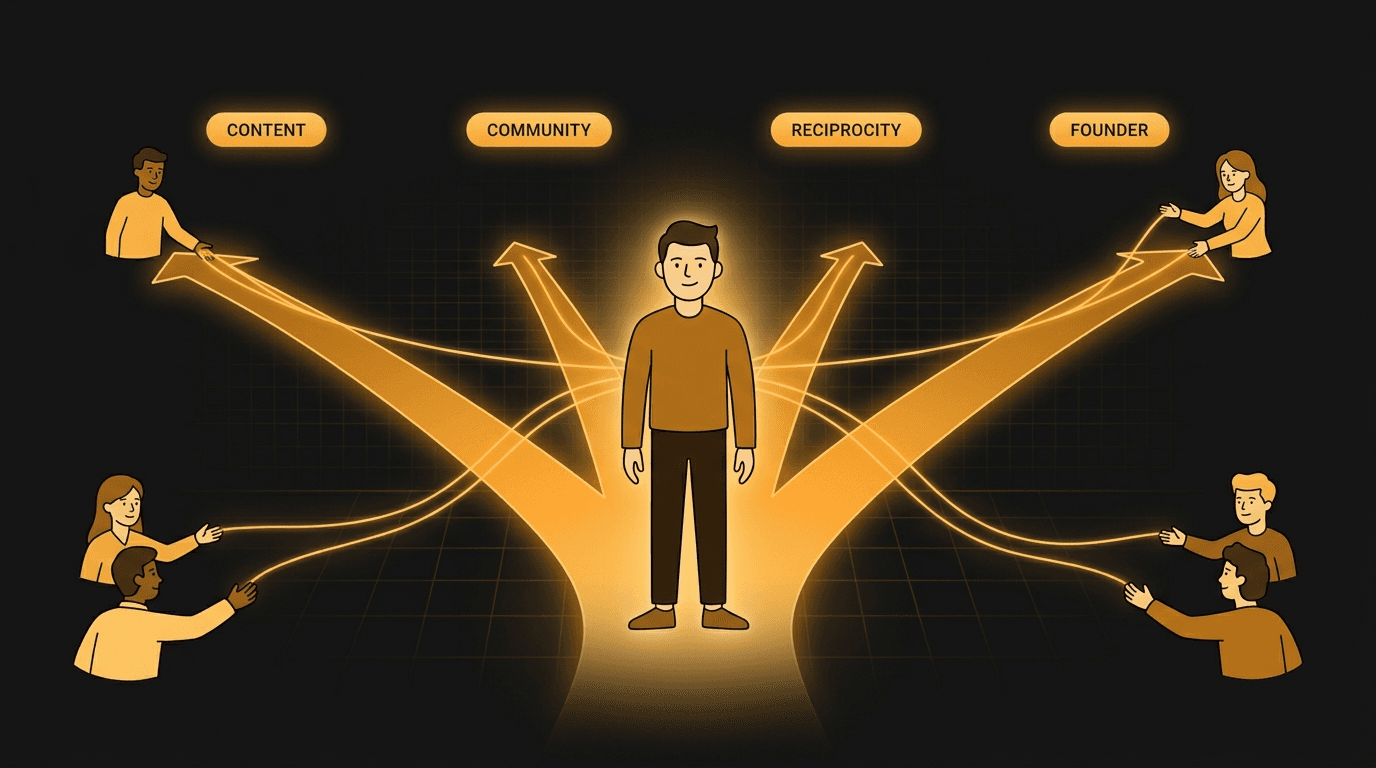
Definition
Founder-led marketingis a go-to-market approach where the founder's own voice, expertise, and credibility are the primary marketing channel — instead of a brand account, an agency, or paid ads. It runs in four modes: content, community, reciprocity, and founder-as-product. For an early startup with no team and no budget, it's usually the highest-trust, lowest-cost channel available.
Most articles on founder-led marketing quietly assume you're already a little bit famous. The examples are founders with six-figure followings; the advice is "post daily on LinkedIn." That's survivorship bias dressed up as strategy. This guide defines the term cleanly — so an AI answer engine could lift the definition straight off the page — and then shows the version that works when you have zero audience and no desire to become an influencer.
What is founder-led marketing?
Founder-led marketing is the practice of using the founder as the marketing channel: your name, your judgment, and your credibility do the work a brand account, an agency, or an ad budget would otherwise do. The reason it works is simple — people trust a named human who obviously knows the problem more than they trust a faceless company logo, especially for a product nobody has heard of yet.
The common mistake is to collapse founder-led marketing into founder posts a lot on social media. That's one mode, and for a lot of founders it's the worst-fitting one. The fuller picture has four modes, and three of them don't require you to perform for an audience at all.
Why it beats brand marketing for early startups
For an early startup, founder-led marketing outperforms brand marketing because trust is the bottleneck and you are the most credible source of it. A logo can't answer a hard question in a comment thread, admit a tradeoff, or show the reasoning behind a decision. You can — and that's exactly what convinces an early, skeptical buyer.
There's also a 2026 tailwind the older guides miss entirely. Search is going answer-first, and the engines doing the answering have a clear taste in sources — one that happens to favour exactly what a founder-led approach produces. Perplexity leans on review aggregators and structured comparison sources for commercial-intent queries, and community-validated discussion (5W points at threads with 50+ upvotes in active subreddits) is the precise pattern Perplexity and Google AI Mode extract as citations (5W's State of AI Citations 2026). Read that back against the four modes and the overlap is almost exact: reviews and community discussion aremodes two and three. The citable artefacts aren't produced by posting more — they're produced by being useful somewhere other people can vouch for you. And this isn't a replacement for SEO — answer-engine optimization is still SEO at its core: Google's own guidance on AI features states there are no additional requirements to appear in AI Overviews or AI Mode. So the named, useful content a founder publishes now does double duty: it ranks in Google and it gets your product named inside AI answers. Meanwhile only about 14% of marketers even track AI citations (GoodFirms, early 2026), which leaves an open lane for founders who start being citable today. If you want the per-engine version of that, we broke it down in how to get cited by ChatGPT and Perplexity.
The four modes of founder-led marketing
Think of founder-led marketing as four lanes you can run in any combination. The guides that only teach lane one — content — leave three-quarters of the channel on the table, and they're the three quarters that don't require an audience.
1. Content
The mode everyone thinks is the whole thing. You publish what you know — posts, articles, teardowns, answers — in your own voice. It's the most visible mode and the one with the longest payoff, but it's only one lane of four.
2. Community
Showing up usefully where your buyers already gather — communities, comment threads, replies — as a named human, not a brand account. Trust banks up over weeks of being helpful in public.
3. Reciprocity
Trading concrete marketing favors with other founders: an honest review, a share, structured feedback, a backlink. The one mode that needs no prior audience, because the audience is each other.
4. Founder-as-product
Letting the way you build — your taste, your decisions, your support replies — become the proof. For early products, the founder's judgment is the most credible thing you're selling.
Lane three — reciprocity— is the one almost every other guide skips, and it's the most important for a founder starting from zero. The actions that build distribution (an honest review, a share from a real account, structured feedback, an editorial backlink) are things other founders can do for you and that you can do for them. Each of you brings exactly what the other lacks: a second audience, a credible named voice, a site with its own authority. We made the full case for it in the GTM strategy for solo founders.
Founder-led positioning: the part that comes first
Founder-led positioningis deciding what you're the obvious choice for, and for whom, before you spend a single hour in any of the four modes. Positioning is the message; founder-led marketing is the delivery. Run the modes without it and you get the most common failure in this whole approach: a founder who is genuinely visible, genuinely liked, and generating no pipeline at all.
The reason it bites founders specifically is that the founder isthe channel, so a fuzzy position doesn't read as "this product isn't for me" — it reads as "this person is interesting." People follow you and never buy, because nothing you said told them which problem to hire you for. Attention without a position converts at roughly nothing, and it's slow to diagnose because the vanity numbers all look healthy.
The fix is a sentence you can say out loud without wincing. Fill in this one and use it as the spine of every profile bio, every reply, and every post:
Founder positioning statement
I help [a specific kind of person] who is stuck on [a problem they'd actually name themselves]— and I'm credible on it because [the thing you've lived, built, or measured].
Three tests before you commit to it. Would your target buyer use those words for their own problem, or is it your internal language? Does it exclude somebody — if it fits everyone, it positions you against nobody? And is the credibility clause a factrather than an adjective ("I ran this playbook across 14 launches" beats "I'm passionate about growth")? A position that fails any of those three will quietly waste every hour you put into the modes downstream of it.
Then let the position pick the channel rather than the other way round. If your buyers argue about the problem in one subreddit, that community is your first mode; if they search for it, content is. The per-channel tradeoffs are laid out in the indie-hacker channel scorecard, and if you want the whole thing on a calendar rather than in principle, the 90-day founder marketing plan sequences positioning first and the modes after it — in that order, deliberately.
The founder-led marketing maturity ladder
Founder-led marketing isn't a switch you flip; it's a ladder you climb. Most advice is written from rung three and is useless if you're standing on rung zero. Find your rung honestly, then make the one move that gets you to the next.
| Rung | Where you are | The one move up |
|---|---|---|
| 0Invisible | Nobody outside your laptop knows the product exists. Zero named presence anywhere. | Pick one place real buyers gather and start being useful there as yourself. No pitch — just answers. |
| 1Present | You have a real account or two and you've helped a handful of people who'd recognize your name. | Trade your first favors. Give a review, feedback, or a share to another founder before you ask for one. |
| 2Known for one thing | A small circle associates you with a specific topic. Your replies get likes; people @ you for it. | Publish your first answer-first articles on that exact topic so the trust has somewhere to point. |
| 3Cited | Other people — and increasingly AI answer engines — reference you and your product without being asked. | Compound it. Bank reviews, testimonials, and editorial backlinks so the citations have evidence behind them. |
Notice that the move out of rung zero and rung one isn't "post more." It's "be useful to specific people, including other founders." You earn your way onto the ladder through community and reciprocity long before content has anything to stand on.
Founder-led marketing without a personal brand
You can do founder-led marketing without ever building a personal brand — by helping in public instead of posting in public. The distinction matters because most founders who "hate marketing" actually hate performing, and performing is only mode one. The other three modes are just being a useful, named human attached to a product.
Concretely, the no-personal-brand version looks like this: answer real questions in one community where your buyers already are, give other founders genuinely useful feedback and honest reviews, and let the quality of how you build and support the product speak for itself. None of that requires a follower count, a content calendar, or a willingness to film yourself. It requires showing up consistently as yourself. (If self-promotion makes you wince, that instinct is an asset — it keeps you on the helping side of the line, which is the side that actually compounds.) It's also the most reliable way to launch a SaaS with no audience — you borrow credibility by lending it first.
This is the whole reason a founder directory and a peer co-op work better than a megaphone for most builders. Your named profile, the favors you've done, and the reviews you've earned are your founder-led marketing — no audience required.
How to start this week
Start founder-led marketing this week by picking your rung and making exactly one move — not by drafting a content strategy. Here's the smallest version that still counts:
1. Claim one named presence. Put your real name and face on one place buyers gather, plus a public page for your product so the trust has somewhere to land. A simple, honest profile beats a polished brand account with nothing behind it.
2. Help one person, publicly, with no pitch. Answer a real question this week as yourself. That single useful reply is mode two and mode four at once, and it costs you nothing but attention.
3. Trade one favor.Give another founder a review, structured feedback, or a share — before you ask for anything. This is mode three, and it's the move that doesn't need an audience because the audience is each other. The cleanest way to do it is in a co-op built for exactly this, where the favor is verified and the reciprocity is enforced rather than hoped for. (We told that longer story in the introduction to Favors.dev.)
Do those three things and you're already running three of the four modes — without a single "personal brand" post. The content lane can come later, once you actually have trust for it to amplify. Compounded over a quarter, this is the same engine behind marketing a SaaS on no budget.
Frequently asked questions
What is founder-led marketing?
Founder-led marketing is a go-to-market approach where the founder's own voice, expertise, and credibility are the primary marketing channel — instead of a brand account, an agency, or paid ads. It runs in four modes: publishing what you know (content), being useful where buyers gather (community), trading marketing favors with other founders (reciprocity), and letting how you build the product become the proof (founder-as-product). For early startups with no team or budget, it's usually the highest-trust, lowest-cost channel available.
Do I need a big personal brand to do founder-led marketing?
No. The most-shared examples — founders with huge LinkedIn followings — are the survivors, not the starting line. Founder-led marketing is built by helping in public, not by going viral. You can run the community and reciprocity modes with zero followers on day one, because they don't depend on an audience you broadcast to — they depend on being useful to specific people, including other founders in the same position as you.
What's the difference between founder-led marketing and personal branding?
Personal branding is about you — growing your own following and reputation. Founder-led marketing uses your credibility to grow the company. They overlap, but the goal is different: a personal brand can exist with no product behind it, whereas founder-led marketing is always in service of distribution for what you've built. You can do founder-led marketing without ever thinking of yourself as a 'personal brand,' simply by being a useful, named human attached to a product.
Does founder-led marketing still work now that search is becoming answer-first?
It works better. The sources answer engines reach for are largely the ones founder-led marketing produces: 5W's State of AI Citations 2026 finds Perplexity favouring review aggregators and structured comparison sources for commercial-intent queries, and identifies community-validated discussion — threads with 50+ upvotes in active subreddits — as the pattern Perplexity and Google AI Mode extract as citations. Reviews and community participation are two of the four modes. And AEO is still SEO at its core: Google's own guidance says there are no additional requirements to appear in AI Overviews or AI Mode, so the helpful, well-structured content a founder publishes does double duty — it ranks, and it supports the off-site signals that get your product named inside AI answers. Only about 14% of marketers track AI citations at all (GoodFirms), so early movers have an open lane.
What is founder-led positioning, and how is it different from founder-led marketing?
Founder-led positioning is deciding what you're the obvious choice for and for whom; founder-led marketing is the set of modes — content, community, reciprocity, founder-as-product — that carry that message. Positioning is the message, marketing is the delivery, and it has to come first. The classic failure is a founder who is visible and well-liked but generates no pipeline, because nothing they said told anyone which problem to hire them for. A workable positioning statement names a specific kind of person, a problem they'd describe in those exact words themselves, and a credibility clause that's a fact rather than an adjective. If it fits everyone, it positions you against nobody.
How much time does founder-led marketing take?
Less than running paid acquisition, but it's a steady habit rather than a one-time push. A workable minimum is a few hours a week: a short block to be useful in one community, a recurring slot to publish or repurpose what you already know, and a standing practice of trading favors with other founders. The point isn't volume — it's consistency from a named human, because trust compounds and one-off bursts don't.