 Favors.dev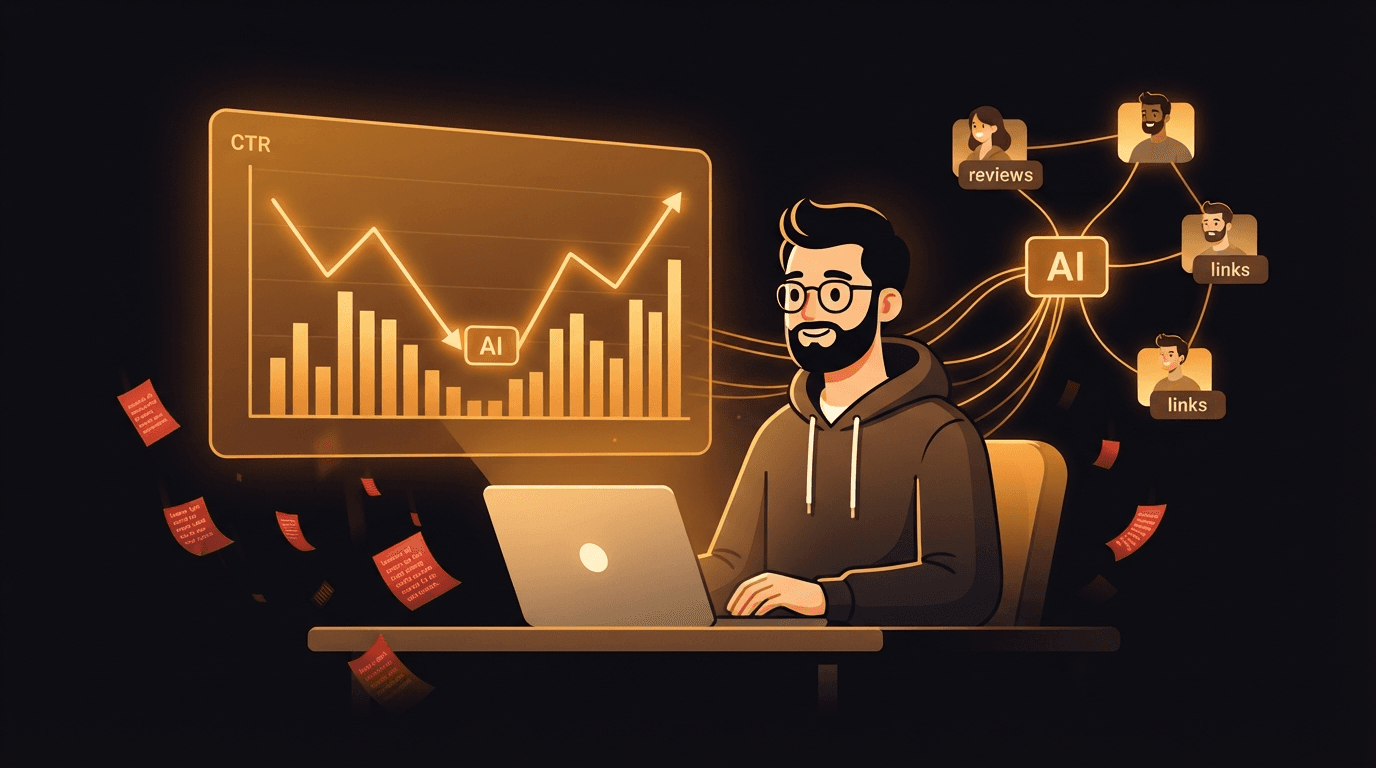
No — organic traffic isn't dying in 2026. It's being redistributed. Click-through rates on queries with an AI Overview fell hard through 2025, then began recovering in early 2026. The reliable data shows a moving target that's stabilizing, not a straight line to zero — and a clear shift in where the value lands: away from the raw click, toward being cited inside the answer.
That's a less dramatic story than the "Google is over" headlines, and it's the accurate one. This is a data report, so I'll show the numbers I trust, name their sources, and flag the viral figures that don't survive scrutiny — then get to the part that matters for a solo founder: what to actually do about it.
Is organic traffic dying in 2026?
No. Search demand is as high as ever; what changed is the path from a search to your site. A larger share of queries now resolve inside an AI Overview or an answer engine before the user clicks anything. So the top-of-funnel informational click got scarcer — but that's redistribution of attention, not the death of organic. The value didn't evaporate; it moved upstream of the click, to the moment an engine decides which sources to name.
Here are the three numbers that anchor the whole discussion — sourced, and stated as ranges rather than scary round figures:
0.61% → 2.4%
Organic CTR with an AI Overview present
From Seer's Sept 2025 low to Feb 2026. A recovering range, not a fixed cliff.
<1%
Publisher referral traffic from AI engines
Even when they cite you (Chartbeat/Conductor, via eMarketer). The click was never the prize.
14%
Of marketers track AI citations
Almost no one is measuring the thing that now matters (GoodFirms).
What does the AI Overviews CTR data actually show?
It shows a sharp 2025 decline followed by a 2026 rebound — which is why any single "AI killed CTR by X%" headline is misleading. The most rigorous public dataset comes from Seer Interactive's AI Overview CTR study, which tracked 53 brands across 5.47 million queries and 2.43 billion organic impressions from January 2025 through February 2026. The number everyone quotes is Seer's September 2025 snapshot: organic CTR of roughly 0.61% with an AI Overview present versus 1.62% without. That's a real low — and it's where most "traffic apocalypse" posts stop reading.
The rebound is the part they skip. In Seer's 53-brand series, CTR on AI-Overview queries fell to a December 2025 low near 1.3% and then climbed back to about 2.4% by February 2026 — roughly an 85% recovery in two months — while CTR on queries withoutan AI Overview rose to about 3.8%. Here's that trajectory:
The deeper 0.61% figure quoted everywhere is Seer's September 2025 snapshot — a low point, not the current state. The trend line is a moving target that's recovering, which is exactly why fixed headline percentages mislead.
One more figure from the same research reframes the whole game: being cited inside an AI Overview delivers roughly +120% more clicks per impressionthan not being cited. The click didn't disappear — it concentrated on the sources the engine names. That single fact is the hinge this entire report turns on.
Correlation studies can only show CTR moving alongside AI Overviews. A randomized field experiment run in early 2026 went further and measured cause. Researchers at the Indian School of Business and Carnegie Mellon assigned 1,065 U.S. desktop users to see Google either normally or with AI Overviews stripped out. Removing the overviews lifted outbound clicks from 0.38 to 0.61 per search, a 38% reduction attributable to the overview itself, and zero-click searches fell from 72% to 54%. Satisfaction ratings came back nearly identical in both groups, so the traffic moved without the reader getting a better answer.
User-level browsing data points the same way. Pew Research Center tracked 68,879 Google searches from 900 U.S. adults and found people clicked a traditional result on 8% of visits where an AI summary appeared, against 15% of visits where none did. They clicked a source inside the summary on just 1% of those visits. That 1% is the number worth planning around, and it is why being named in the answer beats holding a blue link underneath it.
Myths we're not repeating
Half the "traffic crisis" content online is built on figures that failed verification. We left these out on purpose — if a competitor's post leans on them, treat the rest with caution:
- "58.5% / 60% / 77% / 83% of searches are zero-click" — specific figures that don't hold up to sourcing.
- "AI Overviews permanently killed CTR by 61%" — that's a September 2025 snapshot low, not a fixed constant; it rebounded.
- "AI referral traffic converts 3–15x better" and similar multipliers — unverified; we cite only the CTR and referral-share numbers that check out.
Death or redistribution — which is it?
Redistribution. "Death" implies the demand went away; it didn't. What's happening is a reshuffle of who captures the value of a search. Three forces are moving it around at once: AI Overviews answer more queries in place, answer engines like ChatGPT and Perplexity capture a growing slice of research intent, and within what's left, clicks concentrate on cited sources. AI referral traffic to the top thousand sites passed 1.13 billion visits in a single month(June 2025, up 357% year over year, ChatGPT >80% of it — Similarweb, via TechCrunch) — yet those same engines pass publishers less than 1% of their referral trafficeven when they cite a source. The traffic isn't gone. It's being routed through the answer instead of the link.
This is also why the AEO panic and the SEO panic are the same panic with different labels. Getting cited by an answer engine runs on the same foundation as ranking a page did — good content plus off-page authority. If you want the full breakdown of what carries over and what's genuinely new, I laid it out in AEO vs SEO.
Who loses traffic to AI Overviews, and who wins?
The loss is concentrated, not universal. Thin informational content gets absorbed by the answer box; differentiated content and cited brands hold up or gain. Here's the honest breakdown of who's on which side of the redistribution:
| Content / brand type | Verdict |
|---|---|
| Thin informational contentDefinitions, one-paragraph how-tos, and beginner explainers. The answer box satisfies the query in place — there's nothing left to click for. | Loses |
| Undifferentiated comparison posts"Best X for Y" listicles that just restate what's already on ten other sites. If the model can synthesize you away, it will. | Loses |
| Sites cited inside the answerBeing named as a source earns +120% more clicks per impression than not being cited (Seer). The citation is the new front page. | Wins |
| Brands with reviews, mentions & backlinksThe signals engines lean on to decide who to name. Off-page authority is what puts you inside the answer in the first place. | Wins |
| Transactional & branded intent"Sign up", "pricing", "[your product] login" still resolve to a click. AI Overviews mostly eat the top-of-funnel informational query. | Holds |
Notice the pattern: the losers are pages that never had a moat, and the winners are brands with signals the engine trusts enough to name — reviews, mentions, named-author articles, and backlinks. That's not a coincidence. It's the whole mechanism, and it's the same one behind getting cited by ChatGPT and Perplexity.
What should a founder actually do about it?
Stop optimizing for the click and start optimizing to be the cited source. Concretely, that means building the off-page authority that decides who an engine names — and for a solo founder with no budget, those signals are earnable, not buyable. Four moves, in order:
- Publish answer-first content. Lead every page with the direct answer, use question-shaped headings, and keep your entity naming consistent. Roughly 44% of ChatGPT citations come from the first 30% of a page — put the answer where the engine reads first. This is the on-page layer of answer engine optimization.
- Earn reviews and community mentions. These are the sources ChatGPT disproportionately quotes. A handful of honest reviews does more for citability than another thousand words of blog.
- Get named-author articles and backlinks. Editorial features on real sites are what Perplexity and Google AI Overviews lean on, and they compound as your domain grows.
- Measure citation share of voice.Track how often you're named in AI answers for your category. With only 14% of marketers doing this, measuring it at all is an edge.
Every one of those beyond step one is an off-pagesignal — something another person has to say or link about you. That's the catch for a solo founder with no audience: you can't manufacture reviews, mentions, or backlinks alone. You need other people to supply them, honestly.
That's the specific gap Favors.dev fills. It's a founder marketing co-op where you earn points by doing verified marketing favors for other founders — honest reviews, featured articles, structured feedback, backlinks — and spend those points to get the same in return. It's a directory listing that appreciates plus a way to earn exactly the off-page signals answer engines cite, without buying a single one. Because reciprocity is metered by a points economy, the help is real — you can't spend what you haven't earned.