 Favors.dev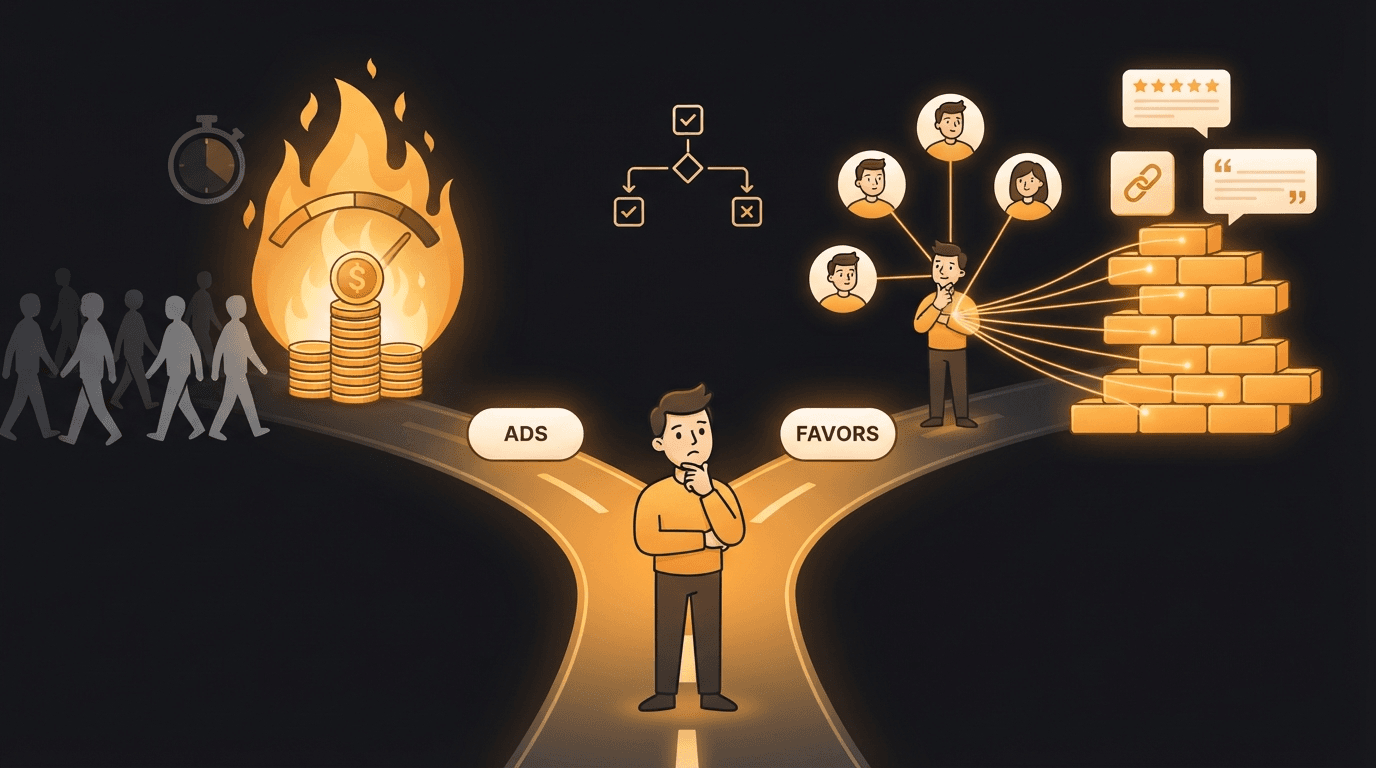
Almost every article on this question picks a side and shouts it. Either paid ads kill startups, or your account is just badly optimized and you should hire someone to fix it. Both answers are selling something, and neither is much use at 11pm when you're staring at a campaign draft wondering whether to hit publish.
I want to give you the boring version instead: the specific conditions under which spending money on ads is rational for a bootstrapped founder, the mechanical reason it usually isn't yet, and a decision tree you can run in about four minutes. I'm not anti-ads. I'm anti-spending-your-runway-to-learn-something-a-conversation-would-have-told-you.
Do paid ads work for bootstrapped startups?
Sometimes — but almost never as a first channel, and almost never before product-market fit. Paid ads are an amplifier, not a discovery tool. They multiply whatever your funnel already does. If your product retains and your page converts, ads buy you speed, and speed is genuinely valuable. If either of those is unproven, ads buy you a faster, more expensive version of not knowing.
That's the whole argument, and everything below is just the mechanism behind it. The uncomfortable part is that a losing campaign doesn't look like failure while it's running. It looks like activity — impressions climbing, clicks arriving, a dashboard with numbers going up. Nothing tells you that the trial signups you just paid for churn at the same rate the free ones do.
Why the pre-PMF ad math doesn't close
Start from the definition. In the essay that popularized the term, Marc Andreessen described product/market fit as "being in a good market with a product that can satisfy that market." Read it twice, because it settles the question. Ads cannot make your market good, and they cannot make your product satisfy it. They can only take people who exist and put them in front of the thing you built.
So run the chain. An ad budget buys clicks. Clicks convert to signups at whatever rate your page manages with cold traffic — which is materially worse than the rate you've been measuring, because everyone who has visited your page so far arrived warm, from a community post or a friend or your own timeline. Signups convert to paid at whatever rate your product earns. And paid customers stay for however long your product is worth staying for.
Every one of those four multipliers is unknown for a pre-PMF product, and three of them are usually worse than the founder assumes. Multiply four optimistic guesses together and you get a number that has no relationship to reality — but you'll only find that out after the money is gone, because the failure surfaces in month three as churn, not in week one as a bad click-through rate.
The deeper problem is opportunity cost, and it's the one nobody puts on the spreadsheet. The budget isn't competing against zero. It's competing against what those same hours and dollars would have produced somewhere else — and for a founder with no audience, the alternatives are unusually strong. I laid out the full menu in the guide to SaaS marketing on no budget, and the short version is that several free channels leave an asset behind. Ads never do.
The beginner's premium nobody warns you about
Here's the part the "just optimize your account" crowd skips: as a new advertiser you don't pay the market rate. You pay worse than the market rate, for structural reasons, and it has nothing to do with your skill.
Google is unusually candid about this. Its own documentation on how the ad auction works explains that position and price are set by Ad Rank, which weighs your bid alongside the expected click-through rate of your ad and the experience your landing page provides. The consequence it states plainly is the one that matters to you: an advertiser with high-quality ads and landing pages can win a higher position at a lower price than a competitor bidding more.
Now flip it. Expected click-through rate is an estimate, and on day one the system has no history for your ads, so the estimate is conservative. Your landing page has no engagement record. Your competitors have both, accumulated over years. That means you are bidding into an auction where the incumbents get a discount you can't access yet, for the same clicks, in the same slot. You are not paying the price they pay. You are paying the beginner's price, and the only way out is volume you can't afford.
This is why agency content on this topic is so consistently unhelpful. The framing is always "you're wasting spend because your account is misconfigured" — and sometimes that's true — but it never admits the option of not running the ads. The possibility that a founder's best move is to close the tab isn't available in a business model that bills for managing campaigns.
When do ads actually make sense?
There are real cases, and pretending otherwise would be exactly the dogma I'm arguing against. Ads are the right call when:
- You have retention data and a known customer value. Not a projection — actual retained accounts you can point at. At that stage ads stop being a bet and become arithmetic, which is exactly what they should be.
- You are buying speed you have already earned. If a channel works organically and you simply want more of it faster, paying to accelerate a proven motion is a rational trade.
- You are running a deliberate demand test.A small, time-boxed campaign to answer "does this message stop a stranger?" is legitimate research. The discipline is declaring it as research before you launch, so you don't quietly relabel it as acquisition once clicks start arriving.
- Your buyer is genuinely unreachable organically. Some niches have no forum, no subreddit, no newsletter. That's rarer than founders think — but when it's true, paid may be the only door.
- You are defending your own brand terms. Cheap, narrow, and occasionally necessary when a competitor bids on your name.
Notice what unites the list: in every case you already know something. None of them are "I need users and I have a credit card."
The run-ads / don't-run-ads decision tree
Four gates. Answer honestly, in order. A single "no" ends the run — you don't get to average them out.
Do you know, from real customers, that people keep using this after week two?
Ads are an amplifier. Pointed at a product people churn out of, they amplify the churn — you just pay to discover it faster and at a worse exchange rate than talking to ten users would have cost you.
If no — Stop. You are buying traffic to test a product question.
Do you know what a customer is worth to you over their lifetime — from actual retained accounts, not a spreadsheet?
Every ad decision downstream is a comparison against that number. Without it you cannot tell a working campaign from a losing one, so you will keep whichever one had a good week.
If no — Stop. You have no benchmark, so you cannot read the result.
Is your conversion path measured end to end — click to signup to paid — and does it convert for traffic you did not personally warm up?
Cold ad traffic converts far worse than the friend-and-community traffic you have been reading. If your page has only ever been tested on people who already knew you, you do not know your conversion rate yet.
If no — Fix the page and the tracking first. Ads will not diagnose this for you.
Can you lose the entire budget, twice, and be genuinely fine?
The first run of any account is tuition, not acquisition. If the money you are about to spend is also the money that keeps you shipping for the next six months, the campaign is not an experiment — it is a bet.
If no — Stop. That is runway, not a marketing budget.
Four yeses — run the ads.
Set a hard budget cap and a review date before you launch, and write down in advance what result would make you stop. The founders who get hurt by ads are rarely the ones who ran a bad campaign. They are the ones who never defined what a bad campaign would look like.
What outperforms ads when your budget is $0
The honest replacement for an ad budget is not "do content, it's free." Content is not free; it costs the scarcest thing you have. The real argument is about what survives the spend.
Paul Graham's case for doing things that don't scale is the sharpest version of the alternative: founders have to go out and personally recruit their earliest users rather than wait for them to arrive. It is slow, it does not feel like marketing, and it outperforms a small ad budget almost every time at this stage — partly because it works, and mostly because of what it teaches you along the way.
The other substitute is the one I spend my time building: trading the marketing work you need with founders who need the same from you. Compare what a small budget buys against what the same effort buys when it's traded rather than spent.
| A small ad budget | The same hours, traded with founders | |
|---|---|---|
| What you get on day one | A burst of cold clicks, sized exactly to the budget. | A handful of honest reviews, a testimonial, structured feedback, a link or two. |
| What is left 90 days later | Nothing, unless someone converted and stayed. The traffic stopped the hour the card did. | All of it. Reviews, links, and directory listings are still on the live web doing their job. |
| Cost to do it again | The same again, every time, forever. There is no residual. | The same hours — but the assets from round one are still working while you do round two. |
| What it teaches you | Which headline gets clicked. Rarely why anyone did or did not buy. | Exactly why a peer would not use it, in their words, in writing. |
| Who it genuinely suits | A product with proven retention, a known customer value, and a funnel that already converts cold traffic. | Anyone with a working product and a few spare hours a week. |
| Speed | Immediate. This is the real argument for ads, and it is a good one. | Days, not hours — slower than a card swipe, much faster than SEO. |
Read the second row on its own and the case is basically closed. An ad campaign is the only marketing activity that resets to exactly zero the moment you stop paying for it. A review, a testimonial, an editorial link, a directory listing — those are still sitting on the live web in six months, still being read, still being counted. That asymmetry is the reason reciprocity ranks so highly on the channel scorecard for indie hackers, and why it belongs in the core of any solo-founder GTM plan long before a card gets entered anywhere.
The mechanism is not complicated. Do a real favor for another founder — an honest review, structured feedback, a testimonial for something you actually used — and it's verified and paid in points on Favors.dev. Post a request and spend those points, and other founders do the same work for you. No money moves, and the effort doesn't evaporate the way a budget does.
How AI search is reshaping paid too
There's a 2026-specific reason to weight this even harder, and it applies to paid and organic alike: the surface you're renting attention on is changing shape underneath you.
eMarketer's consumer-adoption forecast puts generative AI use in the US at 133.0 million people in 2026 — 39.2% of the population. A growing share of the research your buyer does now happens in a conversation with an assistant rather than on a results page with ad slots on it. You cannot bid in that box. There is no auction for being the product an answer engine mentions.
And the traffic is really moving. Similarweb's tracking of generative-AI referral patterns found total AI referral visits across the web grew more than threefold between September 2024 and September 2025. The same analysis shows what those engines lean on when they answer: Wikipedia at roughly 6.2% of ChatGPT's citations and Reddit at roughly 5.2% — reference sources and community discussion, wildly over-represented against the rest of the web.
Sit with the implication. The things that get you named inside an AI answer are reviews, forum threads, named-author articles, and links from real sites. Not one of them is purchasable through an ad platform, and every one of them is the exact output of a founder doing a favor for another founder. Money buys placement on the surface that's being disintermediated; effort buys presence on the one replacing it. If you want the full version of that argument, it's in the guide to answer engine optimization for startups.
A note on the numbers you'll see elsewhere. Almost every article on this topic quotes a tidy indie-versus-funded customer-acquisition-cost comparison, or a specific figure for how much ad spend is wasted. I have not repeated any of them here, because when I went looking for primary sources they were either agency-internal, uncited, or traceable to nobody. Every figure above names the organization that published it and links to it. If a number in a marketing post has no source you can click, assume it was invented.
Frequently asked questions
Do paid ads work for bootstrapped startups?
Sometimes, but almost never as a first channel. Paid ads are an amplifier, not a discovery tool: they multiply whatever your funnel already does, so a product with unproven retention and an unmeasured conversion path gets its problems amplified rather than solved. Ads become a reasonable buy once you know a customer's lifetime value from real retained accounts, your page converts traffic from people who did not already know you, and losing the entire budget twice would not affect your runway. Before those three things are true, the same money and hours produce more when spent on hand-to-hand user recruitment, content, and reciprocal help from other founders.
Should I run ads before product-market fit?
Generally no — with one narrow exception. Marc Andreessen's original framing of product/market fit is being in a good market with a product that can satisfy that market, and you cannot buy your way into either half of that sentence. Ads pointed at a product people leave produce paid churn, and because the spend generates activity, they are unusually good at hiding the problem behind a chart that looks like growth. The exception is running a deliberately tiny campaign as a demand test — you are not buying customers, you are buying the answer to "does this message make a stranger stop?" That is a legitimate use, but you have to declare it in advance and hold yourself to reading it as research rather than quietly relabeling it as acquisition when the clicks arrive.
How much should a startup spend to test paid ads?
Less than the number the platform suggests, and only an amount you can lose twice without flinching. There is no universal minimum, because the spend needed for a readable result scales with your conversion rate and your price: a low-priced product converting at a low rate needs far more clicks before the result means anything than a high-priced one does. The practical test is to work backwards — estimate how many conversions you would need to distinguish a real result from noise, multiply by what a click plausibly costs in your niche, and then ask whether you are willing to lose that figure entirely. If the honest answer is no, the budget is too small for the test to be readable, which means the test is not worth running yet.
Are Google Ads or Meta ads better for a pre-revenue SaaS?
Neither is better in the abstract; they answer different questions. Search ads on Google intercept people who are already looking for a solution, which makes them the higher-intent option — but for a genuinely new category, nobody is searching for you yet, and you end up bidding against established competitors on their terms. Social ads on Meta or LinkedIn create demand rather than intercept it, which suits a product people did not know they wanted, but they require creative that earns attention from someone who was not looking. For most pre-revenue SaaS the honest answer is that both will underperform a founder personally recruiting users, and the platform choice is a rounding error next to that.
What should I do instead of running ads with no budget?
Spend the effort where it leaves something behind. Recruit your first users by hand — Paul Graham's point that founders must go out and get users rather than wait for them is still the highest-yield activity available at zero cost. Publish content that answers the question your buyer actually types. Show up in the communities they already read. And trade the marketing work you need with founders who need the same from you: an honest review, a testimonial, structured feedback, an editorial mention. Every one of those produces an asset that is still on the web in six months, which is the one thing an ad budget structurally cannot do.