 Favors.dev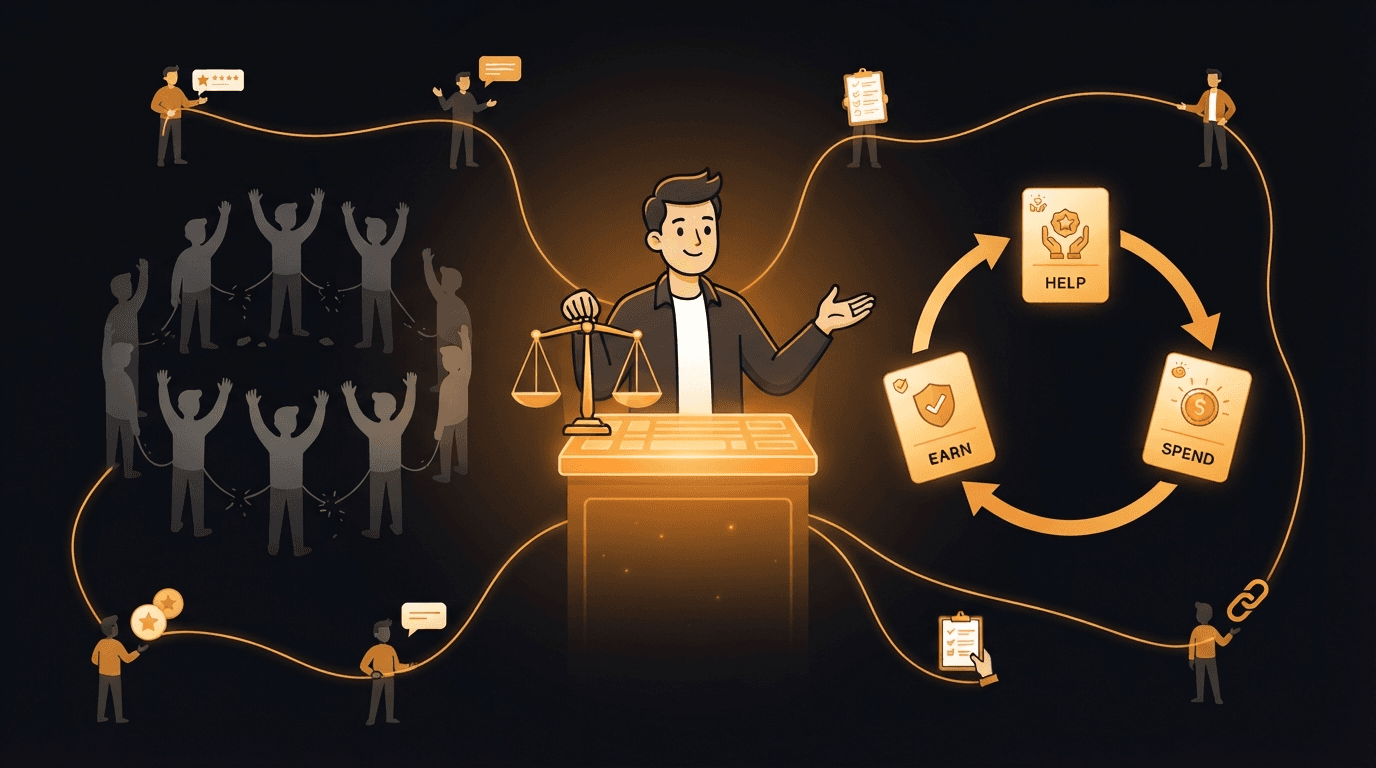
Every article about reciprocity marketing you'll find today is about giving a customer something free so they buy from you later. Free samples, lead magnets, trials, a surprise discount. That's a real tactic, and it's also a rounding error next to what reciprocity can do for a founder with no budget and no audience.
The version nobody writes about is horizontal, not vertical. Not brand-to-customer but founder-to-founder: two people who each need exactly what the other can give — a review, a testimonial, honest feedback, a share, an editorial link — trading it directly instead of buying it. That trade is the cheapest distribution channel a pre-revenue startup has access to, and almost nobody runs it deliberately, because every attempt to run it informally falls apart within about two months.
This piece is my argument for why it falls apart, and what has to be true for it to work. It's also, transparently, the thesis behind the thing I build. I'll show my work.
What is reciprocity marketing?
Definition
Reciprocity marketing is the practice of giving something of genuine value first so that the recipient is motivated to give something back. In its consumer form, a brand gives a customer a sample, a guide, or a free trial. In its founder form, two businesses trade the marketing actions each one needs — honest reviews, structured feedback, testimonials, shares, editorial backlinks — so that neither has to buy them.
The psychological engine underneath both is old and well established. Robert Cialdini put reciprocity first among his principles of persuasion: receive a favor and you feel a pull to return one. Marketers have been monetizing that pull for forty years, which is why your inbox is full of free PDFs.
But notice what the consumer version quietly assumes. It assumes you already have an audience to give something to. It assumes you have a product mature enough to trial, traffic to put a lead magnet in front of, and margin to give something away. On day one you have none of that. The consumer playbook is written for the moment after the moment you're in.
The founder version has no such prerequisite. It needs one thing: other people at roughly your stage who need the same things you do. There are thousands of them launching this month, each with a real account, a real opinion, and a real website that can link to yours. That's not an audience — it's better. It's a supply of the exact assets that build distribution. It is also the mode of founder-led marketing that still works when you have no personal brand to lead with yet.
Why goodwill-based founder groups always collapse
They collapse because unmetered mutual help is a common-pool resource, and common-pool resources fail in a predictable, boring, entirely non-personal way. You have seen the shape of it even if you never named it.
Week one, a founder Slack is magic. Someone drops a landing page, four people tear it apart usefully, everyone feels the lift. Week six, the same channel is a column of "launched today, would love your support 🙏" posts with two reactions each. Nobody did anything wrong. The people who helped most just ran out of hours first, and once the visible generosity drains, asking costs nothing and giving costs everything.
This is the most studied failure in social science, and the person who explained how to escape it won a Nobel Prize for it. Elinor Ostrom's work on the governance of shared resources overturned the assumption that a commons must either be privatized or policed from above. Communities do sustain shared resources for generations — but the ones that succeed aren't the ones with the nicest members. They're the ones that build specific machinery: clear boundaries around who is in, rules matched to local conditions, monitoring of who actually contributes, and graduated consequences when someone doesn't.
Now count how many founder support groups have any of that. Boundaries: anyone with the invite link. Monitoring: none — nobody can see who has given what. Consequences: none, because the only available sanction is a mod removing someone, which nobody wants to do to a peer. Three for three missing.
Reciprocity as infrastructure: metered and verified
If the diagnosis is missing accounting, the treatment is infrastructure — a way to make contribution visible, portable, and settle-able. There are three models available to a founder, and they differ almost entirely on that axis:
| Model | Accounting | Verification | Free-rider risk | Verdict |
|---|---|---|---|---|
| Informal goodwillA founder Slack, a Discord #launches channel, a 'support each other' group chat.Works beautifully until the ask-to-give ratio tips. Then the generous people go quiet and the room becomes a wall of unanswered requests. | None | None | Fatallifespan: 6–10 weeks | skip |
| One-to-one swapsNewsletter swaps, review-for-review, mutual shoutouts, guest-post trades.Genuinely effective and the fairest thing you can do without a system. But every trade needs a negotiation, and matching is the bottleneck. | Implicit, per deal | Trust + screenshots | Containedlifespan: Per relationship | worth it |
| Metered co-opA shared points economy where every favor is priced, escrowed, and verified before it settles.Turns matching into a market. You help whoever needs it now and spend the credit on whoever can help you later — the two don't have to be the same person. | Explicit ledger | Required to settle | Impossiblelifespan: Compounds | worth it |
Read the middle two columns and the argument makes itself. The model everyone defaults to is the one with no accounting and no verification, which is why it's also the one with a lifespan measured in weeks. One-to-one swaps fix the accounting by making it explicit and per-deal — and they genuinely work, which is why newsletter swaps remain one of the best zero-budget moves available. Their ceiling is matching: every trade needs a partner who wants precisely what you have, right now, at your size.
Metering removes that constraint. Once contribution is recorded in a ledger, the person you help and the person who helps you no longer have to be the same person. That's the whole unlock, and it's the difference between a favor and a currency.
Verification is the second half, and it's the half people skip. A points system with no verification is just a leaderboard for claiming things. If "I shared it" pays the same as sharing it, you've built a machine for manufacturing hollow engagement. So the check has to happen before anything settles: the link has to exist on the live page, the review has to be substantive, the feedback has to say something. Points move after the proof, not before.
Why you can't spend what you haven't earned
Here's the rule that makes the whole thing hold, and it's one line: you cannot spend points you did not earn. There is no way to buy them. Free-riding stops being a moderation problem — something a human has to notice, judge, and act on — and becomes arithmetic. You can't take out what you never put in because the balance simply isn't there.
That gives you a three-stage loop instead of a vibe:
Do a real favor
Leave an honest review. Write structured feedback. Publish a featured article that links out. Record a testimonial for a product you actually used.
It gets verified, then it pays
The submission is checked before anything settles — the link exists, the review is real, the feedback is substantive. Only then do the points move.
Pull the same help back
Post a request, escrow the points, and other founders fill it. Your balance is a claim on the network's effort, and it only exists because you did the work first.
The loop is deliberately unglamorous. Nothing in it is a growth hack, and the actions are the same ones you'd do for a friend for free. What changes is that the effort stops evaporating. Help three founders in a week you had spare hours, and that effort is still sitting there as a balance in the week you launch and have none.
The second-order effect is the one I didn't expect when I started building this. A ledger makes contribution legible, and legible contribution turns into reputation on its own. The founders at the top of the leaderboard got there by being useful several dozen times, and that record is visible to everyone deciding whether to work with them. This is the same mechanism that makes a personal brand possible for people who hate self-promotion — you build standing by helping in public rather than posting about yourself.
Where reciprocity fits in the 2026 stack
Reciprocity is not a replacement for your other channels. It's a layer underneath them — the one that supplies the raw material the others need. Content needs something to be credible about. Launches need a crowd. SEO needs links. Every one of those inputs is something another founder can give you and you can give back.
Two things happening in search right now make this layer more valuable than it was even a year ago, not less. The first: answer engines are eating the click. Similarweb's tracking of generative-AI referral patterns shows total AI referral visits across the web grew more than threefold between September 2024 and September 2025 — but AI engines still send publishers a tiny fraction of their referral traffic even when they cite them. The prize has shifted from the ranking to the citation.
The second: what those engines cite. The same Similarweb data puts Wikipedia at roughly 6.2% of ChatGPT's citations and Reddit at roughly 5.2% — community discussion and consensus sources, disproportionately represented against the entire rest of the web. Reviews, forum threads, named-author articles, and links from real sites are what feeds an answer. Which is to say: the currencies founders trade with each other are, almost exactly, the signals AI search rewards. That's a coincidence I've stopped treating as a coincidence.
And the lane is still open. In GoodFirms' early-2026 survey of marketers, only 14% track AI citations at all. Most teams have not started measuring the thing that's replacing their traffic — which is a strange and temporary advantage for a founder who does. (I go deeper on that in the guide to answer engine optimization for startups.)
So on the channel scorecard, reciprocity has an unusual profile: it costs no money, needs no prior audience, pays off in days rather than months, and compounds. That combination is rare enough that I'd argue it belongs in the same tier as content and community in any solo-founder GTM plan — and it's the only one of the three you can start on a Tuesday afternoon with nothing but a working product and an honest opinion. It's also the mechanism that makes community-led growth work at a one-person scale, and one of the highest-leverage rows on the full indie-hacker channel scorecard.
The line between reciprocity and a link scheme
The obvious objection, and the one I take most seriously: isn't this just an organized link exchange? It would be, if it were designed carelessly. Google's spam policies name it explicitly: "excessive link exchanges ('Link to me and I'll link to you')" and partner pages that exist only for cross-linking are link schemes. That's not a gray area and I'm not going to pretend it is.
The line that matters is editorial control. Three tests, all of which a reciprocity system has to pass:
- Can the outcome be negative? A review that must be positive is not a review. An honest system pays for the work of evaluating something, not for a favorable verdict — which means two-star reviews and feedback that says "I wouldn't use this" have to pay exactly the same.
- Is the link a decision or a deliverable? Paying someone to write about you and letting them decide what to say — including whether to link — is editorial. Pre-agreeing the link is a scheme. The unit being traded should be the effort, never the endorsement.
- Is it reciprocal in aggregate, or bilaterally? "You link me, I link you" is the pattern Google names. Contributing to a pool and drawing from it separately is not the same shape, and the ledger is what makes that difference real rather than rhetorical.
This is why Favors.dev prices the writing and publishing of an article rather than a guaranteed link, why reviews are graded on substance and are allowed to be critical, and why there is no upvote-ring action anywhere in the queue and never will be. Some things founders want help with are things I won't build a market for, and coordinated voting is top of that list. A system that can be gamed is a system that will be, and the entire value of a reciprocity network is that the help inside it is real.
Which brings me back to where this started. Reciprocity marketing written up as a customer-acquisition trick — free samples, lead magnets — is fine, but it's the small version. The large version is that a founder with no budget, no list, and no audience has one asset the frameworks never count: several thousand peers who need exactly what they can give. That asset does nothing at all until somebody builds the accounting for it. That's the layer.
Frequently asked questions
What is reciprocity marketing?
Reciprocity marketing is the practice of giving something of genuine value first so the recipient is motivated to give something back. In consumer marketing that usually means a brand giving a customer a free sample, a useful guide, or a trial. For founders it means something more useful: trading the marketing actions you each need — honest reviews, structured feedback, testimonials, shares, editorial backlinks — with peers who need the same things from you. The consumer version is a persuasion tactic. The founder version is a distribution channel.
Is reciprocity marketing the same as Cialdini's reciprocity principle?
It starts there but doesn't end there. Robert Cialdini's principle of reciprocity describes a psychological pull: receive a favor and you feel obliged to return one. That explains why free trials and lead magnets convert. It also explains why informal founder groups feel great for about two months and then die — psychological obligation is unenforceable and unevenly felt, so the givers subsidize the takers until they burn out. Reciprocity marketing at the founder level replaces the feeling of obligation with a record of it.
Why do founder support groups stop working?
Because unmetered mutual help is a common-pool resource, and common-pool resources fail in a predictable way: everyone benefits from the shared effort, nobody's individual contribution is visible, and the rational move is to ask more than you give. Elinor Ostrom's Nobel-recognized research found that communities which successfully sustain shared resources over the long run share concrete features — clear boundaries, monitoring, and graduated consequences. Almost no founder group has any of the three. That's not a culture problem, it's a design problem.
Is trading marketing favors against Google's guidelines?
Trading help is fine. Trading links specifically for links is not. Google's spam policies name 'excessive link exchanges' and partner pages built purely for cross-linking as link schemes. The distinction that keeps you safe is editorial control: if the person publishing decides independently whether your product is worth writing about, and can say no, it's a real editorial link. If the arrangement is 'link to me and I'll link to you' with the outcome pre-agreed, it isn't. Favors.dev prices the work of writing and publishing an article, never a guaranteed link, and reviews and feedback are explicitly allowed to be negative.
How is a points economy different from just being generous?
Generosity is still the input — the points economy is just the bookkeeping. What it changes is the failure mode. Without a ledger, the person who helps ten founders and gets helped by one has no recourse and eventually leaves. With one, that person is the richest member of the network and can spend that credit on whoever can actually help them. It also breaks the matching problem: you no longer need the founder who can help you to be the same founder you can help.